
c. 140 – 173·Feast August 7
St. Donatus of Muenstereifel
Roman Soldier-Martyr and Protector Against Storms
Overview
Donatus of Muenstereifel is a catacomb saint whose relics rest in the Jesuit church at Bad Münstereifel in Germany, where he is widely venerated across the Rhine valley and the Low Countries as a protector against lightning. According to legend he was a Roman of the second century, born in Rome around 140 to Faustus and Flaminia after his mother sought the intercession of Saint Gervasius; his name means 'gift'. At seventeen he enlisted in the famed Twelfth Legion, the 'Thundering Legion', and rose to become a personal bodyguard of Emperor Marcus Aurelius. In 173, during the Marcomannic Wars on the Danube, a sudden divine thunderstorm saved the surrounded legion; Dio Cassius credited the Egyptian sorcerer Arnuphis, while Tertullian and other Christian writers ascribed the deliverance to the prayers of the legion's Christians, and later legend made Donatus their leader. For his thanksgiving to God he was martyred by the emperor. Buried by his mother in the Catacombs of Saint Agnes, he was rediscovered when the catacombs were reopened in 1646, and Pope Innocent X gave his relics to the Jesuits of Münstereifel. A lightning miracle at Euskirchen in 1652 spread his fame.
The Complete Life
The Answer to a Mother's Prayer
Legend gives Donatus a birth as the fruit of a promise. His parents were Faustus and Flaminia, a Christian couple of second-century Rome. When sickness brought Faustus to death's door, Flaminia begged the prayers of Saint Gervasius, who promised her a son and her husband's recovery. So it fell out: the boy was born around 140, his mother called him Donatus — 'gift' — and had him taught the Christian religion from his earliest years. At seventeen the boy took a step that placed him at the center of the empire's wars: he enlisted in the famed Twelfth Legion, the Fulminatrix, the 'Thundering Legion', a unit whose name already carried the memory of divine storms. Promotion came quickly, and before long he stood among the bodyguards of the emperor Marcus Aurelius, the philosopher on the throne whose Danube wars were then consuming his reign. The legend thus sets its hero at the crossing point of everything the second century meant to Christians — a legion with many Christians in its ranks, an emperor both Stoic and persecutor, and a frontier where the empire's fate was being decided. Donatus, the promised child of a Roman household, became a soldier of that frontier.
§ Legend
The Thunderstorm on the Danube
In 173 the Twelfth Legion was engaged in the Marcomannic Wars in Moravia, along the Danube frontier. Dio Cassius, who wrote while the memory was fresh, tells how a detachment of the legion, encircled and close to destruction, was rescued by a storm sent from heaven. Cassius gave the credit to Mercurius, called upon by Arnuphis, an Egyptian magician in the emperor's train; Tertullian and other Christian authors told it otherwise: God, they said, had answered the prayers of the believers serving in the ranks. Later legend put Donatus at their head that day. When the danger had passed, the story continues, he returned thanks to God in public, naming the Christian God — not Mercury, not the emperor's magician — as the legion's deliverer, and for that confession the emperor had him put to death. The story made him, in the memory of the church, a soldier who had seen heaven's own artillery used on his behalf and dared to name its true Commander. His feast of August 7 ties the Roman martyr to his namesake, Donatus of Arezzo.
§ Legend
From the Catacombs to the Rhineland
His mother laid him to rest in the cemetery of Saint Agnes outside Rome, and for fourteen centuries his record sleeps there. In time the way into those burying-grounds was forgotten. When the catacombs were opened anew in 1646, the bodies of Donatus and a great company of martyrs came to light once more. Innocent X presented the Roman's remains to the Jesuits of Münstereifel in the Eifel, and a procession bore them the long road from Rome to the Rhineland. On the morning of June 30, 1652, they rested at Saint Martin's in Euskirchen while Father Heerde, a Jesuit, offered Mass. Benediction had scarcely ended when lightning struck the church and set the altar, and the priest with it, ablaze. He cried on Saint Donatus for help and came away without a wound. News of the wonder ran through the country and gave the saint his second feast, June 30, the Euskirchen anniversary. What the procession carried out of Rome was a Roman soldier's body; what the Rhineland received was a patron for its storms. In his relics the Rhineland had acquired a patron taken from the earliest generations of Roman confessors.
§ Legend
Patron Against the Lightning
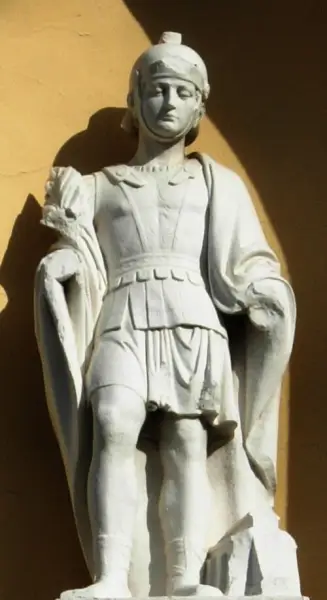
Donatus is invoked above all as a patron against lightning strikes, and by extension against fire and storm. His cult is closely linked to that of Saint Florian, protector against May frost; the two are customarily asked together to guard the grape harvest, above all in Hungary, where his following across the Balaton wine country commends the vintage to him on August 7. Although he does not appear in the Roman Martyrology, he shares the feast of August 7 with his namesake Donatus of Arezzo, and is commonly venerated on June 30 as well. His popular following took institutional form: an annual fair in his honor is held in Euskirchen on the second Sunday of May, and the Archdiocese of Cologne sponsors an annual pilgrimage to Bad Münstereifel on the second Sunday of July. In Mons the Brotherhood of Saint Donat carries his reliquary bust in the 'Car d'Or' procession. Writers have long remarked how the Latin Donatus echoes the German Donner — thunder. He is depicted in Roman armor with a thunderbolt, often holding a martyr's palm or a grapevine, and churches from Luxembourg to Slovenia to Iowa bear his name.
§ Veneration
Timeline
- 140
Born in Rome around this year, the son promised to Faustus and Flaminia after prayer to Saint Gervasius
§ Legend
- 173
A divine thunderstorm saved the surrounded legion during the Marcomannic Wars; Donatus gave thanks to God and was martyred by the emperor
§ Legend
- 1646
The reopened catacombs yielded his relics, which Pope Innocent X bequeathed to the Jesuit church in Münstereifel
§ Legend
- 30 Jun 1652
Lightning struck St. Martin's church in Euskirchen while his relics rested there; the priest who invoked Donatus was unharmed
§ Legend
The Record
- Patron of
- against lightning·against fire·against storms·bakers·Budapest·protection of the wine harvest
- Symbols
- Roman armor·lightning bolt·martyr's palm·grapevine
- Canonization
- Pre-congregation; ancient martyr, not listed in the Roman Martyrology
Prayer
Bibliography
Show 3 sources
- "St. Martin's Church, Euskirchen — site of the miracle in 1652".
- "Donatus May-fair in Stadt Euskirchen".
- "German Wikipedia article: Saint Donatus".
Profile text adapted from the Wikipedia article, licensed CC BY-SA 4.0.
Pray with this saint every day
Save St. Donatus of Muenstereifel to your favorites, read the full profile, and get feast-day reminders in the Saints app.
Get the Saints AppFree on the App Store for iPhone and iPad