
died c. 811·Feast February 25
St. Donatus of Zadar
Bishop and Diplomat of Dalmatian Zadar
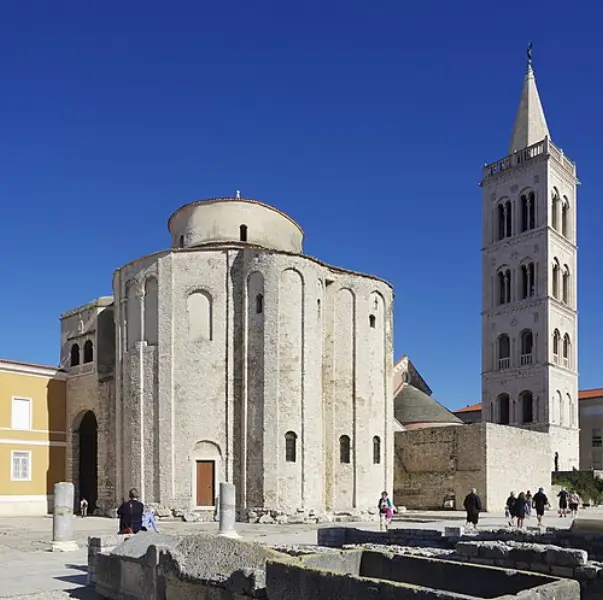
Overview
Donatus of Zadar was a Dalmatian bishop and diplomat of the turn of the ninth century, honored as the patron saint of Zadar. Born in the second half of the eighth century in Zadar — Roman Jadera, then under Byzantine rule — he served the Dalmatian city-state as its chief churchman and envoy. The Frankish annals mention him in 805 as ambassador of the Dalmatian cities to Charlemagne at Thionville. Tradition credits him with initiating either the construction or the expansion of the Church of the Holy Trinity, completed early in the ninth century on the ruins of the Roman forum and later renamed by the Venetians the Church of St. Donatus; it remains the largest pre-Romanesque building in Croatia. Sent with the Venetian duke Beato to Constantinople, on Charlemagne's orders, to negotiate the border between the Byzantine and Frankish spheres, he is said to have brought back from that city the relics of the martyr Anastasia, which a marble sarcophagus in the cathedral preserves with an inscription from his own time. Around 811 he died and was laid to rest within the church he had raised; when French troops took Zadar in 1809, his remains were removed to the cathedral of St. Anastasia.
The Complete Life
A Dalmatian of Byzantine Zadar
Donatus was born in Zadar in the second half of the eighth century. His city — Roman Jadera, later Italian Zara — stood on the Dalmatian coast under the sovereignty of the Byzantine Empire, a Latin-speaking outpost within the Greek emperor's Adriatic world. To be a churchman of Zadar in that age was to live between empires: the Franks were rising in the west under Charlemagne, Constantinople held the coastal cities, and the Croatian territories inland were taking shape as a polity of their own. Of Donatus' family and formation the sources say nothing directly; he appears in the record already as a bishop, the head of his city's church and its most public figure. In such Dalmatian communes the bishop was both pastor and statesman, and Donatus' career shows the combination in action. He served the Dalmatian city-state of Zadar as diplomat as well as bishop, and his name is preserved less by written biography than by two monuments: an entry in the Frankish annals that fixes him in the politics of his day, and a great round church that still stands at the center of his city.
§ Introduction
Bishop and Builder
Tradition credits Donatus with initiating either the construction or the expansion of the Church of the Holy Trinity in Zadar, the work with which his name has been joined ever since. The church was completed at the beginning of the ninth century and renewed again in the fifteenth; standing on the remains of the ancient Roman forum, whose paving is still partly visible, it was later renamed by the Venetians the Church of St. Donatus and remains the largest pre-Romanesque building in Croatia. A builder-bishop is a familiar figure in the early medieval Adriatic, where the reconstruction of urban churches followed the upheavals of the preceding centuries, and the Holy Trinity's austere round form has become an emblem of Zadar. The dedication to the Trinity, later overlaid by the saint's own name, belongs to the theology of a frontier church asserting its faith in a contested sea. For the bishop himself the project joined pastoral office to civic identity: the church was the city's claim to permanence, raised on the stones of its Roman past, and Donatus was buried in it when he died, so that the building became at once his monument and his tomb.
§ Introduction
Envoy to Thionville and Constantinople
The Frankish annals record Donatus in 805 as ambassador of the Dalmatian cities to Charlemagne at Thionville, a mission that placed a Dalmatian bishop at the court of the Frankish ruler in the decisive years of his reign. The Dalmatian cities stood between the two powers, and their envoys negotiated the terms on which they would live. Donatus' second recorded journey took him even further: according to tradition he traveled with the Venetian duke Beato to Constantinople, the pair charged by Charlemagne to settle where the frontier should run between Byzantine lands and the Croatian territories under Frankish control. From that journey, tradition says, came the church's greatest treasure: the relics of the Sirmian martyr Anastasia, which Donatus brought to Zadar from Constantinople. The marble sarcophagus in the cathedral preserves them, with an inscription dating from Donatus' own time. The story binds together the threads of his career — the diplomat at home in both courts, the bishop enriching his see, the city whose cathedral still bears the martyr's name. Donatus stood at the exact point where Byzantium, the Franks, and the Croats met.
§ Introduction
The Round Church and the Moved Bones
Donatus died about 811 and found burial within his own Holy Trinity church, the building now called Saint Donatus. For generations it stood watch over the city's saint; then came darker times. French troops occupied Zadar after 1809, and his remains were removed soon afterward to the cathedral of St. Anastasia, where they rest today; for some two centuries now no Mass has been sung in the old church. The building itself survived to become the most recognizable monument of the Dalmatian coast, its round form rising above the exposed foundations of the Roman forum. Donatus' feast is kept on February 25, and he is honored as the patron of Zadar, the city he served as bishop, builder, and envoy. His historical footprint is unusually precise for a Dalmatian churchman of his age: a dated appearance in the Frankish annals, a named companion on a diplomatic mission, a datable inscription in the cathedral sarcophagus, and a church whose building phases correspond to his lifetime. Few saints of the eastern Adriatic stand so close to the documented history of the Carolingian and Byzantine worlds.
§ Introduction
Timeline
- 805
Named in the Frankish annals as envoy of the Dalmatian cities to Charlemagne at Thionville
§ Introduction
- 811
Died around this time and was buried in his own Church of the Holy Trinity
§ Introduction
- 1809
After the French occupation of Zadar his bones were moved to the Cathedral of St. Anastasia
§ Donatus's Church
The Record
- Major works
- Church of the Holy Trinity (now the Church of St. Donatus), Zadar
- Patron of
- Zadar
- Canonization
- Pre-congregation
Prayer
Bibliography
Show 2 sources
- "Zadar Attractions". New York Times. Retrieved 30 November 2012.
- "St Donatus' Church". izadar.info. Archived from the original on 16 July 2012. Retrieved 30 November 2012.
Profile text adapted from the Wikipedia article, licensed CC BY-SA 4.0.
Pray with this saint every day
Save St. Donatus of Zadar to your favorites, read the full profile, and get feast-day reminders in the Saints app.
Get the Saints AppFree on the App Store for iPhone and iPad