
died c. 304·Feast February 17
St. Donatus, Romulus, Secundian, and 86 Companions
Martyrs of Concordia under Diocletian
Overview
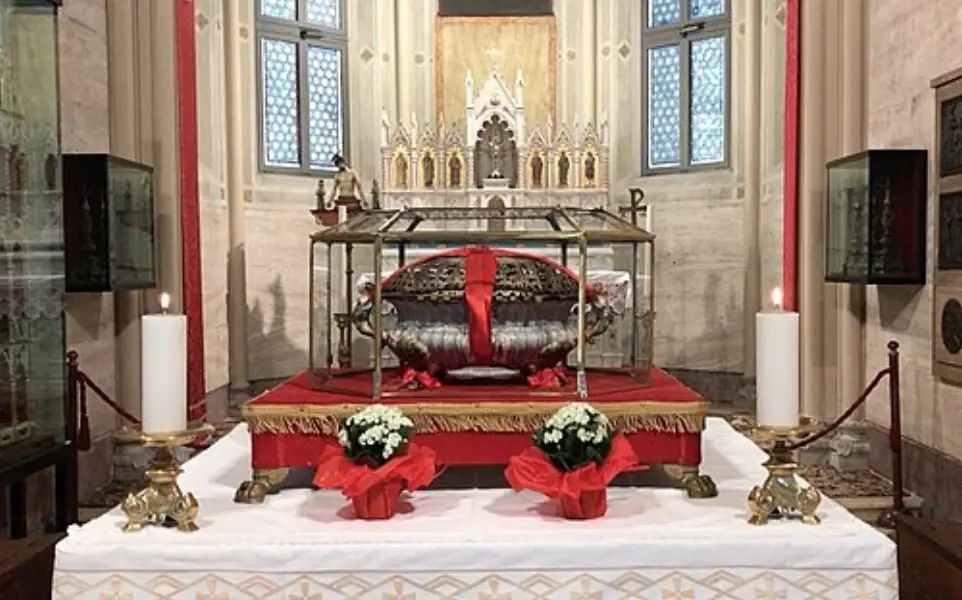
Donatus, Romulus, Secundian, and their eighty-six fellow Christians were put to death around the year 304 at Iulia Concordia — the modern Concordia Sagittaria, near Venice — in the course of the Diocletianic Persecution, the last and most systematic attempt by the Roman empire to suppress the church. Their bones were gathered and kept, and today an urn containing the relics of the Martyrs of Concordia rests in the Cathedral of St. Stephen at Concordia Sagittaria, above the very ground where the ancient Christian community worshipped. Their feast is celebrated on February 17. Beyond the essential facts of the execution, the early sources are nearly silent; the strength of their memory lies in the survivors' fidelity to the site and the physical relics that have remained there ever since.
The Complete Life
The Witness of Iulia Concordia
In the great persecution launched by Diocletian, the eastern empire's edicts reached even the small towns of the Venetian plain, and at Iulia Concordia the cost of refusal was paid by a company of almost ninety believers. Donatus, Romulus, and Secundian are the names that head the list; the other eighty-six are anonymous, recorded only in their number, as is so often the case with the collective martyrdoms of the era. The date, around 304, places their deaths in the persecution's most ferocious phase, when imperial officials throughout the provinces were required to compel sacrifice and punish refusal. Concordia was then a Roman town of the decuman road, its Christian community young and exposed; the modern excavations of Concordia Sagittaria have uncovered the early Christian basilica that rose where the martyrs were buried. The collective character of their passion — a whole congregation's leadership and membership struck at once — made the site itself a memorial, and it was there, not in some distant shrine, that the faithful continued to gather and pray through the centuries that followed the Peace of the Church.
§ Introduction
The Urn at the Cathedral of St. Stephen
The bond between the martyrs and the soil of Concordia was never broken. Their remains were collected and preserved, and the urn holding the bones of the Martyrs of Concordia is kept today in the Cathedral of St. Stephen at Concordia Sagittaria, in view of the faithful. Such continuity is rare: many companies of martyrs from the Diocletianic era are honoured in calendars alone, their resting places forgotten or dispersed. Here the church of northern Italy can point to a physical focus of devotion that has remained at the place of the passion since antiquity, and the town's very name — Concordia Sagittaria — preserves the memory of the ancient community. The liturgical memorial falls on February 17 and is shared by the Catholic Church, which counts Donatus, Romulus, Secundian, and their companions among the saints of the pre-congregation era. For pilgrims to Concordia Sagittaria, the urn beneath the cathedral is a quiet, powerful sign: that the bodies of those who died together were not abandoned, and that the church which buried them still keeps its vigil over their sleep.
§ Introduction
The Record
- Canonization
- Pre-congregation martyrs of the Diocletianic Persecution
Prayer
Bibliography
Show 2 sources
- "St. Donatus". Catholic Online. Retrieved 2012-03-07
- Benigni, Umberto (1913). "Diocese of Concordia (Concordia Veneta)". In Herbermann, Charles (ed.). Catholic Encyclopedia. New York: Robert Appleton Company
Profile text adapted from the Wikipedia article, licensed CC BY-SA 4.0.
Pray with this saint every day
Save St. Donatus, Romulus, Secundian, and 86 Companions to your favorites, read the full profile, and get feast-day reminders in the Saints app.
Get the Saints AppFree on the App Store for iPhone and iPad