
first century AD·Feast October 25
St. Dorcas (Tabitha)
Disciple of Joppa raised from the dead by Peter
Overview
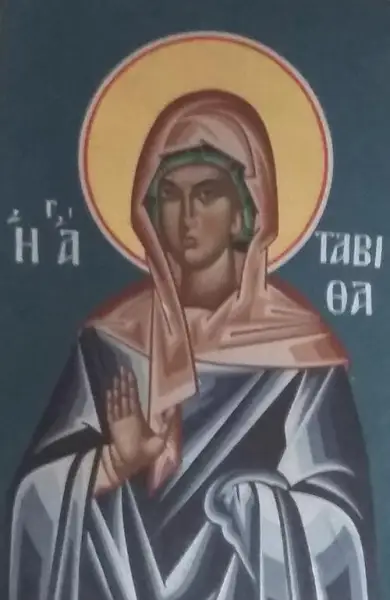
Dorcas, whose Aramaic name was Tabitha and whose Greek name means gazelle, was an early disciple of Jesus living in the port city of Joppa, today part of Tel Aviv. The Acts of the Apostles introduces her as a woman known for good works and works of charity, and particularly for sewing garments for the poor. When she fell ill and died, the widows of the Christian community washed her body and laid it in an upper room, then sent men urgently to Lydda to fetch the Apostle Peter. The widows stood weeping around Peter, showing him the tunics and cloaks she had made while she was with them. Peter sent everyone out, knelt in prayer, and said, Tabitha, rise; she opened her eyes, and taking his hand she stood up — one of the few raisings from the dead recorded in the New Testament. The news swept through Joppa, and many believed in the Lord. She is celebrated by the Catholic Church, the Eastern Orthodox Church, the Anglican Communion, and some Protestant bodies; the Evangelical Lutheran Church in America remembers her with Lydia and Phoebe on January 27, and the Episcopal Church added her to its calendar in 2022. Charitable Dorcas societies that clothe the poor are named for her.
The Complete Life
A Disciple Known by Her Works
Dorcas belongs to the first generation of the church, a woman of Joppa whom Luke explicitly calls a disciple — one of the few women of the New Testament given that title. Her double name marks the world she lived in: Tabitha in Aramaic, the language of her Jewish community, Dorcas in Greek, the language of the port, both meaning gazelle, with Zibiah as the Hebrew equivalent. That she bore both names suggests a Christian community negotiating two languages at once, and some scholars connect the Greek variant precisely to her residence in a cosmopolitan harbour town. Acts records no office she held and no sermon she preached; her vocation was articulated entirely in works. She is described as devoted to good works and acts of charity, and her characteristic labour was sewing clothing for the poor — tunics and cloaks made by her own hands, not purchased by delegation. Whether she was herself poor or a widow the text leaves unclear; what it makes unmistakable is her standing. When she died, her community did not simply bury her. They washed her body and laid her in an upper room, the posture of expectation, and sent for Peter, who was working miracles in nearby Lydda.
§ Position in her community
The Widows' Witness and the Raising
The scene in the upper room of Joppa is one of the most tender in Acts. The widows of the community gathered around Peter as he arrived, weeping and holding up the garments Dorcas had made them — living evidence of a charity that had clothed them one by one. Her name in their mouths was her whole sermon. Peter put the mourners out, knelt, and prayed; then he called, Tabitha, rise. She opened her eyes, saw him, and sat up; taking his hand he raised her, and he presented her alive to the saints and widows. The account concludes that the event became known throughout Joppa and many believed in the Lord. The story has continued to shape Christian imagination: her raising appears in medieval and Renaissance cycles of Peter's life, including Masolino's Brancacci-era panel of 1425, and in stained glass across the world, from Llandaff Cathedral to parish churches in Yorkshire and Derbyshire. In the fourth century Basil of Caesarea could already appeal to her as the standing example for widows with health enough to serve — rule 74 of his Morals — holding up her life of zealous works as the pattern for women of means and strength in every generation of the church.
§ Death and burial sites
Death and Burial at Joppa
Acts records only the first of Dorcas's deaths, the illness and the raising; tradition has had to speak of the rest. According to the local memory preserved at Joppa, she died in the house of Simon the tanner, the same house where Peter was staying when he was summoned — the site, on the seafront of today's Tel Aviv-Jaffa, is shown to visitors as the place of her death and raising. Her second burial took place on ground that today forms the garden of an Orthodox church in Jaffa, where her tomb can still be visited. A Muslim fountain nearby, the Sabil Abu Nabbut of about 1815, was for generations shown to Western travellers as marking the place where she lies, a reminder of how the memory of Tabitha belongs to the shared geography of the city's faiths. Of her family, her age, and the length of her life after the miracle, the sources say nothing. What the church kept was the sequence: a woman whose death was mourned too deeply to accept, whose body was washed and laid in the upper room, and whose community would not let the story of her hands end at the grave.
§ Death and burial sites
Feast Days East and West
Dorcas has never needed a formal canonization process; her cult belongs to the earliest stratum of the church's memory, when the books of the New Testament themselves were her acta. Her commemoration, however, has taken differing forms. The Eastern Orthodox Church celebrates on October 25 Saint Tabitha the Widow — the woman whom the Apostle Peter restored to life — and Lutheran bodies such as the Missouri Synod follow the same date. The Evangelical Lutheran Church in America instead joins her with Lydia of Thyatira and Phoebe the Deaconess in a single commemoration on January 27, immediately after the feast of the Conversion of St Paul — three women remembered as helpers of the apostles. The Roman case is more delicate: while some sources affirm a Catholic commemoration of St Tabitha on October 25, the latest official edition of the Roman Martyrology, published in 2004, records no commemoration of Dorcas or Tabitha on that day or any other. The Episcopal Church moved in the opposite direction, adding Dorcas officially to its liturgical calendar in 2022 with a feast on October 25. She is thus honoured across almost the whole Christian world, on one of two dates, under either of her two names.
§ Feast
Dorcas Societies and the Ministry of Sewing
Dorcas's afterlife in the church runs through the sewing basket. Charitable groups that make and provide clothing for the poor have been called Dorcas societies since at least the early modern period, and the name remains in use from parish guilds to charities on several continents — a rare case of a New Testament woman lending her name to an entire category of philanthropy. Her example was institutionalized early: Basil of Caesarea enshrined it in his rules for widows, and the stained-glass windows raised in her honour — in cathedrals such as Llandaff, in the Lady chapel of St Patrick's Cathedral in Dublin with its legend of a woman full of good works and almsdeeds, in churches from Bath to Pittsburgh to Lawson, New South Wales — usually show her with her needle and her garments, sometimes holding the blue cloth of the window at St. Joseph, Missouri. Poets have kept her memory too, from Robert Herrick's dirge for the widows' tears to George MacDonald's verses. In art her image has been traced back to the fourth century, and her raising became a staple of medieval and Renaissance cycles of Peter's life. The message of all of it is the one the widows of Joppa demonstrated: charity, done personally and by hand, is the strongest apology the church possesses.
§ In Christian tradition
Timeline
- 300
Artistic portrayals of Dorcas, often showing her raising, appear as early as the fourth century
§ In art
- 1425
Masolino da Panicale paints the Healing of the Cripple and Raising of Tabitha
§ In Christian tradition
- 1885
Christ Church, St. Joseph, Missouri, installs a prominent nave window of her holding a blue cloth
§ In art
- 2004
The current official Roman Martyrology edition lists no commemoration of Dorcas on any date
§ Feast
- 25 Oct 2022
Dorcas is formally added to the Episcopal Church liturgical calendar, with her feast fixed on 25 October
§ Feast
In Their Own Words
That a widow who enjoys sufficiently robust health should spend her life in works of zeal and solicitude, keeping in mind the words of the Apostle and the example of Dorcas.
The Record
- Major works
- Garments sewn for the poor of Joppa
- Patron of
- Charitable sewing and clothing societies (Dorcas societies)
- Symbols
- A blue cloth·Sewn tunics and cloaks
- Canonization
- Pre-congregation; celebrated by the Catholic, Eastern Orthodox, and Anglican churches, some Protestant denominations, and (since 2022) the Episcopal Church
Prayer
Bibliography
Show 8 sources
- Douglas, J. D.; Tenney, Merrill C.; Silva, Moisés (revised by) (2011) [1973]. "Dorcas; Tabitha". Zondervan Illustrated Bible Dictionary. Zondervan Academic. pp. 370, 1416. ISBN 9780310492351
- Witherington, Ben (1998). The Acts of the Apostles: A Socio-rhetorical Commentary. Wm. B. Eerdmans. pp. 331–332. ISBN 0802845010
- Pfatteicher, Philip H. (2008). The new book of festivals and commemorations: a proposed common calendar of saints. Minneapolis: Fortress Press. p. 683. ISBN 9780800621285
- Lockyer, Herbert (1967). All the women of the Bible. Grand Rapids: Zondervan. pp. 46–48. ISBN 0310281512
- Basil, Saint (1999). Ascetical Works. CUA Press. p. 191. ISBN 0813211093
- Martyrologium Romanum, ex decreto sacrosancti oecumenici Concilii Vaticani II instauratum auctoritate Ioannis Pauli Pp. II promulgatum, editio [typica] altera, Typis Vaticanis, A.D. MMIV (2004) ISBN 88-209-7210-7
- Ross, Leslie (1996). Medieval Art: A Topical Dictionary. Greenwood Publishing Group. p. 239. ISBN 0313293295
- "Commemoration of St. Tabitha the Widow". Orthodox Church of America. Retrieved 7 Oct 2018
Profile text adapted from the Wikipedia article, licensed CC BY-SA 4.0.
Pray with this saint every day
Save St. Dorcas (Tabitha) to your favorites, read the full profile, and get feast-day reminders in the Saints app.
Get the Saints AppFree on the App Store for iPhone and iPad