
c. 279 – c. 311·Feast February 6
St. Dorothea of Caesarea
Virgin martyr of the roses of paradise
Overview
Dorothea of Caesarea, often called Saint Dorothy, was a virgin martyred at Caesarea Mazaca in Cappadocia around the year 311, in the closing violence of the persecution launched under Diocletian. The historical evidence for her life is slight: the earliest notice, in the Martyrologium Hieronymianum, records only the day of her execution, the city where it took place, and her name together with that of Theophilus. According to the legend that gathered around her, she was brought before the prefect Sapricius, tortured, and condemned to death. As she was led out to die, the lawyer Theophilus mockingly invited her to send him fruits from her bridegroom's garden; a child then brought him her headdress, found to hold roses and fruit of heavenly fragrance, and he promptly declared himself a Christian and shared her fate. The Western church has honored her since the seventh century, and medieval art ranked her with Barbara, Catherine, and Margaret among the four capital virgins. In 1969 Pope Paul VI's reform dropped her from the General Roman Calendar as lacking universal significance, though several regional calendars still keep her feast on 6 February.
The Complete Life
Trial and the Gift of Roses
The account of her passion places Dorothea before the prefect Sapricius at Caesarea in Cappadocia during the great persecution of the early fourth century. Tried for her faith, she was put to the torture and, remaining constant, was sentenced to death on 6 February 311. The oldest strand of the story turns on a strange and tender exchange. As the condemned woman was being led to the place of execution, a lawyer named Theophilus called out to her in jest, telling her, as a bride of Christ, to send him some fruits from her bridegroom's garden. Before the sentence was carried out she sent the man her headdress by the hand of a six-year-old boy. When Theophilus opened it he found it filled with a heavenly scent of roses and fresh fruit. The mockery died on his lips: he at once proclaimed himself a Christian, was stretched on the rack, and died a martyr himself, following her within the hour. This is the earliest and simplest form of the legend; later tellers embellished it, but the boy with his basket, already painted by Hans Baldung Grien and Josse van der Baren, remains at the heart of her cult.
§ Legend
Recognition and Removal
Dorothea belongs to the company of saints honored by the Church from antiquity without any formal process, a pre-congregation martyr. The first documentary trace of her is her entry in the Martyrologium Hieronymianum, which preserves only three facts: the day of her martyrdom, the place where she died, and her name joined to that of Theophilus. On that slender basis her cult spread, and the Western church has venerated her since the seventh century. The modern Roman Martyrology still names Dorothea and her companion Theophilus among the martyrs of Caesarea in Cappadocia, with a common feast on 6 February, and she is officially listed as a virgin martyr. Yet her case also illustrates how the Church prunes its calendar. When Pope Paul VI promulgated the motu proprio Mysterii Paschalis in 1969, revising the universal calendar after the Second Vatican Council, Dorothea was judged to lack universal significance and was removed from the General Roman Calendar. Her feast survives in the Tridentine Calendar and in a number of regional calendars, and the authority control records of the Vatican still list her among the virgin martyrs of the fourth century.
§ Life
The Fourteenth Helper and the Gardeners' Saint
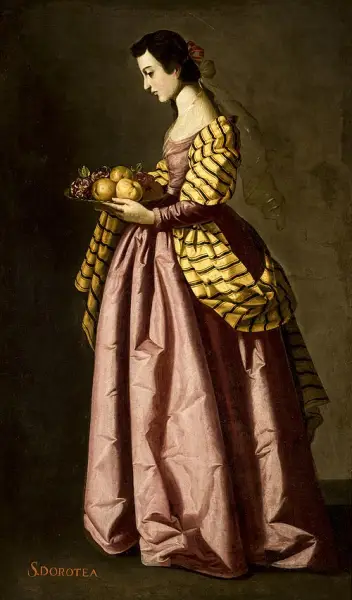
Few early martyrs have left so wide a mark on art and custom. From the fourteenth century onward painters and sculptors across Europe portrayed her, from Lucas Cranach the Elder and Matthias Grünewald to Luca della Robbia and Zurbarán. In late medieval Sweden she was counted the fifteenth of the Holy Helpers, and artists grouped her with Barbara, Catherine, and Margaret as the Quattuor Virgines Capitales, the four capital virgins. Her emblems are rich: a basket of flowers, sometimes with fruit; a crown of roses; stars about her as she kneels before the executioner; an enclosed garden where the Christ Child sits in an apple tree; apples from heaven on a branch. Because of her wreath of roses she is regarded as the patroness of gardeners, and on her feast of 6 February trees are blessed. She also protects brewers, brides, florists, midwives, newlyweds, and the Italian town of Pescia, and a teaching congregation, the Sisters of St. Dorothy, bears her name. Her story even reached the English stage in Massinger and Dekker's The Virgin Martyr of 1622, and a borough of Laval in Quebec, Sainte-Dorothée, keeps her memory.
§ Veneration
Timeline
- 279
Traditional chronology places her birth between about 279 and 290; nothing else of her origins survives.
§ Introduction
- 6 Feb 311
Tried before the prefect Sapricius at Caesarea in Cappadocia, tortured, and executed on 6 February.
§ Legend
- 6 Feb 311
Theophilus, converted by her gift of heavenly roses and fruit, confessed Christ and was put to death after her.
§ Legend
- 1622
The Virgin Martyr, Philip Massinger and Thomas Dekker's drama drawn from her story, was printed.
§ Veneration
- 14 Feb 1969
Pope Paul VI's motu proprio Mysterii Paschalis removed her from the General Roman Calendar as lacking universal significance.
§ Introduction
In Their Own Words
Bride of Christ, send me some fruits from your bridegroom's garden.
The Record
- Patron of
- patroness of gardeners and horticulture·patroness of brewers·patroness of brides and newlyweds·patroness of florists·patroness of midwives·patroness of love·patroness of Pescia, Italy·patroness of Markowa
- Symbols
- wreath or basket of roses·basket of fruit·crown of roses·martyr's palm·apples from heaven on a branch·enclosed garden with the Christ Child in an apple tree
- Canonization
- Pre-congregation martyr; her cult was confirmed by ancient usage, though Pope Paul VI's 1969 reform removed her from the General Roman Calendar.
Prayer
Bibliography
Show 6 sources
- Butler, Alban. The Lives of the Saints. Rockford, Illinois: Tan Books and Publishers, 1995. (Originally published 1878.)
- Englebert, Omer. The Lives of the Saints. Translated by Christopher and Anne Fremantle. New York: Barnes & Noble Books, 1994.
- Harvey, Sir Paul, ed. The Oxford Companion to English Literature. 4th ed. New York: Oxford University Press, 1967.
- Peterson, Joseph Martin. The Dorothea Legend: Its Earliest Records, Middle English Versions, and Influence of Massinger's "Virgin Martyr". University of Heidelberg, 1910.
- Meier, Gabriel. "St. Dorothea." The Catholic Encyclopedia. Vol. 5. New York: Robert Appleton Company, 1909.
- Martyrologium Romanum. Libreria Editrice Vaticana, 2001. ISBN 88-209-7210-7.
Profile text adapted from the Wikipedia article, licensed CC BY-SA 4.0.
Pray with this saint every day
Save St. Dorothea of Caesarea to your favorites, read the full profile, and get feast-day reminders in the Saints app.
Get the Saints AppFree on the App Store for iPhone and iPad