
1347 – 1394·Feast June 25
St. Dorothea of Montau
Anchoress and visionary of fourteenth-century Prussia
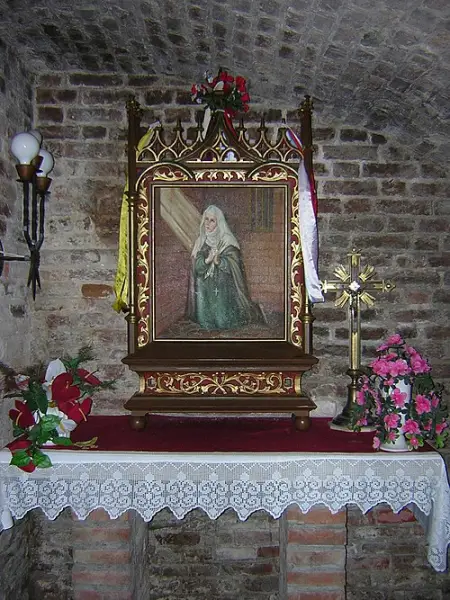
Overview
Dorothea of Montau was an anchoress and visionary of fourteenth-century Prussia, born on 6 February 1347 at Groß Montau, west of Marienburg, to Willem Swarte, a wealthy farmer who had come from Holland. Married at seventeen to the swordsmith Adalbrecht of Danzig, a harsh man in his forties, she began almost at once to experience visions. Her gentleness eventually won her difficult husband over, and the two made pilgrimages together before his death on a Roman pilgrimage around 1389 or 1390. Of her nine children, eight of her children predeceased her — four as infants, four more when plague swept the land in 1383; the one daughter left to her, Gertrude, entered the Benedictines. In 1391 Dorothea settled at Marienwerder, and on 2 May 1393, with the consent of the cathedral chapter and the Teutonic Order, she was enclosed in a cell against the cathedral wall, where she lived an austere life, counseled a steady stream of visitors, and received revelations. Her confessor, the deacon Johannes of Marienwerder, recorded her communications and wrote her life in Latin and German. She died on 25 June 1394, was venerated at once as patron of Prussia, and was beatified by Pope Paul VI in 1976.
The Complete Life
A Farmer's Daughter from Groß Montau
Dorothea was born on 6 February 1347 in the village of Groß Montau in Prussia, a place known today as Mątowy Wielkie in Poland, lying west of Marienburg, the modern Malbork. Her father, Willem Swarte, was a man of means, a wealthy farmer who had migrated from Holland to the frontier settlements of the Teutonic Order. Into that household of Dutch settlers in a Slavic-German borderland, Dorothea was born and raised. At the age of seventeen her life took its decisive worldly turn: she was given in marriage to Adalbrecht, a swordsmith of Danzig, the great port now called Gdańsk. The match could hardly have been easy. Adalbrecht was a man in his forties, old enough to be her father, and his temper was famously ill. Nothing else survives of her girlhood; the record begins in earnest with the visions that followed soon after her wedding. What the sources preserve is a picture of an ordinary medieval woman of artisan and farming stock, planted in a colonial frontier society, whose extraordinary inner life would gradually remake the circumstances into which chance and family had placed her.
§ Life
Marriage, Conversion, and Pilgrimage
Almost immediately after her wedding, Dorothea began to experience visions. Her husband had no patience with these spiritual events and mistreated her, yet she answered him with humility and gentleness rather than resistance. Over time that patience achieved what argument never could: Adalbrecht himself was converted, and the swordsmith who had scorned his young wife's revelations became her fellow pilgrim. Together they journeyed to Cologne and Aachen on the Rhine, and to the pilgrimage church of Einsiedeln Abbey in what is now Switzerland, venerating the great shrines of northern Europe. A still longer journey was planned. With her husband's permission Dorothea set out for Rome, the goal of every medieval pilgrim; while she was on that pilgrimage Adalbrecht died, in 1389 or 1390, leaving her a widow at about forty-two. Her motherhood had been marked by sorrow out of proportion even to its era: nine children were born to her, eight of whom died, four in infancy and four more in the plague year of 1383. The one daughter who survived, Gertrude, entered the Benedictines, so that mother and child were each drawn along a path of consecrated life.
§ Life
The Cell at Marienwerder
Dorothea's move came in the summer of 1391, when she settled at Marienwerder — Kwidzyn, as the Polish town is now called — a cathedral town of the Teutonic Order's Prussian lands. There her vocation found its final form. On 2 May 1393, with the authorization of the cathedral chapter and of the Teutonic Order itself, she was enclosed as an anchoress in a cell built against the wall of the cathedral, and she never left it for the rest of her life. The anchorhold did not cut her off from people; it made her a fixed point for them. Numerous visitors came to the grille seeking her advice and consolation, and the town's clergy and laity alike regarded her as a woman of revelation. Her confessor was the deacon Johannes of Marienwerder, a learned theologian who recognized the value of what he heard. He wrote down her communications and shaped them into literary form, producing a Latin biography in seven books entitled Septililium as well as a German life in four books, so that her mystical teaching reached readers long after her voice fell silent. Her cell still stands at Kwidzyn, a witness to those sealed years.
§ Life
Visions, the Passion, and the Eucharist
Dorothea's inner life centered on two great mysteries of Christian devotion: the Passion of Jesus and the Eucharist. She was described after her death as a devotee of both, and it was said that she bore the stigmata, bodily marks corresponding to the wounds of Christ, a sign medieval Christians read as the seal of crucified love on a chosen soul. From the first months of her marriage her visions and revelations had set her apart, and in the cell at Marienwerder they continued and deepened. Her austere manner of life matched the intensity of these experiences; whatever comfort an anchoress's room might have admitted, she was remembered for renouncing it. The scholar Michelle Sauer has observed that her life bore surprising resemblance to that of St. Jutta of Kulmsee, another anchoress of the same Prussian frontier who had lived at the end of the thirteenth century, suggesting a local tradition of female reclusion into which Dorothea stepped. Thanks to Johannes of Marienwerder, a theologian of real learning, her revelations were not lost to rumor but fixed in writing, in a Latin Septililium and a German four-book life that preserved her communications for later centuries.
§ Life
Enclosure and Death
Dorothea's enclosure lasted little more than a year, but it sealed the reputation she has carried ever since. From 2 May 1393 she remained in the cell against the wall of Marienwerder cathedral, praying, receiving visitors at the grille, and offering counsel to the many who sought her out. Her life there was rigorously austere, and her visions and revelations continued to the end. She died at Marienwerder on 25 June 1394, having lived barely fourteen months within the anchorhold, but those months confirmed for her contemporaries that the widow of Danzig had become a true bride of the enclosed life. Veneration began at the moment of her passing; the people of the Teutonic Order's Prussia took her to their hearts as a guardian of their country. The physical memory of her proved more fragile: her relics were lost, probably during the upheavals of the Protestant Reformation, when the cult of saints in Prussia was violently disrupted. Yet her cell survives at Kwidzyn, and the accounts gathered around her death became the foundation for the canonization process that her admirers almost immediately set in motion.
§ Life
A Cause Interrupted and Completed
Dorothea was venerated popularly from the instant of her death in 1394 as the guardian of the land of the Teutonic Knights and as patron saint of Prussia and Pomerania. A formal process was launched with striking speed: in 1405, no fewer than 257 witnesses spoke under oath of her virtues and her miracles, an unusually rich body of testimony for the period. The formal canonization process, however, was broken off and lay dormant for centuries, a casualty of the Reformation and the political transformation of Prussia. Only in 1955 was the cause resumed, and on 9 July 1976, in the Apostolic Palace at the Vatican, Pope Paul VI beatified Dorothea of Montau, six hundred years nearly to the day after the four-year-old girl had been carried to baptism in a Prussian village church. Her feast is kept on 25 June, the anniversary of her death, with a second observance on 30 October. Her name is entered in the Martyrologium Romanum, and she is numbered by the Church among its virgins and mystics, her cult at last confirmed after almost six centuries of popular devotion.
§ Veneration
Patron of Prussia and Figure of Literature
Dorothea's afterlife has been unusually varied for a provincial anchoress. In her own region she was honored from the moment of her death as guardian of the country of the Teutonic Knights, and her patronage of the former Prussia, of the monastic state itself, and of Pomerania made her a symbol of that vanished frontier Christendom; she remains a patron invoked by brides, by widows, and by parents of large families, roles that mirror the stations of her own life. Her architectural legacy endures in the anchorhold preserved at Kwidzyn, where pilgrims can still see the cell built into the cathedral wall in 1393. Her story entered high literature in 1977, when Günter Grass made her life, told through the eyes of her embittered husband Adalbrecht, one of the threads of his novel The Flounder. Modern scholarship has taken her equally seriously: Ute Stargardt has studied the political and social circumstances of her canonization and edited the original life by Johannes of Marienwerder, while Michelle Sauer's work on violence, isolation, and anchoritic preparation has placed her at the center of the study of female reclusion in late medieval Prussia.
§ Literature
Timeline
- 6 Feb 1347
Born at Groß Montau in Prussia, daughter of the wealthy Holland-born farmer Willem Swarte.
§ Life
- 1383
Four of her children died in the plague, adding to four earlier losses in infancy.
§ Life
- 1389
While she was on pilgrimage to Rome with her husband's blessing, Adalbrecht died, probably in 1389 or 1390.
§ Life
- 1391
In the summer, moved to Marienwerder, the town where she would spend her remaining years.
§ Life
- 2 May 1393
With the permission of the chapter and the Teutonic Order, established an anchoress's cell against the cathedral wall.
§ Life
- 25 Jun 1394
Died at Marienwerder after roughly fourteen months of strict reclusion.
§ Life
- 1405
Two hundred and fifty-seven witnesses testified to her virtues and miracles.
§ Veneration
- 1955
The formal canonization process, long broken off, was resumed.
§ Veneration
- 9 Jul 1976
Beatified by Pope Paul VI at the Apostolic Palace in Vatican City.
§ Veneration
In Their Own Words
bore surprising resemblance
The Record
- Major works
- Septililium, a Latin life of Dorothea in seven books composed by her confessor Johannes of Marienwerder·A German life of Dorothea in four books, also by Johannes of Marienwerder
- Patron of
- former Prussia·monastic state of the Teutonic Knights·patroness of brides·patroness of widows·patroness of parents of large families
- Canonization
- Beatified by Pope Paul VI on 9 July 1976 in the Apostolic Palace, Vatican City, after a canonization process interrupted for centuries and resumed in 1955.
Prayer
Bibliography
Show 6 sources
- Meier, Gabriel. "St. Dorothea." The Catholic Encyclopedia. Vol. 5. New York: Robert Appleton Company, 1909.
- Sauer, Michelle M. (Summer 2015). "Violence, Isolation, and Anchoritic Preparation: Dorothy of Montau, Anchoress of Marienwerder". Magistra. 21 (1): 134.
- Stargardt, Ute (1985). "The Political and Social Backgrounds of the Canonization of Dorothea von Montau". Mystics Quarterly. 11 (3): 107-122.
- Stargardt, Ute (ed.), 1997. "The life of Dorothea von Montau, a fourteenth-century recluse" (original text by Johannes of Marienwerder, d. 1417). Lewiston: E. Mellen Press. ISBN 0-7734-8568-6.
- Martyrologium Romanum (Libreria Editrice Vaticana 2001, ISBN 88-209-7210-7).
- Herbermann, Charles, ed. (1913). "St. Dorothea". Catholic Encyclopedia. New York: Robert Appleton Company.
Profile text adapted from the Wikipedia article, licensed CC BY-SA 4.0.
Pray with this saint every day
Save St. Dorothea of Montau to your favorites, read the full profile, and get feast-day reminders in the Saints app.
Get the Saints AppFree on the App Store for iPhone and iPad