
c. 500 – c. 560/580·Feast June 5
St. Dorotheus of Gaza
Abbot and spiritual master of the Gaza desert
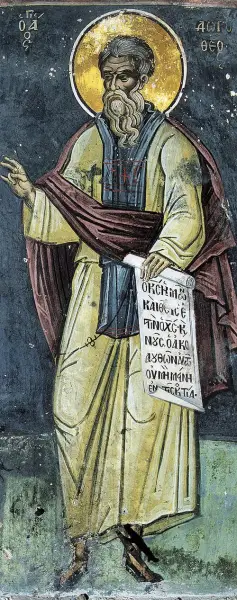
Overview
Dorotheus of Gaza, also called Abba Dorotheus or Dorotheus the Archimandrite, was a sixth-century monk, abbot, and writer whose short body of teaching shaped monastic life in both East and West. Born in the first years of the sixth century — perhaps 506 to 508 — to a well-to-do family of Antioch, he received a classical education, studying rhetoric and medicine at Alexandria or, more probably, Gaza. He became a monk at the Seridus monastery by Gaza in search of an undisturbed, prayerful existence, but his directors, the anchorites Barsanuphius and John the Prophet, set him on another road: he served as porter, ran the guesthouse, and then founded and directed a hospital within the monastery, funded by his own brother. For nine years he acted as go-between for John the Prophet and his petitioners, meanwhile maturing into a spiritual father to younger monks. Once John and Seridus were gone and Barsanuphius had fallen wholly silent, in the years from 540 to 543, his trail thins; John Moschus speaks of a monastery of Abba Dorotheus lying between Gaza and Maiuma, and his death is placed in either the 560s or the 580s. His Discourses, letters, and aphorisms survive, prized for their practical, unspeculative wisdom.
The Complete Life
An Antioch Education
Dorotheus was born at the opening of the sixth century, possibly between 506 and 508, into a well-to-do family of Antioch in Roman Syria. The household was probably Christian, and he seems to have been especially attached to his brother, who went on, in later life, to support as a generous benefactor the community his brother entered — perhaps even taking the monastic habit himself. From childhood he enjoyed the advantages of a classical education, continuing his studies either at Alexandria or, as most scholars judge more likely, at Gaza, whose rhetorical school was famous. Eric Wheeler has proposed that his teacher there was the sophist Procopius of Gaza, whom Wheeler believes Dorotheus alludes to discreetly in one of his Discourses. Alongside rhetoric he studied medicine, and his mature writings show a man thoroughly conversant with the medical science of his day, using technical terms and giving precise accounts of the treatment of wounds. His Discourses and letters are scattered with autobiographical touches that allow this reconstruction, though little else is known of his childhood. One biographical constant runs through it all: his health was always fragile, and with advancing age he suffered increasingly serious illnesses, a burden he carried through a life of ascetic discipline.
§ Early life
From the Schoolroom to the Monastery of Seridus
At an unknown date Dorotheus left the world of rhetoric and medicine for the monastery of Seridus near Gaza. The intellectual circles of Gaza and the monasteries around the city were in constant contact, and it was probably through such channels that he came to know Abbot Seridus and the two anchorites called the Great Old Men, Barsanuphius and John the Prophet. He came seeking quiet contemplation and hoped eventually to become an anchorite himself; instead, his first years were a schooling in disappointment. The passage from a life of comfort to ascetical discipline brought the usual temptations: he found it hard to surrender his property, struggled with certain practices, and had friction at times with his brethren. Seridus, perceiving his intelligence, kept assigning him duties that Dorotheus at first refused as obstacles to his spiritual progress, until obedience prevailed. He served in turn as porter of the monastery and as overseer of the guesthouse. Then Barsanuphius and John asked something greater still: that he establish and run a hospital inside the monastery, a work his brother, already a friend of the community, offered to underwrite.
§ Monastic life
The Infirmary and the Letters
The hospital placed Dorotheus exactly where he did not want to be and exactly where providence meant him to be. The sick came in numbers, and Dorotheus, who never ceased to long for the contemplative life, consulted Barsanuphius repeatedly about how to keep a life of prayer while shouldering the burdens of head doctor. When he wondered whether he should limit his healing methods and set aside the medical volumes that had traveled with him when he took up monastic life, Barsanuphius told him plainly to use what the books contained. Under him worked several assistants, among them the young Dositheus, his first disciple, later honored as a saint in his own right. Throughout these years Dorotheus stayed in close contact with Barsanuphius and John through their enormous correspondence; when John's personal assistant fell ill, Dorotheus became the direct channel between the anchorite and his petitioners, monks and outsiders alike, holding that office for nine years. In that time he grew into spiritual maturity: he moved from the common dormitory into a cell of his own and began to give direction to younger monks who brought him their struggles, becoming a spiritual father while still subject to the hidden elders.
§ Monastic life
Practical Teaching for Ordinary Souls
The heart of Dorotheus's enduring influence is his teaching, fixed in the Didaskaliai, twenty-four instructions on the ascetic life, together with eight letters and a handful of aphorisms. His method is deliberately unspeculative: like Barsanuphius, he cared little for debate and everything for practical guidance, grounded in everyday reality and in his own monastic experience. He forged a synthesis, joining the communal ideals of Basilian and Pachomian monasticism to the desert wisdom of Barsanuphius and John, who stood in the tradition of the monks of Scetis. Scripture saturates the instructions; he typically opens a subject from a biblical passage, often from the Old Testament, and returns to both testaments throughout, yet he offers no doctrinal treatise — Church theology simply lives inside his practical counsel. His prose is plain, clear, and unadorned, aimed solely at the edification of his hearers. His teaching on the passions is typical: every vice is answered by an opposing virtue, pride by humility, anger by meekness, hatred by love; and an oppressive thought, once confessed to a spiritual father and resisted, loses its power. Notably, he insisted his way of life suited all Christians, not monks alone.
§ Writings
Withdrawal and His Own Monastery
When John the Prophet and Abbot Seridus died, and Barsanuphius passed into complete silence sometime between 540 and 543, the thread of Dorotheus's story is broken. The title preserved in the manuscripts of his Discourses says that he withdrew from the monastery of Abba Seridos and, with God's help, began a monastery of his own once Abba John had died and Barsanuphius had ceased to speak altogether, though some suspect a later copyist added the line. Scholars have suggested that he left Seridus's house and either joined or established a new community on the coast between Gaza and Maiuma, or that he retired to a secluded hermitage for undisturbed contemplation, perhaps while still serving as archimandrite, an overseer of the surrounding monasteries. Whatever his exact situation, independent evidence confirms a house in his name: John Moschus, writing in the late sixth century, mentions the coenobium of Abba Dorotheus near Gaza and Maiuma in his Pratum Spirituale. A legendary life of Barsanuphius, written in twelfth-century southern Italy, sets his death in either the 560s or the 580s, by which time his teaching had already outgrown one monastery.
§ Monastic life
A Saint of the Undivided Church
Dorotheus belongs to the saints honored from antiquity without any formal process of canonization, and his cult spans the divided church: the Eastern Orthodox Church, the Oriental Orthodox Churches, and the Roman Catholic Church all keep his memory. His feast falls on 5 June in the Roman Catholic Church; Churches of the Eastern tradition observe 18 June, equivalent to 5 June on the old style, while the Eastern Orthodox Church also commemorates him on 13 August together with Abbot Seridus, and further feasts on 16 September appear in his honor. Both the Greek patrology devoted to his Discourses and the Bollandist Acta Sanctorum style him Dorotheus the Archimandrite, the title under which his authority as a monastic founder was handed on. Four ancient sources preserve what is known of him: his correspondence with Barsanuphius and John, of which François Neyt identified more than a hundred letters addressed to him; the anonymous Life of Dositheus, probably written by one of his own disciples; the Discourses he composed for his community; and his letters to others. He is sometimes confused with Dorotheus of Tyre, another monastic figure who became a bishop.
§ Legacy
From Gaza to the Trappists and the Curia
The travels of Dorotheus's writings rival those of any late antique author. Composed in Greek, they were rendered into Syriac, Arabic, and Georgian in the medieval period; the earliest surviving Greek manuscript is tenth-century, while Arabic versions may reach back to the ninth. A Latin translation appeared in the eleventh century, a French one in 1597, and another in 1686 at the hands of Abbe de Rance, the reformer who founded the Trappist branch of the Cistercians; Slavonic versions began in 1676, and Eric Wheeler's complete English translation followed in 1977. The Didaskaliai are quoted frequently by Theodore the Studite, and the instructions went on to shape Benedictine, Cistercian, Trappist, and even Jesuit spirituality, in time becoming better known than the correspondence of his own masters, Barsanuphius and John. His hand may lie behind collections as well: he has been proposed as compiler of the letters of the Great Old Men, of part of the Sayings of the Desert Fathers — to which he refers at least fifty-five times — and as editor of the Alloquia of abba Zosimas. The story is not over: in December 2024 Pope Francis held him up as a saint and spiritual master of the first rank, drawing on the Instructions in his Christmas address to the Roman Curia.
§ Legacy
Timeline
- 500
Was born into a well-off, probably Christian family of Antioch in Roman Syria, perhaps between 506 and 508
§ Early life
- 540
John the Prophet and Abbot Seridus died, and Barsanuphius withdrew into complete seclusion over 540 to 543
§ Monastic life
- 543
By this time his spiritual fathers were gone; tradition holds that he left Seridus' monastery and founded his own house near Gaza and Maiuma
§ Monastic life
- 560
Died, according to a twelfth-century legendary biography of Barsanuphius, either in the 560s or in the 580s
§ Monastic life
- 1100
His writings received their first Latin rendering during the eleventh century, opening them to Western readers
§ Legacy
- 1597
A first translation of his work into French appeared
§ Legacy
- 1676
Rendering of his instructions into Slavonic languages began
§ Legacy
- 1686
Abbe de Rance, founder of the Trappists, issued his own French translation
§ Legacy
- 1977
Eric Wheeler's complete English translation appeared in the Cistercian Studies series
§ Legacy
- 21 Dec 2024
Pope Francis praised him as an outstanding saint and spiritual master in his Christmas greetings to the Roman Curia
§ Legacy
In Their Own Words
It is impossible for anyone to get angry with his neighbor without initially raising himself above him, belittling him and then regarding himself higher than the neighbor.
Depart from evil and do good
The closer they are to God, the closer they become to one another; and the closer they are to one another, the closer they become to God.
Hold fast to indifference in knowledge and believe that everything that concerns us, even the most trivial thing, happens through God’s providence, and you will bear anything that comes upon you without being troubled.
Do not desire to know the evils of your neighbor and do not entertain suspicions about him, but if suspicious thoughts burst out of your own wickedness, take care to mould them into noble thoughts, and in all things give thanks in accord with God’s goodness and holy love.
In all things that come upon me I never desire to run around in quest of human wisdom, but I always act with the small power I have on whatever it is, and at the same time leave the whole thing to God.
The Record
- Major works
- Didaskaliai (Discourses and Sayings), spiritual instructions on the ascetic life in twenty-four sections·Eight surviving letters·A small collection of aphorisms·Possibly the compiler of the letters of Barsanuphius and John the Prophet·Possibly a compiler of part of the Sayings of the Desert Fathers·Suggested editor of the Alloquia of abba Zosimas
- Canonization
- Pre-congregation saint, venerated by the Roman Catholic, Eastern Orthodox, and Oriental Orthodox churches.
Prayer
Bibliography
Show 8 sources
- Dorotheus of Gaza (1963). Regnault, Lucien (trans.) (ed.). Oeuvres spirituelles. Paris: Éditions du Cerf.
- Wheeler, Eric P., ed. (1977). "Dorotheos of Gaza - Discourses and Sayings". Cistercian Studies. 33. Liturgical Press.
- Dorotheus of Gaza (2000). Scouteris, Constantine B. (trans.) (ed.). Abba Dorotheos: Practical Teaching on the Christian Life. University of Athens. ISBN 978-9-60-910141-7.
- Baldwin, Barry (1991). "Dorotheos of Gaza". In Kazhdan, Alexander P. (ed.). The Oxford Dictionary of Byzantium. Oxford University Press. p. 654. ISBN 0-19-504652-8.
- Bitton-Ashkelony, Brouria; Kofsky, Aryeh (February 2006). The Monastic School of Gaza. Brill. ISBN 9789047408444.
- Champion, Michael W. (2022). Dorotheus of Gaza and Ascetic Education. Oxford University Press. ISBN 978-0-19-886926-9.
- Hevelone-Harper, Jennifer Lee (2005). Disciples of the Desert: Monks, Laity, and Spiritual Authority in Sixth-Century Gaza. Baltimore: Johns Hopkins University Press. ISBN 0-8018-8110-2.
- Chryssavgis, John (2006). Barsanuphius and John: Letters, Volume 1. CUA Press. ISBN 9780813201139.
Profile text adapted from the Wikipedia article, licensed CC BY-SA 4.0.
Pray with this saint every day
Save St. Dorotheus of Gaza to your favorites, read the full profile, and get feast-day reminders in the Saints app.
Get the Saints AppFree on the App Store for iPhone and iPad