
c. 255 – 362·Feast June 5
St. Dorotheus of Tyre
Bishop, confessor of Nicaea, martyr under Julian
Overview
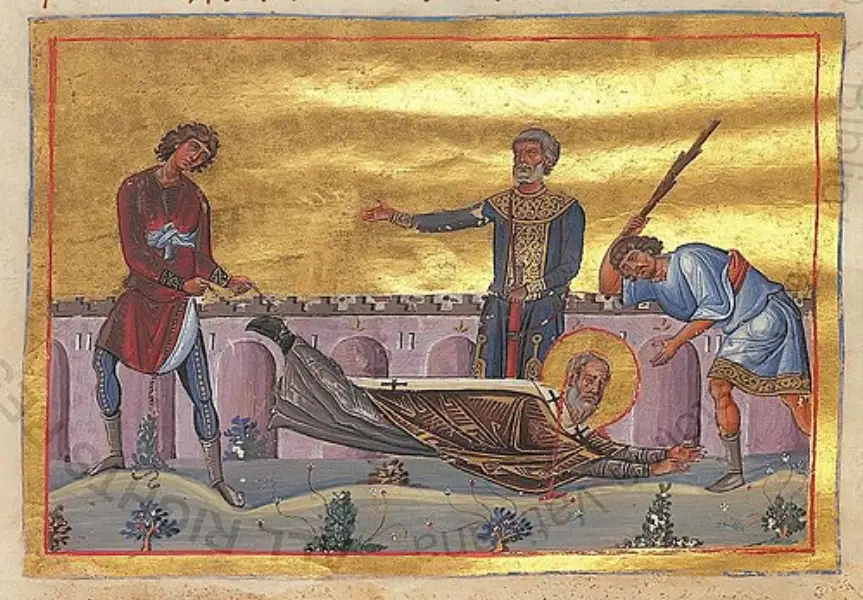
Dorotheus of Tyre was a bishop of Tyre, in present-day Lebanon, whom tradition credits with an Acts of the Seventy Apostles, a work possibly identical with the lost Gospel of the Seventy described in Luke 10:1. Born at Antioch around the year 255, he served that church as a learned priest; the historian Eusebius of Caesarea records his reputation, and later tradition remembers him as a eunuch. When Diocletian's persecution swept the East he is said to have been sent into banishment, returning once the danger passed. As a bishop he took part in the Council of Nicaea in 325, where the Church confessed the full divinity of Christ against Arius. Under the emperor Julian the Apostate he was banished a second time, to Odyssopolis — modern Varna — on the Black Sea coast of Thrace. There, according to the tradition, the priest of about one hundred and seven years was martyred for his faith. He is venerated in both the Catholic and Eastern Orthodox Churches, and a miniature in the Menologion of Basil II preserves his likeness.
The Complete Life
A Learned Priest of Antioch
Antioch on the Orontes, where Dorotheus was born around the year 255, ranked among the great cities of the Roman East and sheltered one of the most vigorous Christian communities of the ancient world. There, according to the traditional account, he was formed for the service of the Church and became a priest of the Antiochene church. The historian Eusebius of Caesarea, surveying the notable figures of the faith in his Ecclesiastical History, commends Dorotheus as a learned man — a rare and deliberate tribute at a time when clerical learning could not be taken for granted. Later tradition adds a striking detail: Dorotheus was a eunuch. In late antiquity such men were often shut out of ordinary civic honor, yet within the Church they could be entrusted with weighty responsibilities, and their condition was sometimes read as a sign of undivided devotion to a life of continence. Whether his study was given to scripture, to the apostolic lists then circulating among the faithful, or to the administration of his church, the memory that endured was of a cultivated and faithful cleric whose reputation outlasted the storms of persecution that were then gathering over the East.
§ Dorotheus of Tyre
Bishop of Tyre and Father of Nicaea
The mature career of Dorotheus belongs to the church of Tyre, the great Phoenician port whose bishop he became, and to the decisive assembly of the fourth century. Before Nicaea he had already tasted the cost of discipleship, for he is said to have been sent into banishment when Diocletian's persecution swept the eastern provinces, returning only after the storm had passed. In 325 he stood among the clergy summoned to the Council of Nicaea, the gathering called to answer the Arian controversy and to give the Church a common confession of the divinity of Christ. To Dorotheus tradition further attaches a literary monument: an Acts of the Seventy Apostles, recounting the missionary band dispatched according to the Gospel of Luke, which some have identified with the lost Gospel of the Seventy. The attribution may be legendary — later ages distinguished a Pseudo-Dorotheus whose compilations traveled under his revered name — yet the very fact of the attribution measures the standing he enjoyed as a keeper of apostolic memory in the Syriac- and Greek-speaking churches of his generation. Whatever the exact boundary between his see and his fame, his name traveled with the conciliar tradition as one of the eastern bishops whom the fourth century did not forget.
§ Dorotheus of Tyre
Exile to Odyssopolis and Martyrdom
The last act of Dorotheus's life falls in the brief and troubled reign of Julian the Apostate, who sought to restore the ancient cults and stripped Christian clergy of favor. The aged bishop — said by the tradition to be one hundred and seven years old — was exiled to Odyssopolis, the Thracian town on the Black Sea known today as Varna in Bulgaria. It was a sentence harsh enough to break far younger men: a Syrian churchman in his second century of life, dispatched to a distant station on the empire's northern frontier. The tradition records something graver still. At Odyssopolis the aged priest was martyred for his faith, sealing with blood a life that had already endured persecution, banishment, and the labors of the great conciliar age. Eastern Christian art preserved the memory of his witness: a miniature in the Menologion of Basil II portrays the saint among the honored confessors and martyrs of the early Church, a quiet figure standing for all who grew old in fidelity and were found faithful at the end. The story has encouraged Christians of every later century who must carry the faith into old age without applause or aid.
§ Dorotheus of Tyre
Memory in East and West
The veneration of Dorotheus passed intact from the ancient Church into both East and West. His feast is kept on June 5 according to the Gregorian calendar, corresponding to June 18 on the Julian reckoning, and he is numbered among the saints of the Catholic Church and the Eastern Orthodox Church alike. The literary tradition gathered around his name proved unusually durable. Beside the Acts of the Seventy Apostles credited to him, later compilations circulated as the works of Pseudo-Dorotheus, and medieval readers received them as handbooks of sacred history. Modern scholars have continued to sift that inheritance — Henry Wace treated him in the Dictionary of Christian Biography, and Roger Pearse has examined the Synopsis transmitted under his name — while acknowledging how little can be securely recovered of the man himself. What remains certain is the outline handed down from antiquity: a learned priest of Antioch, a eunuch devoted to the Church, bishop of Tyre, participant in the Council of Nicaea, twice an exile, and at the last a martyr of extraordinary age who died under Julian rather than betray the faith he had confessed for a century.
§ Dorotheus of Tyre
Timeline
- 255
Born at Antioch around this year, according to the traditional chronology of his life.
§ Introduction
- 325
Attended the Council of Nicaea after returning from exile under Diocletian's persecution.
§ Introduction
- 362
Exiled by Julian the Apostate to Odyssopolis on the Black Sea and martyred there at about one hundred seven years of age.
§ Introduction
The Record
- Major works
- Acts of the Seventy Apostles (traditionally credited; possibly the lost Gospel of the Seventy)
- Symbols
- traditionally credited with an Acts of the Seventy Apostles
- Canonization
- Pre-congregation; venerated since antiquity by the Catholic Church and the Eastern Orthodox Church.
Prayer
Bibliography
Show 3 sources
- Eusebius Pamphilus, Bishop of Caesarea, in Palestine (1865). Ecclesiastical History. Translated by Crusé, C. F. London: Bell & Daldy. pp. xiii.
- "Saint Dorotheus of Tyre". Saints.SQPN. Retrieved April 5, 2011.
- Henry Wace, Dictionary of Christian Biography and Literature to the End of the Sixth Century A.D.
Profile text adapted from the Wikipedia article, licensed CC BY-SA 4.0.
Pray with this saint every day
Save St. Dorotheus of Tyre to your favorites, read the full profile, and get feast-day reminders in the Saints app.
Get the Saints AppFree on the App Store for iPhone and iPad