
1624 – 1693·Feast December 13
St. Dosoftei
Metropolitan, scholar, and first Romanian poet
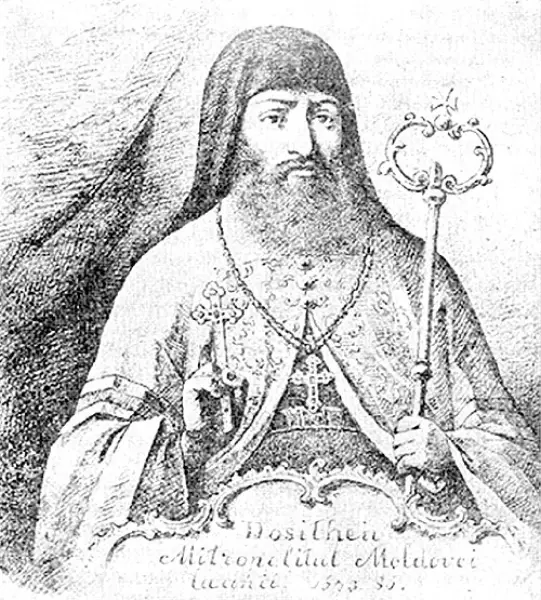
Overview
Dosoftei, born Dimitrie Barilă at Suceava on October 26, 1624, was Metropolitan of Moldavia, scholar, poet, and translator, and stands among the most important Romanian scholars of the seventeenth century. Born into a family of Greek origin, he received his education at the school of the Trei Ierarhi Monastery in Iaşi and at the school of the Orthodox Brotherhood in Lviv, where he absorbed the humanities and mastered several tongues. He became a monk at Probota Monastery in 1648, served as bishop of Huşi from 1658 to 1660 and of Roman from 1660 to 1671, and twice held the metropolitan see of Moldavia, from 1671 to 1674 and again from 1675 to 1686. He left for Poland in 1686 and never returned, living out his days there until his death at Zhovkva on December 13, 1693. Dosoftei was the first important poet of the Romanian language and its first translator of epics, historical works, and religious scriptures in Moldavia. Best known of all his labors is the psalter rendered into Romanian verse. The Romanian Orthodox Church enrolled him among its saints in 2005, and his feast is kept on December 13.
The Complete Life
A Youth Between Suceava and Lviv
Dimitrie Barilă was born at Suceava on October 26, 1624, into a family of Greek origin — a background that placed him at the meeting point of Greek, Slavonic, and Romanian Christian culture which shaped the principalities of the East. The Moldavia of his childhood was a frontier society of monasteries, brotherhoods, and printing houses, where the inherited languages of the Church had not yet fully met the rising vernacular. His education followed the best channels the region offered. He first attended the school of the Trei Ierarhi Monastery in Iaşi, the celebrated foundation whose church still bears the marks of Moldavian learning at its height. From there he went on to the Orthodox Brotherhood school in Lviv, one of the chief educational institutions of the Orthodox world in the Polish-Lithuanian lands, where he studied the humanities and learned several languages. This double formation — monastic scholarship at home, humanist breadth abroad — gave him the linguistic range and the literary ambition that would later make him the first great voice of Romanian letters, prepared before he ever took monastic vows.
§ Dosoftei
Monk of Probota, Bishop of the Realm
In 1648 Dimitrie received the monastic habit at Probota Monastery, taking the name Dosoftei. The foundation among the woods of northern Moldavia was a fitting cradle for a vocation that joined the contemplative tradition to a life of books. His capacities soon drew him from the cloister into the government of the Church: in 1658 he was elevated to the bishopric of Huşi, and in 1660 he was translated to the see of Roman, two of the principal suffragan thrones of Moldavia. Eleven years at Roman established him as a figure of the first rank in the Moldavian hierarchy, and in 1671 he was raised to the metropolitan throne of Moldavia itself. His tenure was not continuous — he held the see from 1671 to 1674, and after an interval returned to it from 1675 to 1686 — a pattern that suggests the turbulence of Moldavian public life, where princely politics reached deep into episcopal appointments. Through all these changes he carried forward the work for which he is remembered: the building of a written culture for his Church in its own language.
§ Dosoftei
Metropolitan and Father of Romanian Letters
Dosoftei's lasting mission was accomplished with pen as much as with crozier. He was among the most important Romanian scholars of the seventeenth century, and his pioneering place is threefold. He was the first important poet of the Romanian language, proving that the vernacular of his Church could carry verse of dignity and measure. He was the first translator into Romanian — within Moldavia — of epics, of works on history, and of religious scriptures, opening to his people the inherited literature of Christendom in their own tongue. And above all he gave the Romanian Church its psalter in verse, the work for which his name has remained familiar ever since: the Psalms of David recast as Romanian poetry, so that the prayer book of the temple might be sung in the language of the people. The manuscript of this psalter, together with its 1673 edition, was later published by the Romanian Academy, a sign of the esteem in which his text has been held by scholars. In him the Moldavian Church found both its hierarch and its first great man of letters, joined in a single vocation.
§ Works
Exile in Poland and a Quiet End
In 1686, in circumstances that removed him from his metropolitan see, Dosoftei moved to Poland, and there he remained for the rest of his life. The change closed his quarter-century of leadership in Moldavia but placed him among the Orthodox communities of the Polish-Lithuanian Commonwealth, the world in which he had once studied as a young man at Lviv. He lived into his sixty-ninth year, and died at Zhovkva on December 13, 1693 — far from the cathedral city of Iaşi whose church and school had formed him, and far from the throne of Moldavia he had twice occupied. His death in the Commonwealth joined the two halves of his biography: the bishop who had governed the Church of Moldavia ended his days in the land of the Orthodox brotherhoods that had educated him. The date of his falling asleep, December 13, became the day on which the Church would later keep his memory, and the quiet Polish town of his death became a station in the biography of the first poet of the Romanian language. Exile, in his case, did not silence the work; the scholarly labors for which he is honored had already been given to his people before he crossed the frontier for the last time.
§ Dosoftei
Enrolled Among the Saints of Romania
More than three centuries after his death, the Romanian Orthodox Church formally recognized the sanctity of Dosoftei. In July 2005 the Synod of the Romanian Orthodox Church decreed his canonization, and the act was proclaimed on October 14, 2005, adding the learned metropolitan to the calendar of the nation's saints. The recognition closed the circle of a reputation that had never rested on wonder-working but on the union of scholarship, poetry, and pastoral service: the Church raised to the altars a man whose holiness had been expressed through learning and through the gift of Scripture to his people in their own voice. His feast was assigned to December 13, the day of his repose in 1693. In the Orthodox understanding the canonization of a bishop-scholar bears its own witness — that the life of study, when it is a life of prayer, is itself a path to holiness, and that the translator who carries the Psalms across the frontier of language performs a work of evangelization worthy of the altars. His glorification in 2005 thus crowned not only a biography but a language, which through his labors had learned to pray in verse.
§ Dosoftei
Memory in Letters and in Bronze
Dosoftei's afterlife has been lived largely in the culture of Romanian letters. The psalter in verse, edited by Professor I. Bianu from the original manuscript and from the 1673 edition, was published by the Romanian Academy in 1887 and has remained a foundational monument of the language's poetic history. Historians of Romanian culture, from Nicolae Iorga onward, have weighed the question of his Greek origin and drawn from it a larger lesson: at the beginnings of the making of Romanian national culture stand men of Greek education, such as Coresi and Dosoftei, who gave the vernacular its first great written instruments. Modern commemoration has taken visible form as well. In 2015 Chișinău gave him a place on its Alley of Ecclesiastical Personalities: a bronze bust by the sculptor Veaceslav Jiglițchi, raised on a pedestal of Cosăuți stone wrought by the folk master Veaceslav Lozan — a public tribute in the capital of neighboring Moldova to the metropolitan whose tongue and Church were one across the region. Scholar, poet, translator, and saint, he stands at the fountainhead of Romanian Christian literature.
§ Dosoftei
Timeline
- 26 Oct 1624
Born at Suceava into a family of Greek origin.
§ Introduction
- 1648
Became a monk at Probota Monastery.
§ Introduction
- 1658
Began service as bishop of Huşi, holding that see until 1660.
§ Introduction
- 1660
Translated to the bishopric of Roman, which he led until 1671.
§ Introduction
- 1671
Elected Metropolitan bishop of Moldavia for his first tenure.
§ Introduction
- 1674
First term as Metropolitan of Moldavia came to an end.
§ Introduction
- 1675
Returned to the metropolitan see of Moldavia for a second term.
§ Introduction
- 1686
Moved to Poland, where he remained for the rest of his life.
§ Introduction
- 13 Dec 1693
Died at Zhovkva in the Polish–Lithuanian Commonwealth.
§ Introduction
- Jul 2005
Canonized by the Synod of the Romanian Orthodox Church.
§ Introduction
- 14 Oct 2005
His canonization was publicly proclaimed.
§ Introduction
- 2015
A bronze bust of him was installed on the Alley of Ecclesiastical Personalities in Chișinău.
§ Introduction
The Record
- Major works
- Romanian psalter in verse·First Romanian translations of epics, historical works, and religious scriptures·Psaltirea în versuri (published from the manuscript and the 1673 edition)
- Patron of
- patron of Romanian letters and translators
- Symbols
- bishop's omophorion·book of the Psalter·writing quill
- Canonization
- Canonized by the Synod of the Romanian Orthodox Church in July 2005; proclaimed on October 14, 2005.
Prayer
Bibliography
Show 6 sources
- Revista de istorie (in Romanian). Vol. 27. Editura Academiei Republicii Socialiste România. 1974. p. 1486.
- Țurcanu, Ion (2007). Istoria românilor: Cu o privire mai largă asupra culturii (in Romanian). Istros. p. 215. ISBN 978-973-1871-02-8.
- Aleea Personalităților Bisericești din mun. Chișinău
- Абрамов Ф., прот. "Митрополит Сучавский Досифей," Журнал Московской Патриархии, 1974, No. 3, 50-52.
- Mirela Cimpoi, "Dosoftei, sfântul învăţat", Jurnalul Naţional, July 17, 2006.
- Dosofteiu Mitropolitul Moldovei 1671–1686. Psaltirea in versuri publicata de pe manuscrisul original și de pe edițiunea dela 1673 de Prof. I. Bianu. Edițiunea Academieĭ Române. Bucuresci 1887.
Profile text adapted from the Wikipedia article, licensed CC BY-SA 4.0.
Pray with this saint every day
Save St. Dosoftei to your favorites, read the full profile, and get feast-day reminders in the Saints app.
Get the Saints AppFree on the App Store for iPhone and iPad