
1105 – 1186·Feast April 16
St. Drogo
Shepherd and Anchorite of Sebourg
Overview
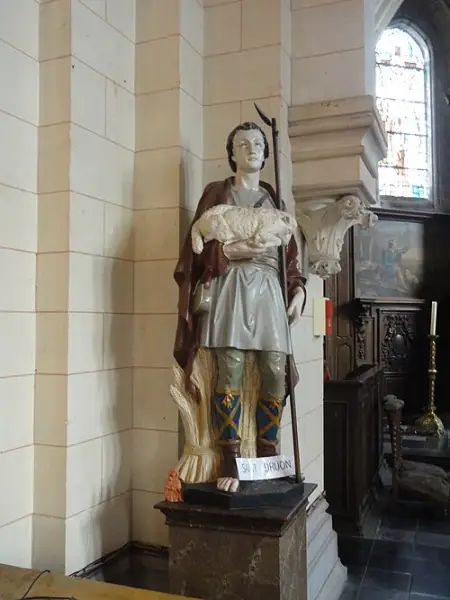
Drogo of Sebourg, a Flemish saint also called Druon, Dreux, or Drogon, was born on 14 March 1105 at Epinoy in Artois and orphaned at birth, his father having died before he arrived and his mother in the childbirth that brought him into the world. Raised by relatives, he renounced his inheritance at twenty, gave everything to the poor, and chose a life of hardship and prayer. For six years he worked as a shepherd at Sebourg near Valenciennes in the service of Elizabeth de la Haire, winning the affection of all by his piety and charity, and becoming the subject of stories of bilocation. Fleeing human praise, he took to the roads as a pilgrim, reportedly reaching Rome nine times and visiting the great shrines of France and Italy. A hernia finally ended his wandering, and he enclosed himself in a cell against the church wall at Sebourg, where he lived as an anchorite for forty-five years until his death on 16 April 1186 at the age of eighty-one. He is invoked as patron of shepherds and, by a later and anachronistic custom, of coffee.
The Complete Life
An Orphan of Artois
Drogo entered the world under a double sorrow. Born on 14 March 1105 into a noble family of Epinoy in the County of Artois, within the Flemish lands that obeyed the French crown, he never saw his father, who had died before the birth, and he lost his mother within hours, for she died in bringing him forth. The newborn lord was thus an orphan from his first day, and relatives took charge of his upbringing in the house of his ancestors. The boy grew up without knowing the full story of his origin; only at the age of ten did he learn how his parents had died, and the discovery grieved him deeply. It is easy to imagine what such knowledge worked in a sensitive child: the estate he would one day inherit had cost him both parents, and the grandeur of his name carried a hidden wound. Medieval hagiographers saw in this early bereavement the hand of God preparing a soul for himself, weaning it early from every earthly attachment. Whatever the psychology of it, Drogo carried the memory of his birth into an adolescence spent among relatives, waiting to come of age in a world where rank and property decided everything.
§ Life
Renunciation and the Shepherd's Fields
At twenty years of age Drogo made the decision that defined his life. He disposed of his money and goods for the benefit of the poor, surrendered his estates to the next heirs, and set out with nothing, choosing poverty and penance in deliberate imitation of Christ. After visiting several holy places he took service tending sheep for a rich landowner of Sebourg, the lady Elizabeth de la Haire, whose home lay two leagues distant from Valenciennes. The work suited him perfectly: the long solitude of the pastures gave him the silence in which prayer flourishes, and for six years he kept his flocks while filling the hours with penitential devotion. He proved good at the trade, reading the weather as it changed and knowing how to treat the ailments of his animals, and he passed these skills on to others freely. Gifts came to him from admirers, and every one of them went straight to the poor. Word spread of something stranger still: people said he possessed the gift of being in two places at once, seen in the fields and in the church at the same hour, a wonder that passed into a local saying still repeated in the countryside about anyone who cannot be in two places at one time.
§ Life
Pilgrim to Rome
Esteem is dangerous for a soul that seeks obscurity, and Drogo came to fear the admiration his holiness attracted. To escape the peril of praise he abandoned his post and gave himself to the pilgrim road. Tradition counts nine journeys from Flanders to Rome, undertaken in an age when such a pilgrimage meant months of walking, begging, exposure, and danger, and along the way he frequented the principal shrines of France and Italy, kneeling at the tombs of the apostles and martyrs where crowds of pilgrims gathered. Now and again he went back to Sebourg, where the lady Elizabeth and the villagers had never forgotten their shepherd, before taking the road once more. The pilgrimages were themselves a form of penance and prayer, a way of living as a stranger everywhere, with no house of his own and nothing to guard but his soul. In an age when the nobility of Flanders built castles and waged private wars, the young lord of Epinoy tramped the roads of Europe as a beggar for God. The roads, however, exacted their price, and the years of walking eventually damaged the body that carried him.
§ Life
The Cell at Sebourg
A hernia at last brought the wandering to an end, and Drogo settled on the most radical solution available to a twelfth-century penitent: enclosure. Beside the church of Sebourg he had a small cell built against the wall, a room from which he would never emerge. One window opened to the outside world, through which the people of the village passed him food and water and brought him their prayers and troubles; a second window looked into the church itself, allowing the recluse to follow the liturgy from his confinement and receive holy communion. In that narrow space Drogo passed the last forty-five years, entering it as a man of about thirty and leaving it only when he died there in 1186, an old man in his eighty-first year, a living monument of penance at a village church door. The villagers who had known him as their shepherd now considered him their treasure, and pilgrims sought him out for counsel and intercession. When he died on 16 April 1186, the people of Sebourg buried their saint, and the date became his feast. His body rests in the church of Saint Martin at Sebourg, where a chapel in the lower church marks his shrine.
§ Life
Recognition of the Cult
Drogo was never canonized by papal process; he belongs to the long company of saints raised to the altars by the voice of the people before formal procedures existed, and his cult is accordingly described as pre-congregation. The veneration that grew immediately after his death received official confirmation only in the early seventeenth century, when Bishop Richardot, in the year 1609, formally recognized the cult of Saint Drogo by the ceremony of raising his relics to the altar at Sebourg, thereby approving the public honour paid to him. The translation of the body itself had already passed into legend: at his death the people of his birthplace, Épinoy, came to claim the remains of their own lord, over the protests of the Sebourg villagers who wished to keep the man they had honoured in life. As the cart bearing the body moved away from the church it grew heavier and heavier until the animals could draw it no farther, and the bystanders accepted the event as a sign from heaven that Drogo was to remain at Sebourg. A cross was planted where the cart stood still, and the relics were returned to the church where they remain today.
§ Veneration
Patron of Shepherds and of Coffee Houses
The memory of Drogo has proved unexpectedly durable. Each year on Trinity Sunday a procession carries his relics through Sebourg, and the saint is honoured as a patron of shepherds and of the flocks they tend, a patronage drawn directly from his years in the fields of Elizabeth de la Haire. His intercession is sought for an astonishing range of human troubles: the sick, the deaf and the mute, the mentally ill, orphans, midwives, and those suffering from hernia and gall stones, the very affliction that had shaped the close of his own life. Towns in France honour him as well, among them Baume-les-Messieurs and Fleury-sur-Loire. In modern times he has also been adopted as the patron of coffee houses and their keepers, a devotion popular among those who work in the trade, though historians of the bean are quick to note that the connection is anachronistic: coffee was unknown in twelfth-century Flanders, and no twelfth-century pilgrim could have drunk it, since the drink appears in the historical record only centuries later. Whatever the origins of that patronage, the shepherd of Sebourg keeps his place among the beloved saints of the Low Countries, the noble orphan who chose sheep, silence, and God.
§ Veneration
Timeline
- 14 Mar 1105
Born at Epinoy in Artois; his father had already died and his mother passed away in childbirth.
§ Life
- 16 Apr 1186
Died in his anchorite cell at Sebourg at the age of eighty-one.
§ Life
- 1609
Bishop Richardot formally approved his cult by raising the relics to the altar at Sebourg.
§ Veneration
In Their Own Words
At Sebourg in Hainaut, around 1186, Saint Druon (Drogon). In search of a simple and solitary life, as a shepherd of flocks and then as a pilgrim, he lived for God alone
The Record
- Major works
- Anchorite cell built against the church wall at Sebourg
- Patron of
- shepherds·sheep and cattle·coffee house keepers and owners·deaf and mute people·mentally ill people·orphans·midwives·sick people·against hernias, gall stones, rupture, and illness·Baume-les-Messieurs·Fleury-sur-Loire
- Symbols
- Benedictine habit·sheep·shepherd
- Canonization
- Pre-congregation; the cult was formally approved by Bishop Richardot in 1609
Prayer
Bibliography
Show 5 sources
- "Druon", Saints du Pas de Calais, Diocese of Arras.
- Butler, Alban. Lives of the Fathers, Martyrs, and Principal Saints, 1866. CatholicSaints.Info, 15 April 2013.
- O'Connell, Christian E., "Rediscovering Saint Drogo of Sebourg", Crisis Magazine, April 16, 2015.
- Monks of Ramsgate. "Drogo". Book of Saints, 1921. CatholicSaints.Info, 18 November 2012.
- Pendergrast, Mark (2019). Uncommon Grounds: the History of Coffee and How It Transformed Our World. Basic Books. pp. 4-5. ISBN 9780465024049.
Profile text adapted from the Wikipedia article, licensed CC BY-SA 4.0.
Pray with this saint every day
Save St. Drogo to your favorites, read the full profile, and get feast-day reminders in the Saints app.
Get the Saints AppFree on the App Store for iPhone and iPad