
c. 465 – c. 550·Feast November 14
St. Dubricius
Evangelist of Ergyng and bishop of south-east Wales
Overview
Dubricius, known in Welsh as Dyfrig, was a sixth-century British ecclesiastic venerated as a saint, remembered as the evangelist of Ergyng — later Archenfield in Herefordshire — and of much of south-east Wales. Born at Madley, the illegitimate son of Efrddyl, daughter of King Peibio Clafrog of Ergyng, his earliest story is one of rejection and reconciliation: his grandfather cast his mother into the waters of the Wye, yet could not drown her, and the family was restored when the child Dubricius touched Peibio and cured his leprosy. Renowned for precocious intellect, he was known as a scholar throughout Britain while still a young man. He founded monasteries at Hentland and Moccas, taught many of the famous Welsh saints, including Teilo and Samson, and healed the sick by the laying on of hands. Episcopal office in Ergyng followed — seated, perhaps, at Weston under Penyard — with influence reaching across what would one day be the diocese of Llandaff. He sat in the Synod of Llanddewi Brefi of 545 and there, tradition says, yielded his throne to St. David, withdrawing afterward to Bardsey Island, the place of his last years, his death, and his burial. Five centuries later, in 1120, his remains were brought to Llandaff Cathedral.
The Complete Life
A Child of Rejection and Healing
The story of Dubricius begins in scandal and ends in a miracle of restoration. His mother was Efrddyl, daughter of Peibio Clafrog, king of Ergyng, the Welsh kingdom on the modern Herefordshire border. When Peibio discovered that his daughter was pregnant outside marriage, his rage was extreme: he threw her into the River Wye, but she did not drown. The child, Dubricius, was born at Madley in Herefordshire, on the wrong side of his grandfather's judgment. The reconciliation that followed established the pattern of his life. According to the tradition, the young Dubricius touched his grandfather and cured him of his leprosy, and the king was reconciled to both mother and child. The episode, whatever its historical seasoning, gave the hagiographers their theme: the rejected child whose touch heals the one who rejected him. It also announced the gifts for which he would be remembered. His intellect was famously premature; while he was still a young man his name carried weight as a scholar through all Britain — a reputation remarkable in a sub-Roman land emerging from political collapse, and the foundation of the teaching career that followed.
§ Biography
Schoolmaster of the Welsh Saints
Dubricius's vocation took institutional form in two foundations. He established a monastery at Hentland on the Wye, and afterward another at Moccas, houses that became the nurseries of British Christianity in the marcher country between Wales and England. From these communities came his most enduring influence: many of the renowned saints of Wales took their learning from him, among them Teilo, whose name is woven through the churchland of South Wales, and Samson, who carried the monastic tradition from Dubricius's schools to Dol in Brittany. In the Celtic world the master-disciple chain was the very structure of the Church, and Dubricius stands at the head of one of its great lines. The tradition adds that he cured the sick of many afflictions by laying his hands upon them — the same gift the legends attributed to his childhood touch upon his grandfather. Dedications at Porlock and close by Luccombe, on the coast of Exmoor in Somerset, might point to journeys of his own in that southwestern region. Before any episcopal office, he had already built the Church he would later govern, monasteries first and a bishopric after.
§ Biography
Evangelist of Ergyng and Bishop
Dubricius is honored as the evangelist of Ergyng — the Welsh Erging, later Archenfield in Herefordshire — and of much of south-east Wales, the region through which the Gospel was planted among the post-Roman British. In time he took up episcopal office in Ergyng — his throne, if he kept one, may have stood at Weston under Penyard — and his authority seems to have stretched across Glamorgan and Gwent together, the ground that afterward formed the see of Llandaff. The nature of his episcopal authority is a matter of scholarly caution: his order may have existed chiefly to ordain clergy rather than to govern a territory-wide church, a distinction that reflects the fluid structures of the Celtic Church. Among his close friendships the tradition numbers St. Illtud, the master of the school at Llantwit Major, and his own pupil Samson. His episcopal career reached its documented climax at the Synod of Llanddewi Brefi in 545, the assembly that vindicated St. David; there, by the story told of him, Dubricius gave up his own throne so that David might take it — a renunciation that made room for the greatest of Welsh saints and completed his own authority by surrendering it.
§ Biography
Retirement to Bardsey Island
After the Synod of Llanddewi Brefi, having resigned or laid aside his see, Dubricius withdrew to Bardsey Island, the island off the Llŷn Peninsula that Celtic tradition called the island of the saints, and there he spent his final years. He died on the island around the year 550, and it was there that he was eventually buried, in keeping with Bardsey's reputation as the resting place of the holiest men of the age. The 2004 Roman Martyrology records the place of his end exactly: Dyfrig, entered under November 14, closed his life on Bardsey, off the northern shore of Wales, bearing the twofold title of bishop and abbot — the double title honoring both his episcopal office and his monastic foundation at Hentland. In 1120, more than five centuries after his death, his body was transferred from the island to Llandaff Cathedral, bringing the saint whose jurisdiction had probably covered Glamorgan and Gwent to the cathedral church of the diocese that bore his influence. The translation made Llandaff the heir of his cult and fixed his memory in the Anglo-Norman church of the conquered South Wales.
§ Biography
A Saint of the Undivided Church
Dubricius belongs to the saints of the pre-congregation era, venerated from antiquity and now honored across the divided churches of the West: he is venerated in the Eastern Orthodox Church, the Roman Catholic Church, and the Anglican Communion alike. His liturgical cult remains officially anchored in the Roman Martyrology. In the 2004 edition, Dyfrig is listed under November 14 with the Latin name Dubricius, described as having died on Bardsey Island as a bishop and abbot. Wales's Catholic calendar keeps the old day of November 14 for him still, a continuity that links the modern Welsh Church to the medieval cult of the saint. No formal canonization decree was ever needed or issued: his sanctity rested on the evangelization of a people, the monasteries he founded, the saints he taught, and the tomb on Bardsey that drew pilgrims for centuries. That the calendar for Wales still keeps his day is a quiet testimony that the church of the sixth century and the church of the twenty-first regard the same man as a father of the faith in the land of the Welsh.
§ Liturgical cult
Churches, Icons, and the Legend of Arthur
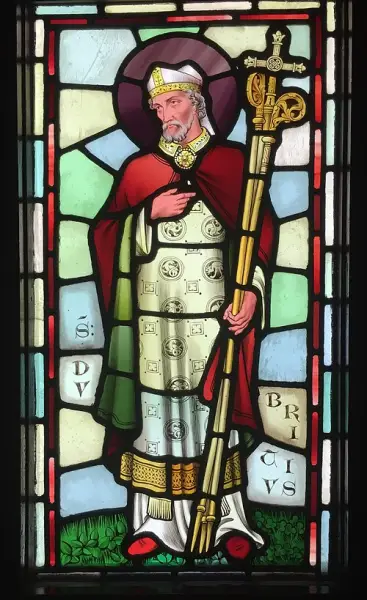
Dubricius's legacy lives in two registers, one historical and one legendary. On the ground, his cult is written in dedications: the Church of England churches at Ballingham, Whitchurch, Hentland, and Hamnish in Herefordshire, and at Porlock in Somerset; the Church in Wales churches at Gwenddwr in Breconshire and Llanvaches in Newport; and the Catholic church at Treforest, dedicated to Dyfrig. In art he ordinarily appears with two pastoral staffs in his hands, the emblem of his rule over Caerleon and Llandaff together, together with the cross of an archbishop — the attributes recorded in the oldest martyrologies and repeated in a stained-glass depiction designed by William Burges at Castell Coch, Cardiff. Legend, however, carried him farther: he was made Archbishop of Llandaff by St. Germanus of Auxerre, and, in the romances, crowned King Arthur. Geoffrey of Monmouth gave him a speaking part in the Historia Regum Britanniae, Wace recast him in the Roman de Brut after Geoffrey, and Tennyson, six centuries on, set him among the figures of the Idylls of the King. History and poetry alike thus preserved the bishop of Ergyng, the first great churchman of Welsh memory.
§ Iconography
Timeline
- 465
Born at Madley in Herefordshire, son of Efrddyl and grandson of King Peibio Clafrog of Ergyng.
§ Biography
- 545
Sat in the Synod of Llanddewi Brefi and, tradition holds, yielded his see to Saint David.
§ Biography
- 550
Died on Bardsey Island off the north coast of Wales, where he had retired.
§ Biography
- 1120
His body was transferred from Bardsey Island to Llandaff Cathedral.
§ Biography
The Record
- Major works
- Monastery of Hentland — founder·Monastery of Moccas — founder·School of Hentland, where Teilo, Samson, and other Welsh saints were trained
- Patron of
- patron of the diocese of Llandaff·patron of churches at Hentland, Ballingham, Whitchurch, Hamnish, Porlock, Gwenddwr, Llanvaches, and Treforest
- Symbols
- two crosiers, signifying jurisdiction over the sees of Caerleon and Llandaff·archiepiscopal cross
- Canonization
- Pre-congregation; listed in the 2004 Roman Martyrology under November 14 as a bishop and abbot, and commemorated in the Catholic calendar for Wales.
Prayer
Bibliography
Show 7 sources
- Rabenstein, Katherine (March 1999). "Dubricius". Saint of the Day, November 14. Archived from the original on 5 November 2007. Retrieved 2 March 2012.
- Baring-Gould, Sabine and Fisher, John, The Lives of the British Saints: The Saints of Wales and Cornwall and such Irish Saints as have dedications in Britain, Vol.2, p.363, Charles J. Clark, London, 1908.
- Toke, Leslie. "St. Dubric." The Catholic Encyclopedia. Vol. 5. New York: Robert Appleton Company, 1909. 14 April 2015.
- Butler, Rev. Alban, The Lives of the Saints, Volume XI, 1866.
- Rees, W. J. ed., The Liber Landavensis, The Welsh MSS. Society. Llandovery, W. Rees, 1840.
- Martyrologium Romanum, 2004, Vatican Press (Typis Vaticanis), p. 622.
- National Calendar for Wales. Accessed 2012-02-06.
Profile text adapted from the Wikipedia article, licensed CC BY-SA 4.0.
Pray with this saint every day
Save St. Dubricius to your favorites, read the full profile, and get feast-day reminders in the Saints app.
Get the Saints AppFree on the App Store for iPhone and iPad