
mid 6th century – early 7th century·Feast September 7
St. Dunod
First Abbot of Bangor Iscoed in Wales
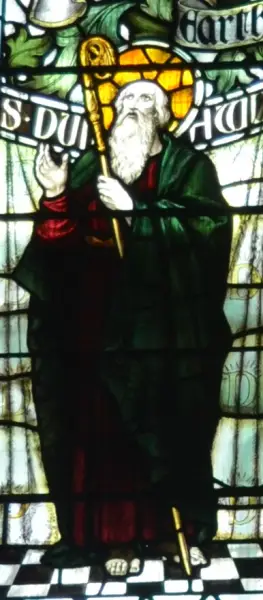
Overview
Dunod, whose name appears in the sources as Dinooth, Dinothus, and Dunawd, stands among the founding figures of Welsh monasticism as the first abbot of Bangor Iscoed, the great monastery on the River Dee in north-east Wales. Before his religious career he had been a chieftain among the Britons of the old North, driven south into Wales by the collapse of his fortunes, and he brought to monastic life the authority of a man who had commanded in the world. Married to Dwywai, daughter of Lleënog, he was the father of three sons, Deiniol, Cynwyl, and Gwarthan, who shared his dedication to the Church. Under the patronage of Cyngen Glodrydd, Prince of Powys, he and his sons established the monastery of Bangor on the Dee, which grew into one of the religious wonders of the age: the Triads record two thousand four hundred monks, who sang the divine office in relays of one hundred every hour, day and night, without interruption. Dunod is the only Welsh ecclesiastic whom Bede names in his Ecclesiastical History, in connection with the meeting between Augustine of Canterbury and the Welsh bishops around 602 or 603. His monastery was destroyed after the Battle of Chester, about the year 613.
The Complete Life
A Chieftain of the Old North
Before he was a monk, Dunod was a man of the sword and the council fire. The sources describe him as a chieftain of the North British, one of the lords of the old Brittonic kingdoms that survived beyond the Hadrian's Wall country after the Anglo-Saxon advance, and reverses of fortune drove him from those northern lands into Wales. He arrived, then, not as a landless wanderer but as a dispossessed noble, carrying the memory of a lost inheritance and the habits of command. He married Dwywai, daughter of Lleënog, and the marriage produced three sons, Deiniol, Cynwyl, and Gwarthan, all of whom would follow their father into the service of the Church; Deiniol himself is honoured as the first Bishop of Bangor in Gwynedd. Medieval genealogists sometimes identified this Dunod with Dunod Fawr ap Pabo Post Prydain, a Brythonic king who ruled somewhere in the north of Britain, but the chronology of the two men makes that identification unlikely, and modern scholars keep them apart. What matters is the shape of the life: a warrior aristocrat of the vanquished Britons, with a family and a reputation, redirected his whole household's energy from war to the building of the Church in a new country.
§ Early life
Founding Bangor on the Dee
In Wales Dunod found both a refuge and a vocation. Sustained by the favour of Cyngen Glodrydd, who ruled as Prince of Powys, he together with his sons established a monastery beside the waters of the Dee in the country's north-east, the house known to history as Bangor Iscoed. The foundation was no modest hermitage but one of the great religious centres of the Brittonic world, important through the fifth and sixth centuries. Its most famous feature was the laus perennis, the perpetual choir: following a practice known from the eastern Mediterranean, the community organized itself so that the divine praise never ceased. The Triads preserve the astonishing figures: two thousand four hundred monks at Bangor, divided into relays of one hundred, each group taking its hour in turn so that the singing of the divine service continued through every hour of the day and night, year upon year. Whether the numbers are exact matters less than the picture they preserve of a monastery of vast scale and rigorous discipline, staffed in part by the sons and followers of a displaced northern war band. The chieftain's talent for organization found its true field at Bangor, and the dispossessed lord of the North became the father of one of Wales's holiest places.
§ Religious life
The Abbot and Augustine
Dunod's name crossed into written history through a confrontation that shaped the future of British Christianity. When Augustine of Canterbury, the Roman missionary sent by Pope Gregory the Great, sought to bring the native British churches into alignment with Roman practice, a second meeting was arranged between him and the seven bishops of the Welsh, at a place Bede calls Augustine's Oak, perhaps Aust in Gloucestershire or Cressage in Shropshire, in 602 or 603. Bede records that Dunawd, as he names him, was still abbot of Bangor Iscoed at that time, and Dunod remains the only Welsh ecclesiastic whom Bede mentions by name in the Ecclesiastical History, a measure of the standing of his monastery. The historian George Cyprian Alston, writing in the Catholic Encyclopedia, doubted that Dunod attended in person: representatives of Bangor certainly appeared at the conference, yet by that date the abbot must have been very elderly, and the trek from north Wales to the lower Severn valley would have taxed an aged man severely. The meeting ended without agreement, the Welsh bishops declining Augustine's terms, and the abbey of Bangor stood at the head of that independent British tradition.
§ Religious life
Destruction, Survival, and Memory
The monastery Dunod founded outlived him only briefly in its original form. In about 613 the Anglo-Saxon king Æthelfrith of Northumbria defeated the Welsh at the Battle of Chester, and in the aftermath of that victory Bangor was destroyed; a number of its monks withdrew to Bardsey Island, the holy isle off the Llŷn Peninsula, carrying their tradition to a new refuge. The abbot's own memory proved more durable than the buildings. His feast is kept on 7 September, and he is venerated in the Church in Wales, the Roman Catholic Church, and the Eastern Orthodox Church. His chief monument in Bede's history secured his place as the one Welsh churchman the great historian of the English chose to name, an involuntary tribute to the greatness of Bangor Iscoed. His family continued his work, above all through his son Deiniol, first bishop of Bangor in Gwynedd, whose cathedral city keeps the father's achievement alive in the map of Wales. In the village of Bangor-on-Dee, beside the river where the perpetual choir once sang, the primary school bears his name in Welsh, Ysgol Sant Dunawd, so that children in the saint's own valley still learn and speak his memory daily.
§ Legacy
Timeline
- 602
Named by Bede as abbot of Bangor Iscoed at the time of Augustine of Canterbury's second meeting with the seven Welsh bishops, held in 602 or 603.
§ Religious life
- 613
The monastery of Bangor was destroyed by King Æthelfrith of Northumbria after his victory over the Welsh at the Battle of Chester.
§ Religious life
The Record
- Major works
- Monastery of Bangor on the River Dee (Bangor Iscoed)
- Canonization
- Pre-congregation
Prayer
Bibliography
Show 5 sources
- "CATHOLIC ENCYCLOPEDIA: St. Dinooth", www.newadvent.org, retrieved 9 April 2025.
- Emanuel, Hywel David. "Dunawd, saint (fl. 6th century)", Dictionary of Welsh Biography, National Library of Wales.
- Baring-Gould, Sabine; Fisher, John (1911). The Lives of the British Saints, Volume 2. London: The Honourable Society of the Cymmrodorion, p. 326.
- "Dunod Fwr ap Pabo Post Prydyn (500, d. 595)", A Classical Welsh Dictionary, p. 235.
- "Ysgol Sant Dunawd - Bangor-on-Dee, Wrexham", retrieved 9 April 2025.
Profile text adapted from the Wikipedia article, licensed CC BY-SA 4.0.
Pray with this saint every day
Save St. Dunod to your favorites, read the full profile, and get feast-day reminders in the Saints app.
Get the Saints AppFree on the App Store for iPhone and iPad