
c. 909 – 988·Feast May 19
St. Dunstan
Reforming Archbishop of Canterbury and royal counselor
Overview
Dunstan was an English Benedictine monk, metalworker, artist, and statesman who rose from a Somerset village to become Abbot of Glastonbury, Bishop of Worcester, Bishop of London, and finally Archbishop of Canterbury from 959 until his death in 988. Born around 909 near Glastonbury to Heorstan and Cynethryth, and related to several bishops, he was educated by Irish monks among the abbey ruins and became famous for learning and craftsmanship. Twice cast down by court intrigue — accused of witchcraft under King Æthelstan and exiled under King Eadwig — he each time returned to greater responsibility. As Abbot of Glastonbury he rebuilt the abbey and planted Benedictine monasticism at its heart; as archbishop, in partnership with King Edgar, he reformed the English Church, enforcing clerical celibacy, banning simony, and installing reforming bishops. His crowning act of statesmanship was Edgar's coronation at Bath in 973, the service from which the modern British coronation rite descends. Under Æthelred the Unready his influence waned and he retired to Canterbury to teach and pray. He died on 19 May 988 after announcing his death from the pulpit. Canonized in 1029, he was for nearly two centuries England's most popular saint.
The Complete Life
A Glastonbury Boyhood
Dunstan's origins are known through his earliest biographer, a member of his household known only as 'B', who records that his parents, Heorstan and Cynethryth, lived near Glastonbury. B says that Dunstan 'oritur' in the days of King Æthelstan, between 924 and 939; though long read as 'was born', the word probably means 'emerged', since another source has him ordained within Æthelstan's reign, which would be impossible for a man born after 924. A birth around 910 fits the evidence. He was connected to the episcopal aristocracy of Wessex: related to Bishop Ælfheah the Bald of Winchester and Bishop Cynesige of Lichfield, and, by the testimony of a later biographer, a nephew of Athelm, Archbishop of Canterbury. His earliest teachers were the Irish monks then dwelling among the ruins of Glastonbury Abbey, under whose schooling the boy dreamed of the abbey's restoration and survived a near-fatal childhood illness, and showed exceptional gifts for learning and artistic craftsmanship. Tonsured with his parents' consent, he received minor orders and served the ancient church of St Mary, before his kinsman Athelm summoned him to service and the court of King Æthelstan called him away.
§ Birth and relatives
Disgrace, Illness, and the Hermit's Cell
At court Dunstan quickly became a royal favorite, and the envy his success provoked nearly destroyed him. Plotters branded him a practitioner of sorcery and dark arts; the king commanded his departure from court, and as he went out, his enemies beat him, bound him, and flung him into a cesspool. Crawling free, he made his way to Winchester and the protection of his kinsman Bishop Ælfheah. The bishop pressed him to become a monk, but Dunstan doubted he had a vocation to celibacy. The answer, in the hagiography's own logic, came through his body: an eruption of swelling tumours, so severe it was thought to be leprosy and more probably blood poisoning from the beating, changed his mind. He took Holy Orders in 943 in Ælfheah's presence and returned to Glastonbury as a hermit, building against the old church of St Mary a cell barely five feet long and two and a half feet deep. There he studied, practiced his art, and played his harp — and there, according to a legend of the late eleventh century, the Devil came to tempt him and was caught fast by the face with Dunstan's red-hot tongs, the first of the many devil-stories that clung to his memory.
§ School to the king's court
Abbot of Glastonbury
Wealth and office found him in the hermit's cell. Lady Æthelflæd, the king's niece, left him a fortune, and his father's death brought another inheritance; both he devoted to the monastic revival. King Edmund made him a minister at Cheddar, and when court jealousy again drove him toward disgrace, the king's hair-breadth escape at the Cheddar cliffs — a stumble on the very edge, halted, it was said, by his promise to make amends to Dunstan — ended with Edmund installing him as Abbot of Glastonbury. The reform began at once. Dunstan re-created monastic life on the Rule of St Benedict, rebuilt the church of St Peter and the cloister, and restored the monastic enclosure, committing the house's business to his brother Wulfric so that the monks might never break enclosure. He founded a school for local youth that became the most famous in England, and extended the drainage of the Somerset Levels. Under Kings Edmund and Eadred his influence dominated government for nine years; he twice refused a bishopric, in 951 and 953, declaring he would not leave the king's side while the king needed him, and lent his weight to the policy of unifying the Danish and English halves of the realm.
§ Abbot of Glastonbury
The Craftsman Monk
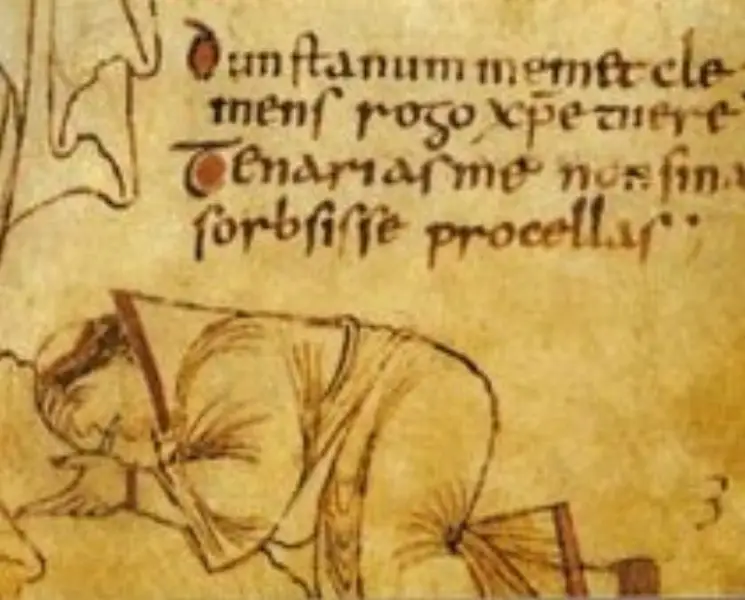
Dunstan's spirituality was worked with his hands. At Glastonbury he labored as a silversmith and in the scriptorium, and he won fame as a musician, illuminator, and metalworker — a combination that won the admiration of Osbern, the eleventh-century biographer, who painted and wrote himself and observed that Dunstan excelled in making pictures and forming letters, like other clergy of his age who rose to high rank. It is thought likely that his own hand drew the famous image in the Glastonbury Classbook of Christ with a small kneeling monk beside him, one of the earliest of the outline drawings that became a hallmark of Anglo-Saxon art; a drawing of Dunstan playing his harp while the Devil pays a visit preserves another, more mischievous, side of his reputation. The pattern of his inward life is visible in his choices: the hermit's cell beside St Mary's church, the fortune spent on monasteries rather than himself, the refusal of episcopal dignity to remain at his king's side, and, at the last, long hours of private prayer by day and night, constant attendance at Mass and the daily office, and pilgrimages to the shrines of St Augustine and St Æthelberht in his cathedral city. Contemplation and craft, prayer and government, were for him one seamless obedience.
§ Life as a monk
Canterbury and a Holy Death
The accession of Eadwig in 955 brought exile: the young king's feud with Dunstan — fabled to have begun when Dunstan dragged him from the company of Ælfgifu back to his own coronation feast — drove the bishop over the channel to the Abbey of Mont Blandin near Ghent, where he first saw the strict Benedictine observance reborn at Cluny. Recalled by King Edgar before the end of 957, he was made a bishop, holding Worcester and then London in plurality, and on Eadwig's death in 959 the archbishopric of Canterbury was his. He received the pallium in Rome in 960 and spent the next reign as the king's chief partner in reform. But after Edgar died in 975 and Edward the Martyr was murdered at Corfe in 978, Dunstan crowned the boy Æthelred with a prophetic warning — and retired to Canterbury to teach in the cathedral school. Only three public acts remain from those years: the translation of Edward's relics in 980, the appointment of Ælfheah to Winchester in 984, and the hundred pounds of silver that bought off the persecution of Rochester in 986. On Ascension Day 988 he preached three times, announced his death, chose his tomb, and died on Saturday 19 May after Mass and the last rites.
§ Final years (978–88)
England's Best-Loved Saint
The English people accepted Dunstan as a saint almost immediately after his burial in his own cathedral, and the Church made the acclaim official: he was formally canonized in 1029, and in that same year the Synod of Winchester ordered his feast to be kept solemnly throughout England. For nearly two centuries he remained the most popular saint in England, beloved not only as a reforming archbishop but as the cunning craftsman-saint whose tongs had seized the Devil by the face. Only when the cult of Thomas Becket exploded after 1170 did Dunstan's star begin to fade. His feast on 19 May is kept by the Catholic Church and the Eastern Orthodox Church, and he is honored in the Church of England and the Episcopal Church on the same day. His shrine at Canterbury was claimed as well by the monks of Glastonbury, who told how his body had been carried to their abbey for safety during the Danish sack of 1012; Archbishop William Warham settled the dispute in 1508 by opening the tomb and finding the relics still at Canterbury. In 2023 a pastoral area of the Catholic Diocese of Clifton was named in his honor, a quiet token of a cult a millennium old.
§ Final years (978–88)
Tongs, Horseshoes, and the Coronation Throne
Dunstan's deepest legacy lies in institutions. The Benedictine reform he seeded at Glastonbury, carried forward with Æthelwold and Oswald under Edgar, permanently changed the English Church, placing monks in the great cathedrals and binding clergy to celibacy, competence, and residence. The rite he composed for Edgar's crowning at Bath in 973 — its accompanying poem preserved in the Anglo-Saxon Chronicle — stands behind the ceremony with which Britain crowns its monarchs today, and the submission of six kings to Edgar at Chester marked the high-water mark of his statesmanship. After his death in 1180 his remains were moved to a new tomb beside the high altar on its southern side, a translation made necessary by the fire of 1174; the shrine itself was destroyed at the Reformation. Because he had worked as a silversmith making church plate, the goldsmiths and silversmiths of England took him as patron, and blacksmiths, locksmiths, musicians, and bellringers followed. Folklore kept him vivid: the rhyme of the red-hot tongs, pictured in a twelfth-century Canterbury manuscript and echoed by Dickens in A Christmas Carol; the horseshoe nailed to the Devil's hoof, origin of the lucky horseshoe over the door; and the 'Franklin Nights' late frosts said to be his bargain with the Devil over cider and beer. As Lord of Stepney he remains that parish's patron saint.
§ Legacy
Timeline
- 909
Born at Baltonsborough in Wessex, near Glastonbury, to Heorstan and Cynethryth, relatives of several bishops.
§ Birth and relatives
- 940
After King Æthelstan's death, the new king Edmund summoned Dunstan to Cheddar and made him a royal minister.
§ Life as a monk
- 943
Received Holy Orders from Bishop Ælfheah of Winchester, then returned to Glastonbury to live as a hermit.
§ School to the king's court
- 946
King Edmund was assassinated; under his successor Eadred, Dunstan's influence dominated the government for nine years.
§ Abbot of Glastonbury
- 951
Declined the bishopric of Winchester, and again the see of Crediton in 953, vowing to remain at the king's side.
§ Abbot of Glastonbury
- 952
Founded or rebuilt the church of Stepney, later rededicated in his honor after his canonisation.
§ An East London saint
- 955
On Eadred's death, clashed with the new king Eadwig and fled to the Abbey of Mont Blandin near Ghent.
§ Changes in fortune
- 957
Recalled by Edgar's advisers after the Mercians and Northumbrians drove out Eadwig; consecrated a bishop for Worcester.
§ Bishop and archbishop (957–978)
- Oct 959
Eadwig died in October, and King Edgar conferred the archbishopric of Canterbury on Dunstan.
§ Bishop and archbishop (957–978)
- 960
Traveled to Rome and received the pallium from Pope John XII.
§ Bishop and archbishop (957–978)
- 963
Æthelwold's appointment to Winchester completed the reforming episcopate with which Dunstan renewed the English Church.
§ Bishop and archbishop (957–978)
- 973
Officiated at King Edgar's imperial coronation at Bath, using a rite of his own devising that underlies the modern British coronation.
§ Bishop and archbishop (957–978)
- 975
After Edgar's death, secured the disputed succession of Edward the Martyr, who was crowned at Winchester.
§ Bishop and archbishop (957–978)
- 31 Mar 978
Following Edward's murder at Corfe, crowned Æthelred the Unready on Low Sunday with a solemn warning, then withdrew to Canterbury.
§ Final years (978–88)
- 980
Joined Ælfhere of Mercia in translating King Edward's relics from Wareham to a shrine at Shaftesbury Abbey.
§ Final years (978–88)
- 984
Persuaded King Æthelred to appoint Ælfheah Bishop of Winchester in succession to Æthelwold.
§ Final years (978–88)
- 986
Induced the king, by a donation of one hundred pounds of silver, to halt his persecution of the See of Rochester.
§ Final years (978–88)
- 19 May 988
Died at Canterbury on the Saturday after preaching three times on Ascension Day and announcing his approaching death.
§ Final years (978–88)
- 1029
Formally canonised; that year the Synod of Winchester ordered his feast kept solemnly throughout England.
§ Final years (978–88)
- 1180
Relics translated to a new tomb south of Canterbury's high altar during restoration after the fire of 1174.
§ Legacy
- 1508
Archbishop William Warham opened his tomb and found the relics still at Canterbury, refuting Glastonbury's claim.
§ Legacy
In Their Own Words
He hath made a remembrance of his wonderful works, being a merciful and gracious Lord: He hath given food to them that fear Him.
St Dunstan, as the story goes, Once pull'd the devil by the nose With red-hot tongs, which made him roar, That he was heard three miles or more.
The Record
- Major works
- Restoration of Benedictine monastic life at Glastonbury Abbey·Reform of the English Church under King Edgar·The coronation service of King Edgar (973), basis of the British coronation ceremony·Drawing of Christ with a kneeling monk in the Glastonbury Classbook (attributed)·Church bells, organs, and silversmith's church plate from his workshop·Foundation or rebuilding of Stepney's church (952)
- Patron of
- patron of blacksmiths·patron of goldsmiths·patron of silversmiths·patron of locksmiths·patron of musicians·patron of bellringers·patron of Charlottetown, Canada·patron of Stepney, London
- Symbols
- pair of smith's tongs·dove hovering near him·troop of angels before him
- Canonization
- Canonized in 1029; that year the Synod of Winchester ordered his feast to be kept solemnly throughout England.
Prayer
Bibliography
Show 8 sources
- Alexander, Jonathan J. G. (1992). Medieval Illuminators and Their Methods of Work. New Haven, CT: Yale University Press. ISBN 978-0-300-05689-1.
- Cross, F. L.; Livingstone, E. A., eds. (1997). The Oxford Dictionary of the Christian Church (3rd ed.). Oxford University Press.
- Lapidge, Michael (23 September 2004). "Dunstan [St Dunstan] (d. 988)". Oxford Dictionary of National Biography. Oxford University Press.
- Stenton, F. M. (1971). Anglo-Saxon England (Third ed.). Oxford: Oxford University Press. ISBN 978-0-19-280139-5.
- Toke, Leslie Alexander St. Lawrence (1909). "St. Dunstan". In Herbermann, Charles (ed.). Catholic Encyclopedia. Vol. 5. New York: Robert Appleton Company.
- Winterbottom, Michael; Lapidge, Michael (2011). The Early Lives of St Dunstan. Oxford: OUP. ISBN 978-0-19-960504-0.
- Roach, Levi (2013). Kingship and Consent in Anglo-Saxon England, 871–978. Cambridge: Cambridge University Press. ISBN 978-1-107-03653-6.
- Schama, Simon (2011). A History of Britain. Vol. 1: At the Edge of the World? 3000 BC-AD 1603. Random House. ISBN 978-1-4090-1824-7.
Profile text adapted from the Wikipedia article, licensed CC BY-SA 4.0.
Pray with this saint every day
Save St. Dunstan to your favorites, read the full profile, and get feast-day reminders in the Saints app.
Get the Saints AppFree on the App Store for iPhone and iPad