
1000 – 1065·Feast March 8
St. Duthac
Bishop of Ross and Patron of Tain
Overview
Duthac, remembered also as Duthus or Duthak, was a Scottish prelate of the eleventh century who served as Bishop of Ross and became one of the most beloved saints of medieval Scotland. According to the Aberdeen Breviary he was a native Scot, and tradition places his birth at Tain on the Dornoch Firth and his education in Ireland, a crossing that earned him the title Chief Confessor of Ireland and Scotland. He died in 1065, his passing recorded in the Annals of Ulster, and was buried at Tain, where his body was later found incorrupt. His shrine drew kings and commoners alike: James IV made repeated pilgrimages to it, and the family of Robert the Bruce sought shelter in his sanctuary. A chapel and sanctuary were established at Tain in the thirteenth century by Ferchar mac in tSagairt, first Earl of Ross, and served by the Norbertine canons of Fearn Abbey, while the collegiate church built to house his relics between 1370 and 1458 remained the focus of his cult until the relics vanished around the time of the Reformation in about 1560. His feast day is 8 March, and Tain still bears his name in Gaelic: Baile Dhubhthaich, the town of Duthac.
The Complete Life
A Son of Tain
Duthac was born, if tradition speaks truly, in the town whose destiny he would forever shape. The Aberdeen Breviary, the great collection of the lives of Scottish saints, calls him a native Scot, and the local memory of Tain has always claimed him as its own child, pointing to the spot where St Duthus's Chapel later stood as the place of his birth. For his formation he crossed the North Channel to Ireland, receiving his education there in the island whose monastic schools had schooled saints for centuries. That double inheritance, Scottish birth and Irish learning, explains the unusual title by which he was known in later devotion: the Chief Confessor of Ireland and Scotland, honoured in the Gaelic form Dubtach Albanach. In an age when the sea united rather than divided the Gaelic world, the boy from the Dornoch Firth followed a well-worn road of saints, and the honour paid to him on both shores shows how completely he belonged to both. From Ireland he returned to the land of his birth, taking up the service of the Church in Ross, the far northern province where his family and his people lived and where his name would become the most famous in the region.
§ Biography and legacy
Bishop of Ross
The summit of Duthac's earthly career was his service as Bishop of Ross, the diocese that embraced the northern lands around the Cromarty and Dornoch Firths in the eleventh century. Little record survives of his episcopal acts, a silence typical of the early Scottish Church, but the office itself tells the story: he was no obscure hermit but the chief pastor of a wide and demanding province, responsible for the faith of a people living at the edge of the Christian world. As bishop he must have travelled constantly among the glens and coastal settlements of Ross, sustaining churches and clergy in a landscape where authority was exercised through personal presence. The holiness of his life attracted such veneration that after his death he was regarded as the great confessor, the saintly teacher of the faith, of both Ireland and Scotland, and the church at Tain was raised in his honour by his own townspeople. He died in 1065, and the annalists of Ulster, recording the deaths of the notable men of the Gaelic world, judged his passing worth their ink. He was buried at Tain, and there, in the ground of his birthplace, the story of his relics began.
§ Biography and legacy
Death and Incorrupt Relics
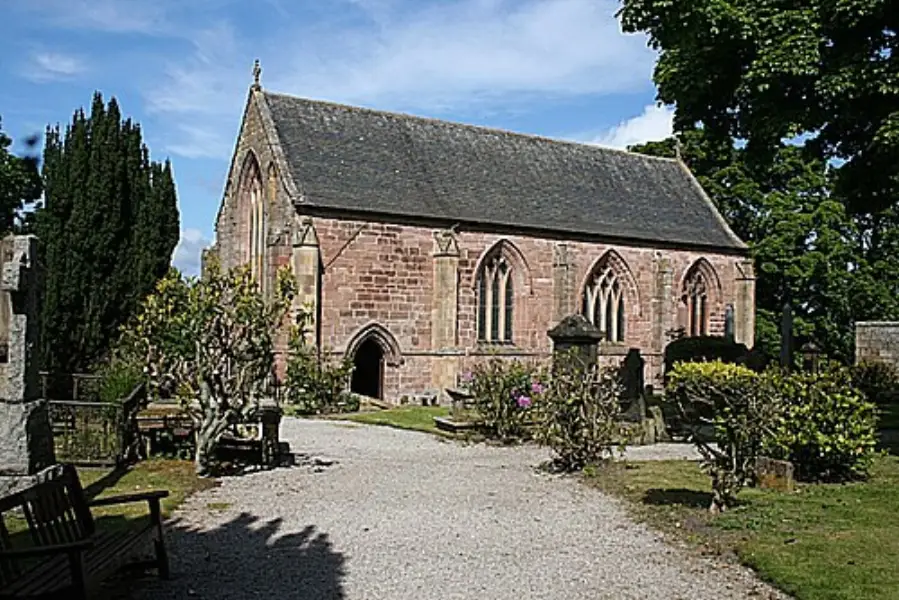
Duthac ended his days where he had begun them, at Tain, dying in the year 1065 as the Annals of Ulster record. The town buried its bishop and its saint together, and around his grave gathered the devotions of the northern Gaelic world. In the course of time, when his tomb was opened, his body was found to be incorrupt, a sign that medieval piety read as the seal of heaven on a life of purity. His remains were afterwards translated with honour to the shrine of St Duthus Collegiate Church, the great church at Tain whose construction ran from 1370 to 1458 and which stood as the centre of his cult for the last centuries of Catholic Scotland. There the relics remained until the upheaval of the Reformation, when around the year 1560 they disappeared, and the shrine of the Chief Confessor fell silent. The church itself still stands in ruin at Tain, at the heart of the old burial ground on the shore of the Dornoch Firth, and the chapel believed to mark his birthplace nearby keeps the geography of his life visible to any pilgrim who walks the town's quiet streets today.
§ Biography and legacy
The Pilgrim Kings and St Duthac's Way
Few Scottish saints drew such exalted pilgrims as Duthac. King James IV, the most devout pilgrim ever to wear the crown of Scots, visited his shrine on many occasions, and Robert the Bruce and his family honoured the saint of Tain in their devotions; indeed Bruce's wife, daughter, and sisters took shelter within the sanctuary of Tain when they fled, until English partisans violated the holy place and seized them. The sanctuary itself owed its existence to Ferchar mac in tSagairt, first Earl of Ross, who founded chapel and sanctuary at Tain in the thirteenth century and placed them in the care of the Norbertine canons of Fearn Abbey. The land keeps his name in a hundred forms: Tain is Baile Dhubhthaich, Duthac's town, in Gaelic, and Kilduthie, Arduthie near Stonehaven, and Kilduich on Loch Duich all carry the memory of the saint across Scotland; St Duthac's Cairn stands near the town, though the biennial fairs held under his name have ceased. A modern pilgrimage route, St Duthac's Way, runs from Tain to Aberdeen and onward to St Andrews, threading past Dunnottar Castle, Arbroath Abbey, and the Tay, restoring on foot the devotion that once moved kings. Catholics, Anglicans, and Orthodox all keep his feast on 8 March.
§ Veneration
Timeline
- 1000
Born, according to tradition, at Tain in Ross; educated in Ireland.
§ Biography and legacy
- 1065
Died at Tain; his death is recorded for this year in the Annals of Ulster.
§ Biography and legacy
- 1370
Construction of St Duthus Collegiate Church at Tain, built to enshrine his relics, began.
§ Biography and legacy
- 1458
St Duthus Collegiate Church, the shrine church of his translated relics, was completed.
§ Biography and legacy
- 1560
His relics disappeared from the shrine at Tain around the time of the Reformation.
§ Biography and legacy
The Record
- Patron of
- Tain, Scotland
- Canonization
- Pre-congregation; venerated as the Chief Confessor of Ireland and Scotland
Prayer
Bibliography
Show 5 sources
- Turpie, Tom. "The many lives of St Duthac of Tain", Northern Studies, vol. 44.
- Dieghi, Franco. "San Duthac di Ross", Santi e Beato.
- "St. Duthus's Chapel", Easter Ross Peninsula.
- "St Duthus's Chapel, Tain (SM3753)", portal.historicenvironment.scot, 14 September 2016.
- Boyle, Alexander, "Notes on Scottish Saints", The Innes Review, Spring 1981, pp. 66-7.
Profile text adapted from the Wikipedia article, licensed CC BY-SA 4.0.
Pray with this saint every day
Save St. Duthac to your favorites, read the full profile, and get feast-day reminders in the Saints app.
Get the Saints AppFree on the App Store for iPhone and iPad