
fl. 5th century; died c. 460·Feast January 25
St. Dwynwen
Welsh patron saint of lovers of Anglesey
Overview
Dwynwen, sometimes called Dwyn or Donwen, is the Welsh patron saint of lovers, celebrated throughout Wales on 25 January. A daughter of the fifth-century King Brychan Brycheiniog — her mother may have been Rigrawst — she is remembered chiefly through a legend retold in many versions: loved by a young man named Maelon Dafodrill but unable to marry him, she prayed to fall out of love. An angel appeared with a potion that turned Maelon to ice, and God granted her three requests — that Maelon be freed, that true lovers be watched over through her intercession, and that she herself remain unmarried. In gratitude she withdrew to the tidal island of Ynys Llanddwyn off Anglesey, where she lived as a hermit until her death around 460, founding the church of Llanddwyn whose ruins still stand. Tradition credits her with knowledge of healing herbs and with curing sufferers from across Wales. Her church became a major medieval pilgrimage shrine, its holy well consulted by anxious lovers. Suppressed at the Reformation and long abandoned to drifting sands, her cult revived in modern times, and Dydd Santes Dwynwen has become a Welsh answer to Valentine's Day.
The Complete Life
A King's Daughter and a Frozen Suitor
Dwynwen's story reaches back to the age of the Celtic saints, when she is said to have flourished in the fifth century as one of the many children of King Brychan Brycheiniog, the legendary father of a whole generation of Welsh saints; her mother may have been Rigrawst. The tale that made her famous survives in several versions, the original having been woven together with folklore and Celtic story. In the best-known telling, a young man named Maelon Dafodrill fell in love with her, but she rejected him; in another, she loved him in return but could not marry him because her father had already promised her to another. Distraught, Dwynwen prayed to be delivered from her own love. An angel appeared bearing a potion: when it was given, Maelon turned to ice. God then granted her three requests in answer to her prayer — that Maelon be released from his frozen fate, that God watch over all true lovers through her intercession, and that she herself remain unmarried. Thus a thwarted romance became the seed of a national patronage of love, and a disappointed princess became the confidante of every Welsh heart.
§ History and legend
The Retreat to Llanddwyn
In thanksgiving for the three-fold answer to her prayer, Dwynwen abandoned court life altogether. Some texts say she fled out of fear of Maelgwn Gwynedd, the powerful king of Gwynedd; all agree that she chose solitude. Her retreat was Ynys Llanddwyn, a small tidal island off the southwest coast of Anglesey near Newborough, reachable on foot only when the tide allowed. There she built her life as a hermit and there, in time, she established a church that took her name — Llanddwyn, the Church of Dwynwen — whose ruins remain visible on the island today. Tradition also gives her the arts of a healer: she studied the properties of local herbs and cured the ailments of those who sought her out from every part of Wales, so that the island became a place of hope for the sick as well as a refuge for the saint. The combination was characteristic of the Celtic monastic world: a woman alone at the edge of the sea, tending a church, a garden of simples, and an open door for sufferers. From that resolve to live unmarried and devoted, her cult as a saint grew.
§ Ynys Llanddwyn
Healer and Guardian of Lovers
Dwynwen's mission, as tradition tells it, operated on two fronts: the body and the heart. To the sick she offered the fruit of her study of herbal medicine, curing ailments brought to her by pilgrims from across Wales. To lovers she offered something subtler — an intercession she had won, according to the legend, at the price of her own renunciation, when God agreed to watch over all true love through her prayers. After her death both ministries continued at her shrine. The holy well on Ynys Llanddwyn, associated with the saint, became a site of pilgrimage where the fortunes of lovers could be read: the movements of sacred fish in its waters were taken to forecast whether a couple's love would prosper. Medieval pilgrims crossed the tidal sands to consult the well and honor the saint, and the Welsh poets Dafydd ap Gwilym and Dafydd Trefor both recorded her popularity by writing of the pilgrimages to Llanddwyn. Beside lovers, the sick and the owners of ailing animals kept her memory, for she came to be considered a patron of sick animals as well as of the heartsick.
§ History and legend
Solitude, Prayer, and the Three Requests
The legend of Dwynwen is, at bottom, a story about the conversion of desire. Her three requests map a whole spirituality: release for the one who had hurt her, protection for all who love, and freedom for herself. She asked nothing for her own happiness except the liberty to remain unmarried to God, and it was precisely that renunciation that made her fruitful for others. The shape of her life afterward — a hermit's solitude on a tidal island, a church raised by her own founding, a garden of healing herbs, long hours of intercession — made her one of the classic figures of Celtic consecrated virginity in Wales. Her shrine continued the teaching in symbolic form: lovers came not to grasp at love but to test it, watching the sacred fish of the holy well as one watches conscience, willing to read in the water's mystery a verdict on their own intentions. The Church honored her with the title of virgin, and Orthodox tradition keeps her among the venerable women of the Celtic Church. Modern Wales has found in her a saint of tenderness rather than sentiment — one who knew that love, to be blessed, must be surrendered first.
§ History and legend
Death on the Island
Dwynwen's life closed where it had been spent, in the solitude of Ynys Llanddwyn, around the year 460. The island that had received her as a fugitive from court kept her as its saint, and her grave and church made it holy ground. Her memory might have remained entirely local, as that of many Celtic saints did, but the church she founded grew into one of the principal shrines of medieval Wales, drawing pilgrims across the sands for a thousand years. Even after the Reformation extinguished the pilgrimage and the drifting sands buried the church in disrepair, ordinary people kept coming: when the crowds turned instead to nearby Saint Elian's Well, some still honored Dwynwen at her ruined church on the island. In the Eastern Orthodox Church she is venerated to this day, with a commemoration on 7 February under the Julian reckoning of 25 January. The ruin of her church, the two crosses raised in her honor, and the tides that still cut the island off from Anglesey each day preserve the outline of the life she chose: a king's daughter who asked to be nobody, and became the beloved saint of a nation's lovers.
§ History and legend
An Ancient Cult and Its Calendars
Dwynwen belongs to the native Celtic saints honored by custom long before any formal process existed, and her cult's antiquity is documented: her feast appears on 25 January in calendars reaching back to the 1400s, and the church on her island had grown, across the medieval centuries, into a shrine of the first importance. The seventeenth-century hagiographer Nicolas Roscarrok complicated the picture by placing "St Dwin" on 13 July and arguing that Dwin and Dwynwen were simply two forms of one saint's name; under 25 January his records instead commemorate "Dwinwent" or "Damwent". In the modern Church her status is unofficial: she is absent from the Roman Martyrology as revised in 2004, from the official Catholic calendar for Wales, and from the Church in Wales calendar as it stood after its 1995 revision. Yet she is not forgotten liturgically. Orthodox communities in places keep her memory, Eastern Orthodox and certain traditional Catholic liturgical websites carry her listing, and the Holy Trinity Russian Orthodox Church calendar honors her on 7 February, corresponding to 25 January. Whatever the calendars decide, the devotion of Welsh lovers has proved the sturdiest canonization of all, renewing itself each January for six centuries.
§ Dydd Santes Dwynwen
Dydd Santes Dwynwen and the Rediscovered Island
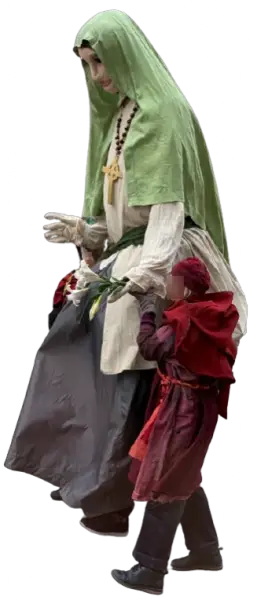
Dwynwen's modern afterlife is one of the happiest revivals in Welsh cultural life. After the Reformation silenced her shrine, the Oxford Movement of the late nineteenth century brought renewed Anglican attention to the site, and two crosses rose on the island — a plain fourteen-foot cross around 1879 and the Hon. F. G. Wynn's Celtic cross of 1903. In the 1960s a Bangor University student, Vera Williams, designed Welsh "Valentine's" cards to revive St Dwynwen's Day; local press and businesses embraced the idea, until by 2004 the January feast had taken firm root in the Welsh calendar, promoted even by Gwynedd Council itself. In 2003 the Welsh Language Board partnered with Tesco to give away 50,000 cards, one hiding a prize-marked heart, and urged celebrations from love-themed gigs to love poetry in pubs, with traditional lovespoon-carving demonstrations joining the festivities. Concerts, parties, and cards now mark a feast that, though still overshadowed by Valentine's Day, keeps spreading. Her name endures in the landscape — Ynys Llanddwyn, Porthddwyn on Anglesey, and the Cornish church of "Sen Adhwynn" at Advent — and in music, from Joseph Parry's 1896 Eisteddfod chorus to the giant puppet that parades through Aberystwyth each year.
§ Present day
Timeline
- 460
Died as a hermit on Ynys Llanddwyn, the tidal island off Anglesey where she had founded her church.
§ History and legend
- 25 Jan 1400
Fifteenth-century calendars and later assign her feast to 25 January, later adopted as the Welsh lovers' festival.
§ Dydd Santes Dwynwen
- 1879
A plain cross roughly fourteen feet high was raised on Ynys Llanddwyn in Queen Victoria's sixtieth year to commemorate her.
§ Veneration
- 1896
Joseph Parry's music for the chorus "Dwynwen", with words by Benjamin Williams, featured at the Llandudno National Eisteddfod.
§ Legacy
- 1903
F. G. Wynn of Glynllivon, heir to the Newborough barony, raised a grander Celtic cross on the island in her honor.
§ Veneration
- 1960
During the 1960s, Bangor student Vera Williams designed Welsh "Valentine's" cards that revived St Dwynwen's Day.
§ Present day
- 2003
The Welsh Language Board partnered with Tesco to give away 50,000 St Dwynwen's Day cards across Wales.
§ Present day
- 2004
The January festival honoring Wales's patron of love was by now a fixture of the calendar, championed even by Gwynedd Council.
§ Present day
The Record
- Major works
- St Dwynwen's Church (Llanddwyn) on Ynys Llanddwyn, Anglesey
- Patron of
- patroness of lovers in Wales·patroness of sick animals
- Canonization
- Pre-congregation; venerated in Wales since the early medieval period, though not listed in the 2004 Roman Martyrology or the Church in Wales calendar.
Prayer
Bibliography
Show 7 sources
- Farmer, David. "Dwyn", The Oxford Dictionary of Saints (5 rev. ed.). Oxford University Press, 2011. ISBN 9780199596607.
- Price, Thomas (1848). Iolo Manuscripts: A Selection of Ancient Welsh Manuscripts. W. Rees; sold by Longman and Company, London. p. 474.
- Farmer, D. H. (1978). The Oxford Dictionary of Saints. Oxford: Clarendon Press.
- Stevens, Catrin. Santes Dwynwen / Saint Dwynwen. Gomer Press, 2005.
- Owen, Hugh. "Llanddwyn Island". Transactions of the Anglesey Antiquarian Society and Field Club, also citing Llanstephan MS 117.
- Davies, John; Jenkins, Nigel (2008). The Welsh Academy Encyclopaedia of Wales. Cardiff: University of Wales Press. p. 228. ISBN 978-0-7083-1953-6.
- Martyrologium Romanum, 2004, Vatican Press (Typis Vaticanis).
Profile text adapted from the Wikipedia article, licensed CC BY-SA 4.0.
Pray with this saint every day
Save St. Dwynwen to your favorites, read the full profile, and get feast-day reminders in the Saints app.
Get the Saints AppFree on the App Store for iPhone and iPad