
7th century·Feast May 30
St. Dymphna
Virgin Martyr and Patron of Mental Health
Overview
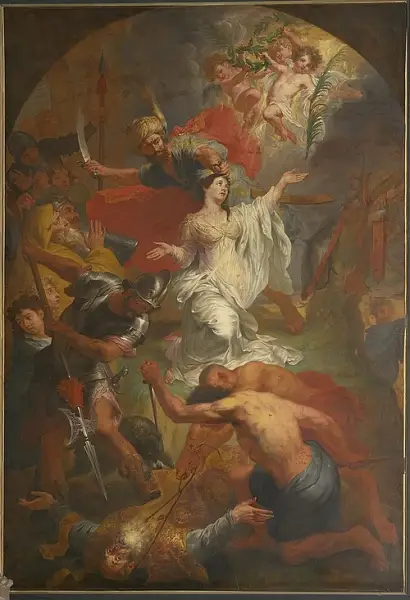
Dymphna, whose Irish name Damhnait means little poetess, is honoured in Catholic and Orthodox tradition as a virgin martyr of the seventh century, put to death by her own father. Her mother, the devout Christian wife of Damon, a petty king of Oriel, died while Dymphna was in her teens, and the king's grief unraveled his mind. Advised to remarry, he could find no woman who matched his lost wife, and his gaze fell on his own daughter, who so closely resembled her mother. Consecrated to Christ by a vow of chastity, Dymphna fled the court with her confessor Father Gerebernus, two servants, and the king's fool, and crossed the sea to Geel in what is now Belgium. There, tradition says, she used her wealth to build a hospice for the poor and sick, until coins from her purse betrayed her hiding place. Damon came in person, killed Gerebernus when his agents would not act, and when his daughter refused to return with him, drew his sword and struck off her head. She was fifteen. The people of Geel buried the martyrs in a cave, and the town that received her body developed a five-century-old tradition of community care for the mentally ill that continues to be studied and admired throughout the world.
The Complete Life
A King's Daughter in Ireland
Ireland in the seventh century saw the birth of Dymphna, child of Damon, a petty king of Oriel, and of a mother whose devout Christianity marked the household. The child bore a name rich in meaning: formed from the Irish damh, meaning poet, with the feminine ending, it signifies poetess, and its Gaelic form Damhnait survives in the variants Damnat and Davnet under which she is also invoked. From her mother she received the faith that would define her, and she grew up amid the comforts and dangers of a royal court, Christian in a land where kings still negotiated between the old religion and the new. The ancient sources for her life are late, for the story of Dymphna was first set down in the thirteenth century by a canon of the Church of Aubert of Avranches at Cambrai, writing at the commission of Guiard, Bishop of Cambrai, some six hundred years after her death. Hagiographers therefore caution that her tale reaches us through generations of retelling. Yet its details carry the texture of lived experience: the beauty she inherited from her mother, the vow taken in adolescence, and the household of servants and fools that surrounded a petty king's only daughter in early medieval Ireland.
§ Story of her life and death
The Vow of Chastity
At fourteen years of age Dymphna made the decision that set her against her own family: she consecrated herself to Christ and bound herself by a vow of chastity, renouncing the marriage that a king's daughter would ordinarily be expected to accept. Her consecration was scarcely made when calamity struck the court, for her mother died. The king had loved his wife with a deep and singular attachment, and her death shattered his reason; his mental health deteriorated sharply in the aftermath, and the court watched a sovereign sink into disturbance. His counsellors pressed him to take another wife, and at last he consented, but on one inexorable condition: the new queen must be as beautiful as the woman she was to replace. Messengers searched and found no one who answered the standard. Slowly the king's disordered affection fixed on the person who most resembled his dead wife, his own daughter, whose face carried her mother's features. Whatever Dymphna knew of her father's intent, she knew that marriage to him was impossible and that her vow stood in the way of a court that had ceased to be governed by reason. She prepared to lose everything rather than lose her consecration.
§ Story of her life and death
Flight and Hospice at Geel
To escape her father's design, Dymphna fled the court in the company of her confessor, Father Gerebernus, two trusted servants, and the king's fool. The little band sailed from Ireland toward the Continent and came ashore in the region that is now Belgium, settling at Geel, a town in the Campine country where they believed the king's arm could not reach. There the fugitive princess did not hide in idleness: tradition relates that she built a hospice for the poor and the sick of the district, spending her own wealth on the care of strangers. That charity, however, became her betrayal, for some of the coins she spent made their way back through trade and enabled her father's agents to trace them to Belgium. When Damon learned where his daughter had gone, he sent men to seize her and then came in person to Geel to bring her home. His servants, confronted with the holy priest and the girl who refused her father, killed Gerebernus; the soldiers sent against Dymphna could not bring themselves to strike her. Enraged at their refusal, the king drew his own sword and beheaded his daughter where she stood. She was fifteen years old, a virgin martyr killed by the hand that should have protected her.
§ Story of her life and death
Burial and Translation
After the double murder at Geel, the townspeople took the bodies of Dymphna and Gerebernus and buried them together in a cave nearby, honouring as martyrs the priest and the princess who had died within moments of each other. Years later the people of the town judged that the remains deserved a worthier resting place and moved them to a more suitable site. The remains of Dymphna were eventually placed in a silver reliquary and kept in the church at Geel that bears her name, raised on the ground where her body was first believed to lie, while the relics of Gerebernus were translated to Xanten in Germany. Her beheading, the sources agree, took place on 30 May, though the year of her death cannot be fixed; her remains were moved on 15 May in a subsequent year, and the anniversary of that translation stood for centuries as her principal feast. In the twenty-first century the post-conciliar Roman Martyrology returned her celebration to 30 May, the anniversary of her martyrdom, as the 2004 edition records for the virgin and martyr at Geel in Brabant. The church at Geel still stands, and her cult has never been interrupted since the day the townspeople carried her to the cave.
§ Veneration
The Mercy of Geel
The strangest and most beautiful fruit of Dymphna's martyrdom grew in the town that received her body. In 1349 a church was raised in her honour at Geel, and by 1480 so many pilgrims were arriving from every corner of Europe to seek help for psychiatric disorders at her shrine that the town's lodging for them had to be enlarged. When the sanctuary itself overflowed, the people of Geel did what no institution had done: they took the afflicted into their own homes. From that practical mercy grew a tradition of care that has endured for more than five hundred years. Those who come to Geel are not called patients but boarders, treated as members of the host family, working at ordinary tasks and sharing the life of the household; some stay months, some decades, some a lifetime. At the practice's height in the 1930s more than four thousand boarders lived among the town's families, and sociologists and psychiatrists still study Geel as a model of community care. Art has kept her memory too: Goossen van der Weyden painted her altarpiece in 1505, restored and exhibited at Geel in 2022, and Harry Clarke's stained glass shows her robed and crowned, the Lily of Eire with the sword of her martyrdom, trampling the demon at her feet.
§ Veneration
Patroness of the Mentally Ill
Dymphna's recognition as a saint belongs to the earliest and most organic stratum of the Church's honouring of martyrs; tradition assigns her canonization to the year 620, and she is venerated today by Catholics and Orthodox alike. Her cult, centred on Geel, made her the patron saint of mental illness and of those who suffer disorders of the mind, together with the professionals who treat them, a patronage that flows directly from her father's madness and from the healing tradition of the town that keeps her relics. The devotion crossed the ocean: the US National Shrine of St. Dymphna stands within St. Mary's Catholic Church at Massillon, Ohio, and though fire destroyed it in 2015, it was rebuilt and reopened in December 2016, still receiving pilgrims. In Ireland her name is attached to St. Dymphna's Special School at Ballina in County Mayo, which operates under the patronage of the Western Care Association. Artists have shown her crowned and robed in ermine, holding the sword of her beheading, or with a lamp in her hand and a chained devil at her feet, the demon-slayer of the old iconography; modern holy cards dress her in green and white with a book and white lilies, emblems of the wisdom and purity that suffering could not take from her.
§ Patronage
Timeline
- 620
Canonized according to the traditional date recorded for her recognition as a saint.
§ Veneration
- 1349
A church honouring Dymphna was built at Geel on the site of her burial.
§ Veneration
- 1480
Pilgrim lodgings at Geel were expanded as sufferers of psychiatric disorders came from across Europe.
§ Story of her life and death
- 2015
The US National Shrine of St. Dymphna in Massillon, Ohio, was destroyed by fire.
§ Patronage
- Dec 2016
The rebuilt National Shrine of St. Dymphna at Massillon reopened to pilgrims and visitors.
§ Patronage
- 2022
St Dymphna's Church at Geel exhibited the restored altarpiece by Goossen Van der Weyden in her honour.
§ Veneration
The Record
- Major works
- Hospice for the poor and sick at Geel
- Patron of
- mental health professionals·those suffering from mental illnesses
- Symbols
- lamp·sword·lilies·crown, ermine, and royal robes
- Canonization
- Canonized in 620, according to tradition
Prayer
Bibliography
Show 5 sources
- Surius, Laurentius (1579). De Probatis Sanctorum Historiis, Tomus Tertius, Complectens Sanctos Mensium Maii et Iunii. Cologne: Gerwin Calenius & the Quentel heirs, p. 347.
- O'Hanlon, John (1875). Lives of the Irish Saints. Vol. 5. Dublin: James Duffy and Sons, p. 362.
- Gammack, Rev. James (1877). "Dimpna (Dympna)". In Smith, William; Wace, Henry (eds.). A Dictionary of Christian Biography, Literature, Sects and Doctrines. Volume I: A-D, p. 832.
- Martyrologium Romanum, 2nd ed. Vatican City: Libreria Editrice Vaticana, 2004, p. 311.
- Kirsch, Johann Peter. "St. Dymphna." The Catholic Encyclopedia, Vol. 5. New York: Robert Appleton Company, 1909.
Profile text adapted from the Wikipedia article, licensed CC BY-SA 4.0.
Pray with this saint every day
Save St. Dymphna to your favorites, read the full profile, and get feast-day reminders in the Saints app.
Get the Saints AppFree on the App Store for iPhone and iPad