
died c. 650·Feast July 18
St. Eadburh of Bicester
Seventh-century Mercian abbess and foundress of Aylesbury
Overview
Eadburh of Bicester — also rendered Eadburth or Edburg — was an English nun and abbess of the seventh century whose outline remains elusive. Medieval writers could not even agree on her father: one tradition makes him Penda, the pagan king of the Mercians, whose household nevertheless produced Christian children, while another names a King Frithewald. She was born at Quarrendon, a Buckinghamshire village long since deserted. With her sister Edith, or Eadith, she established a religious house near Aylesbury and probably governed it as abbess, and she trained her niece Osgyth in the religious life. Legend tells how the two sisters found Osgyth three days after she had drowned and witnessed her return to life. Eadburh may also have lived at Adderbury, about thirty miles from Aylesbury, a place whose name possibly preserves her own. She died around 650, and where she was buried no record survives. In 850 a simple Saxon church was raised at Bicester, and in 1182 her relics were translated there when Augustinian canons founded a priory dedicated to her and the Virgin Mary. Pilgrims frequented her shrine and holy well until the Reformation, when in 1536 Sir Simon Harcourt destroyed the priory church but rescued her shrine and installed it at Stanton Harcourt. A late-1940s attempt to return it to Bicester failed. Her feast is kept on 18 July.
The Complete Life
A Daughter of Mercian Kings
The parentage of Eadburh is one of the unsettled questions of Anglo-Saxon hagiology. Different authorities give her different fathers: one tradition makes her a daughter of Penda, the pagan king of the Mercians, a ruler remarkable for fathering Christian children despite his own adherence to the old gods; another names a King Frithewald. Because several Saxon saints carried the same name, identifying which of them was the woman honored at Bicester has proved so difficult that one modern historian has called her "a bit of a mystery." Her mother's name is nowhere recorded. What the sources agree on is her birthplace: she was born at Quarrendon, a settlement in Buckinghamshire that has since vanished from the map. Her sister Edith, also called Eadith, shared her religious commitment, and the bond between the two women would shape the church of their region. Through her family Eadburh was also connected to Osgyth, another celebrated Mercian saint, who was her niece and in time her pupil. Into this world of royal power and rival faiths was born a woman who would choose the cloister over the court, and whose choice would give the town of Bicester its patron.
§ Eadburh of Bicester
Abbess at Aylesbury
Eadburh's religious career unfolded near Aylesbury, where she and her sister Edith founded an abbey. The sources indicate that Eadburh probably became its abbess, governing the community that their shared vocation had brought into being. Her influence reached into the next generation: her niece Osgyth was entrusted to her, and Eadburh trained the girl in the religious life, making her in effect the spiritual mother of one of Mercia's best-remembered saints. Local legend preserved the two sisters together in a scene of astonishing drama. Osgyth, having drowned, was found by Eadburh and Edith three days afterward, and the sisters were said to have witnessed her return to life. Whatever historical kernel the story contains, it testifies to the standing the two foundresses enjoyed in popular memory and to the way their identities became intertwined in the devotion of the region. Eadburh may also have lived for a time at Adderbury in Oxfordshire, roughly thirty miles from Aylesbury; the place-name itself has been thought to carry a memory of her presence. There she passed her final days, and there or nearby she died about the year 650, a nun and abbess whose grave no record now identifies.
§ Eadburh of Bicester
The Shrine That Survived
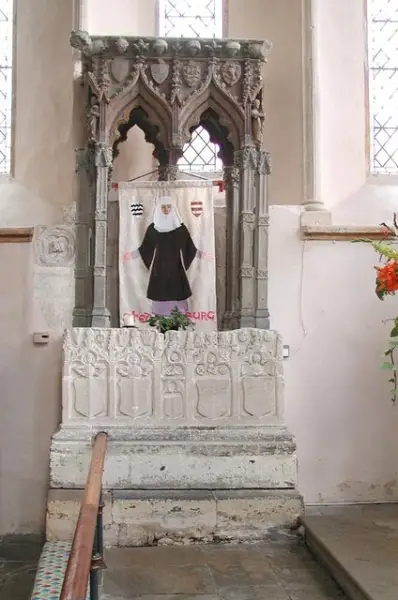
Eadburh's cult took visible shape centuries after her death. In 850 a simple Saxon church was raised at Bicester, and in 1182, when a company of Canons Regular founded an Augustinian priory in the town, they dedicated it to Saint Eadburh and to the Virgin Mary and translated her relics into their church. Her shrine and holy well drew streams of pilgrims through the Middle Ages. The Reformation brought this tradition to a violent end: in 1536 Sir Simon Harcourt, sheriff of Oxford, destroyed the Bicester Priory church. Yet he spared the saint's shrine, removing it to Saint Michael's Church at Stanton Harcourt so that it could serve as an Easter sepulture, while other fragments were worked into a tomb in the Harcourt chapel. The stone monument thus survives, salvaged from ruin, in a village church far from the town that built it. In the late 1940s an effort was made to carry it back to Bicester, but the project came to nothing. Veneration endures in the Orthodox, Catholic, and Anglican traditions, and her feast is kept on 18 July — the quiet tribute of the church to the abbess whose history is shadowy but whose memory refused to die.
§ Eadburh of Bicester
Timeline
- 650
Died around 650, remembered as a nun and probable abbess at Aylesbury; her burial place is unknown.
§ Introduction
- 850
A simple Saxon church was built at Bicester, anchoring her memory in the town.
§ Introduction
- 1182
Her relics were translated to Bicester, where Augustinian canons founded a priory dedicated to her and the Virgin Mary.
§ Introduction
- 1536
During the Reformation, Sir Simon Harcourt demolished the priory church but moved her shrine to St Michael's, Stanton Harcourt.
§ Introduction
- 1948
An attempt in the late 1940s to return her shrine from Stanton Harcourt to Bicester proved unsuccessful.
§ Introduction
The Record
- Major works
- Co-foundress of the abbey near Aylesbury
- Canonization
- Pre-congregation; venerated from earliest times by the Orthodox, Catholic, and Anglican traditions
Prayer
Bibliography
Show 6 sources
- Hathaway, Matthew. "Saint Edburg". St Edburg's History. Retrieved 25 November 2020.
- Farmer, David (2011). The Oxford Dictionary of Saints. Oxford, England: Oxford University Press. p. 134. ISBN 978-0191036736.
- Williams, T., "Origins and First Growth of Christianity in Bucks", Records of Buckinghamshire, Vol. 7, J. Pickburn, 1897, p. 358.
- Monks of Ramsgate. "Edburga". Book of Saints 1921. CatholicSaints.Info. 21 November 2012.
- Crook, John (2011). English Medieval Shrines. Woodbridge, Suffolk: Boydell Press. p. 263. ISBN 978-1-84383-682-7.
- "St Edburg's Church". Bicester Local History Society. Retrieved 28 November 2020.
Profile text adapted from the Wikipedia article, licensed CC BY-SA 4.0.
Pray with this saint every day
Save St. Eadburh of Bicester to your favorites, read the full profile, and get feast-day reminders in the Saints app.
Get the Saints AppFree on the App Store for iPhone and iPad