
654 – 721·Feast June 4
St. Eadfrith of Lindisfarne
Bishop-scribe of the Lindisfarne Gospels
Overview
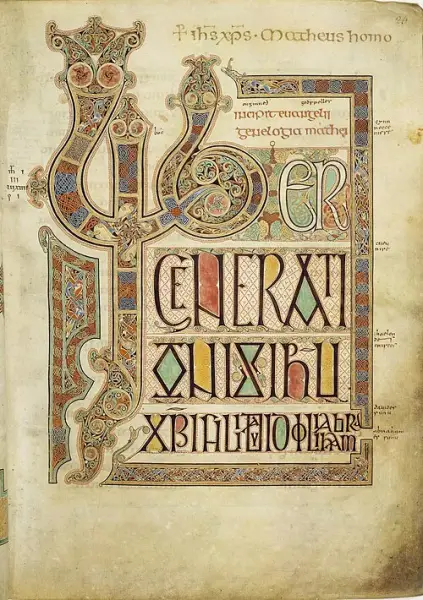
Eadfrith of Lindisfarne, also known as Saint Eadfrith, was Bishop of Lindisfarne from about 698 until his death in 721, shepherding the island monastery that held the graves of Saints Aidan and Cuthbert and stood among the chief religious centers of the Northumbrian kingdom. Tradition, recorded in a tenth-century colophon to the Lindisfarne Gospels, names him as the scribe and artist of that masterpiece — an illuminated rendering of the four Gospels produced, extraordinary to say, by a single hand laboring full-time for roughly two years. Most historians who accept the attribution date the work to the years just before or during his episcopate; Michelle Brown argues he made it as a hermit-like act of devotion in the Columban tradition between 715 and 722. Eadfrith was also the great patron of the cult of St Cuthbert: he commissioned the first anonymous life of the saint, written between 699 and 705, and had it recast by Bede into both prose and verse around 720. He restored the hermitage on Farne where Cuthbert had lived, and Æthelwulf's ninth-century poem De abbatibus remembers him advising Eanmund, first abbot of an otherwise unknown monastery. When Vikings forced Lindisfarne's abandonment in the late ninth century, his remains accompanied the wandering community, resting a century at Chester-le-Street before reaching Durham Cathedral in 995.
The Complete Life
Bishop of the Holy Island
Eadfrith carried the episcopal care of Lindisfarne from about 698 until his death, probably in 721 or 722. Twelfth-century writers held that Eadberht had gone before him in the see, and nothing in the surviving records tells against that account. The island he governed was no ordinary monastery. Lindisfarne stood among the principal religious sites of the Northumbrian kingdom in the early eighth century, and it was the resting place of two giants of English Christianity: Aidan, the apostle of Northumbria, and Cuthbert, the hermit-bishop whose holiness had become the pride of the northern church. To be bishop of such a place was to inherit both a missionary tradition stretching back to Iona and a living cult of sanctity that would shape the rest of Eadfrith's life. Evidence of his standing beyond his own island survives in Æthelwulf's ninth-century poem De abbatibus, which names him as the counselor whom Eanmund, first abbot of a monastery founded during the reign of King Osred, sought out for guidance — the name and location of that house being now unknown. A bishop whose advice was remembered by later monastic founders was plainly a man whose wisdom matched his office.
§ Eadfrith of Lindisfarne
The Making of the Gospels
The work that carries Eadfrith's name across the centuries is the Lindisfarne Gospels, the incipit page of Matthew among the most celebrated openings in western art. A colophon added to the manuscript in the tenth century states plainly that Eadfrith was its scribe and artist. If true, the achievement is staggering: one man alone drew, wrote, and illuminated the whole book, giving it his full labor for close to two years — a scriptorium of one. For this reason, historians who accept the attribution generally date the book to the period before Eadfrith became bishop, when he would have had such years to give. Not every scholar is convinced. Some suggest he ordered the book made by another hand rather than writing it himself; a few dismiss the whole attribution as legend. Michelle Brown, the manuscript's leading modern student, argues firmly for Eadfrith as both artist and scribe, dating the work on the evidence of the liturgies marked in its pages to between 715 and 722, and reading it as an eremitic act of devotion in the Columban tradition. On her account the bishop made his masterpiece not in spite of his office but as its deepest expression, and he was likewise the chief architect of the cult of St Cuthbert that grew around the island's greatest treasure.
§ Life
Devotion in Ink and Stone
Eadfrith's spirituality was anchored in the memory of St Cuthbert, and he proved that devotion in works that outlasted him. He commissioned the first life of the saint, an anonymous account written between 699 and 705, and then ordered its revision by the greatest scholar of the age: around 720, at Eadfrith's command, Bede produced both a prose and a metrical life of Cuthbert — the prose work, the Vita Cuthberti, being dedicated to Eadfrith himself. Without the bishop's patronage, the literary Cuthbert — and much of what the world knows of Anglo-Saxon sanctity — might never have taken shape. He likewise oversaw the restoration of the hermitage on the island of Farne where Cuthbert had often lived, repairing the physical frame of the saint's memory so that pilgrims could stand where holiness had dwelt. Michelle Brown's reading of the Gospels adds an interior dimension to this same devotion: the book, she argues, was made as an eremitic act in the Columban tradition, one man's long, silent labor of prayer. Bishop, patron, and craftsman were one; for Eadfrith, honoring the saints, writing, and building were not separate activities but a single continuous act of reverence.
§ Life
Death and the Long Road to Durham
Eadfrith died in 721, or by some reckonings 722, after roughly twenty-three years as bishop of Lindisfarne. His burial on the holy island placed him among the saints whose graves made Lindisfarne a place of pilgrimage, and there he rested for more than a century and a half. Then the Viking age reached the Northumbrian coast. When the community abandoned Lindisfarne in the late ninth century, the monks carried their holiest possessions with them on a long wandering through Northumbria, and Eadfrith's remains went with the body of St Cuthbert and the other treasures of the church. The relics of Cuthbert — Eadfrith's traveling with them — came to rest at last at Chester-le-Street, their dwelling for the next hundred years while the community slowly rebuilt its life on the mainland. In 995 the whole company was translated again, this time to Durham, where Cuthbert's shrine would become the heart of one of the great pilgrim churches of medieval Christendom. Eadfrith lies there still among his own: at Durham he was commemorated on 4 June, together with his predecessor Eadberht and his successor Æthelwold, the three bishops honored side by side.
§ Life
A Thousand Years of Light
Eadfrith's legacy is unusually double: he is remembered both as a maker and as a patron. As patron, he stands behind the literary monument of St Cuthbert — the anonymous life that first told the saint's story and Bede's twin recensions that fixed it forever, works commissioned by a bishop who understood that sanctity needs witnesses. As maker, he is the man tradition credits with the Lindisfarne Gospels, the book that Michelle Brown calls the product of one devoted hand working in the Columban tradition, its liturgies and ornament still studied, facsimiled, and marveled at more than twelve centuries on. The veneration he received after death joined him to the communion of the northern saints: honored in the Roman Catholic Church, the Eastern Orthodox Church, and the Anglican Communion, remembered at Durham each 4 June alongside Eadberht and Æthelwold. His relics, which had shared every stage of the community's exile — the island, the wanderings, the century at Chester-le-Street — came to rest at Durham Cathedral in 995, where Cuthbert's own cult flourished under the shadow of the book Eadfrith had made for him. Few bishops of his age left so fair a monument; fewer still left one that can still be opened and read.
§ Life
Timeline
- 654
Born; his origins and early formation are unrecorded.
§ Introduction
- 698
Probably became Bishop of Lindisfarne, succeeding Eadberht, in what was then a chief religious site of Northumbria.
§ Introduction
- 699
The anonymous Life of Saint Cuthbert, whose production he commissioned as a supporter of the cult, was written between this year and 705.
§ Life
- 715
By Michelle Brown’s dating, began work as scribe and artist on the Lindisfarne Gospels, continuing to about 722.
§ Life
- 720
On his orders Bede revised the anonymous Cuthbert life, producing prose and verse lives around this date.
§ Life
- 721
Died after more than two decades as Bishop of Lindisfarne; some sources give 722.
§ Introduction
- 995
His relics, travelling with those of Saint Cuthbert, were translated to Durham Cathedral.
§ Life
The Record
- Major works
- The Lindisfarne Gospels (attributed scribe and artist)·Commissioned the anonymous Life of St Cuthbert (699-705) and Bede's prose and verse recensions
- Symbols
- Illuminated gospel book
- Canonization
- Pre-congregation; venerated by the Catholic, Orthodox, and Anglican traditions; commemorated at Durham on 4 June
Prayer
Bibliography
Show 8 sources
- Alcock, Leslie (2003). Kings and warriors, craftsmen and priests in Northern Britain AD 550–850. Edinburgh: Society of Antiquaries of Scotland. ISBN 0-903903-24-5.
- Blair, John (1999). "Lindisfarne", in Lapidge, Michael (ed.), The Blackwell Encyclopedia of Anglo-Saxon England. Oxford: Blackwell, pp. 287–288. ISBN 0-631-22492-0.
- Blair, Peter Hunter (1977). An Introduction to Anglo-Saxon England (2nd ed.). Cambridge: Cambridge University Press. ISBN 0-521-29219-0.
- Blair, Peter Hunter (1990). The World of Bede (2nd ed.). Cambridge: Cambridge University Press. ISBN 0-521-39138-5.
- Brown, Michelle P. (1999). "Lindisfarne Gospels", in Lapidge, Michael (ed.), The Blackwell Encyclopedia of Anglo-Saxon England. Oxford: Blackwell, pp. 288–289. ISBN 0-631-22492-0.
- Fryde, E. B.; Greenway, D. E.; Porter, S.; Roy, I. (1996). Handbook of British Chronology (Third revised ed.). Cambridge, UK: Cambridge University Press. ISBN 0-521-56350-X.
- Thacker, Alan (1999). "St. Cuthbert", in Lapidge, Michael (ed.), The Blackwell Encyclopedia of Anglo-Saxon England. Oxford: Blackwell, pp. 131–133. ISBN 0-631-22492-0.
- Thacker, Alan (2004). "Eadfrid or Eadfrith (d. 721)". Oxford Dictionary of National Biography (online ed.). Oxford University Press. doi:10.1093/ref:odnb/8381.
Profile text adapted from the Wikipedia article, licensed CC BY-SA 4.0.
Pray with this saint every day
Save St. Eadfrith of Lindisfarne to your favorites, read the full profile, and get feast-day reminders in the Saints app.
Get the Saints AppFree on the App Store for iPhone and iPad