
c. 630 – 693·Feast April 30
St. Erkenwald
Bishop of London, Abbot of Chertsey, and Light of London
Overview
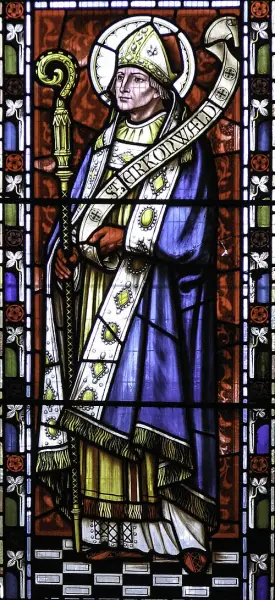
Erkenwald, whose name also appears as Earconwald, Ercenwald, or Erconwald, died in 693 after serving as Bishop of London from 675. A Saxon prince by birth, he is the first bishop of the post-Roman period from whom the unbroken Saxon succession of the London see descends. Before his consecration he had already founded two Benedictine houses: Chertsey Abbey in Surrey for men, over which he himself ruled as abbot, and Barking Abbey for women, whose first abbess was his own sister Æthelburh. As bishop he became a decisive figure in the reconversion of Essex, a counsellor named in King Ine of Wessex's law code as his advisor, and a celebrated peacemaker who brokered the reconciliation between Archbishop Theodore and Wilfrid at his own residence. Tradition credits him with repairing Bishopsgate and with heavy spending on the early building of St Paul's. He died on a visit to Barking Abbey, and the struggle over his burial — resolved, legend says, when the waters of the Roding and the Lea parted for the Londoners carrying him home — began the great shrine at Old St Paul's that made him Lundoniae maximum sanctus, the most holy figure of London. A medieval poem bearing his name ranks among the foundations of English literature.
The Complete Life
Noble Blood and a Precious Name
Erkenwald came into the world around the year 630, and tradition has always insisted on his royal or noble birth, though the pedigrees offered by medieval writers refuse to agree. Dugdale, for instance, writes him into the house of King Offa of Essex, while John of Tynemouth prefers Offa of East Anglia; chronology, however, tells against both. Another tradition gives King Annas, that holy ruler of the East Angles, as his father, while the Frankish form of the first element of his name has been taken to suggest Kentish descent. What can be said with confidence concerns the name itself: Erkenwald joins the Germanic elements eorcen (genuine, pure, precious) and weald (rule, power), and so carries something like the sense of a noble ruler — an apt enough name for a man who would govern both monasteries and a diocese. His birthplace is placed in the Kingdom of Lindsey, in modern Lincolnshire. In his youth he may have received teaching from Mellitus of Canterbury — the same archbishop whose shrine would one day stand near his own in St Paul's.
§ Origins
Founder of Chertsey and Barking
Around the year 666, well before he wore a bishop's mitre, Erkenwald established two Benedictine abbeys that would shape English monastic life for centuries. Chertsey Abbey in Surrey he founded for men, and over it he ruled in person as abbot, governing the community he had brought into being. For women he founded Barking Abbey, and set over it his own sister Æthelburh, who is honoured as St Ethelburga of Barking; sensing the weight of what he asked, he is said to have brought in Hildelith to school his sister in an abbess's duties. Barking is sometimes mistaken for the first nunnery in England, but the honour belongs elsewhere — Folkestone had been founded as early as 630 by King Eadbald with his daughter St Eanswith as its first abbess, and at the Dissolution Barking's considerable wealth was surpassed by Sion and Shaftesbury. Chertsey's later history was tragic: the house was destroyed during the Danish wars and ninety of its monks were killed, and it was refounded only centuries later under King Edgar and Bishop Ethelwold. A charter records that in the late seventh century Erkenwald, together with Frithwald, granted land in Streatham and Tooting Graveney to Chertsey, a gift confirmed in the time of King Athelstan in 933.
§ Career
Bishop of the East Saxons
In 675 Erkenwald became Bishop of London, succeeding Bishop Wine at the choice of Archbishop Theodore of Canterbury, and it is also said that his selection came at the insistence of King Sebbi. London's early diocese matched the bounds of the Essex kingdom, so that its bishop shepherded the East Saxons — a Christian people first planted by Gregory's Roman missionaries and later rooted by Cedd's monks from Lindisfarne. An ancient epitaph credits him with eleven years of service, years devoted above all to reconciliation: he calmed resistance to Theodore's reforms within the English Church, and he played the decisive part in settling the long dispute between Theodore and Wilfrid, a peace concluded at the bishop's own residence shortly before Theodore's death. His counsel reached into the law of the land, for King Ine of Wessex named him as an advisor on his code and called him my bishop in its preface; the Church's contribution sought to temper the wergeld system of private restitution with sanctuary and a more ordered legal peace. Modern scholarship regards him as a significant figure in how Anglo-Saxon charters took shape, and Cædwalla's grant to Farnham may even be his own drafting. Legend adds that he often preached to the woodmen of the wild forests north of London, and that he repaired Bishopsgate, which is said to take its name from him.
§ Bishop
Death and the Journey Down the Rivers
Erkenwald died in 693 while visiting Barking Abbey, the community of his sister. His Vita tells how a marvellous perfume flooded the dying man's cell, as if every corner of the building had been bathed in sweetness. What followed entered London legend at once. St Paul's canons and the Chertsey monks fell to quarrelling over the right to lay him in the ground, and amid the dispute the Londoners snatched up the body and bore it toward the city, saying that so splendid a city and flock deserved the strengthening and honour such a patron would bring. During the chase a severe storm broke; the party was blocked at the River Roding when its waters surged, until a devout Londoner bade everyone halt and pray, leaving the verdict to heaven — whereupon the storm instantly passed, the candles about the body relit of themselves, and the river parted to let them cross. On the same journey the River Lea, too, is said to have divided to make way for the dead saint. The body was laid in a pilgrimage shrine at Old St Paul's Cathedral, and this local outpouring is reckoned the first evidence that the Saxons of London had become properly enthusiastic about the Christian faith restored among them.
§ Death and legacy
The Shrine in St Paul's
Veneration of Erkenwald rose quickly and never died. Old St Paul's greatest glory, in Margaret MacLean's words, was his shrine, a monument compared to that of Edward the Confessor at Westminster. In the fire of 1087 it was said to have stood untouched; the relics were then enshrined in silver within the vast new crypt that Bishop Maurice built for them. A cathedral shrine received the body in 1140; eight years later, on 14 November, it came to rest close by the high altar, next to Mellitus. The new fixed shrine whose foundation stone Bishop Gilbert de Segrave set in place in 1314 received the relics twelve years on, enclosed in a leaden casket wrought like a gabled house or church; an inventory of 1245 records a wooden feretory sheathed in silver and studded with a hundred and thirty gemstones. Even the chair that had borne him about in his last, weakened years was said to work cures. Offerings poured in from canons and merchants — twelve nobles from King John of France, a sapphire from the grocer Richard de Preston for the cure of eye infirmities — and new arrivals at the tomb could be moved only clandestinely at night for fear of the crowds. His principal feast falls on 30 April, and his three translations each have their own observance: 1 February, 13 May, and 14 November; before the Reformation these were feasts of the first class at St Paul's by Bishop Braybroke's ordinance of 1386. Catherine of Aragon offered at the shrine, and princely weddings — Arthur's, and in some accounts Henry VIII's with Anne Boleyn — were timed to his day.
§ Relics and shrine
The Saint of London in Letters and Stone
No English saint of the early church entered literature so durably as Erkenwald. The fourteenth-century alliterative poem St Erkenwald — reckoned a cornerstone of early English literature and commonly assigned to the hand behind Sir Gawain and the Green Knight — dramatises the salvation of a virtuous pagan judge, and survives in a single manuscript, British Library MS Harley 2250, which Thomas Percy rescued from oblivion in 1757. Medieval devotion produced the Miracula Sancti Erkenwaldi, preserved in a twelfth-century Parker manuscript at Corpus Christi College, Cambridge, and nineteen miracles are catalogued in his tradition, from the healing of blind girls and a deaf child to the pall that survived the great burning of the city. In art he rides in a small wheeled chariot, the mitigation of his severe gout, sometimes with a woman touching the chair in allusion to his healing wonders, and sometimes beside his sister Ethelburga of Barking. After the Reformation stripped the shrine by 1550, and the Great Fire consumed the empty monument in 1666, the fate of the relics became a mystery — plundered, burned, reburied, or hidden, with a modern thesis, argued before Shropshire Council and on national podcasts in 2026, that Sir Rowland Hill carried them to Soulton Hall. Christopher Wren dug for his Saxon church in the ruins and found nothing; the city keeps the name anyway.
§ The poem of St Erkenwald
Timeline
- 630
Born around this time, traditionally in the Kingdom of Lindsey in modern Lincolnshire, of royal ancestry
§ Origins
- 666
Established two Benedictine abbeys around this date: Chertsey in Surrey for men and Barking for women, over which his sister Æthelburh became abbess
§ Career
- 675
Became Bishop of London, succeeding Bishop Wine, at the choice of Archbishop Theodore of Canterbury and reportedly the insistence of King Sebbi
§ Bishop
- 691
Granted the manor of Fulham, about this year, for himself and his successors as Bishop of London
§ Bishop
- 693
Died while visiting Barking Abbey, after about eleven years as bishop, and was buried at a pilgrimage shrine in Old St Paul's Cathedral
§ Death and legacy
- 933
A charter recording his late seventh-century grant of land in Streatham and Tooting Graveney to Chertsey Abbey was confirmed under King Athelstan
§ Career
- 1087
His shrine was said to survive the great fire untouched; the relics were placed in a silver shrine in Bishop Maurice's new crypt
§ Relics and shrine
- 1140
His body was transferred to a shrine in St Paul's Cathedral
§ Relics and shrine
- 14 Nov 1148
His remains were moved to a spot beside the high altar, next to St Mellitus's shrine, where the two shrines probably stood side by side
§ Relics and shrine
- 1245
A cathedral inventory described his feretory as a wooden structure sheathed in silver and set with a hundred and thirty gemstones
§ Relics and shrine
- 1314
Bishop Gilbert de Segrave laid the foundation stone of a new St Paul's shrine, beginning the fixed monument that lasted until the Reformation
§ Relics and shrine
- 1326
Twelve years after the foundation stone was laid, his relics were translated into Bishop de Segrave's new shrine, sealed in a gabled leaden casket
§ Relics and shrine
- 1386
Bishop Braybroke's ordinance made the anniversaries of his death and translation feasts of the first class at St Paul's
§ Feast day and translation day
- 1400
A Middle English life of him was composed about now, apparently part of a London episcopal effort to renew devotion to the saint
§ Memorialisation of St Erkenwald
- 1550
His relics were removed from the St Paul's shrine by this date, during the Reformation; the empty monument survived
§ Relics and shrine
- 1666
The Great Fire of London destroyed the empty shrine, whose loss severed the last physical link with the cathedral's Saxon predecessor
§ Relics and shrine
- 1757
Thomas Percy discovered the sole surviving manuscript of the fourteenth-century alliterative poem about him in a Shropshire collection
§ The poem of St Erkenwald
In Their Own Words
We are like strong and vigorous men who will... undermine and overturn cities heavily fortified with men and weapons before we give up the servant of God, our protector... we ourselves intend that such a glorious city and congregation shall be strengthened and honoured by such a patron.
London's greatest saint... by no means undeserving of the favour of the canons because of the speed with which he answers
The Record
- Major works
- Chertsey Abbey, Surrey (founded c. 666)·Barking Abbey, Essex (founded c. 666)·Early building works at St Paul's Cathedral·Repair of Bishopsgate, London·Contribution to the law code of King Ine of Wessex·Charter drafting in the evolution of Anglo-Saxon charters
- Patron of
- Patron saint of London·Invoked against gout
- Symbols
- Bishop riding in a small chariot·Depicted with Saint Ethelburga of Barking
- Canonization
- Pre-congregation; acclaimed by popular devotion and the see of London from the century of his death
Prayer
Bibliography
Show 8 sources
- Andrew, Malcolm. "The Saint of London: The Life and Miracles of St. Erkenwald." Notes and Queries, vol. 41, no. 4, Dec. 1994, pp. 541+.
- Farmer, David Hugh (2004). Oxford Dictionary of Saints (Fifth ed.). Oxford, UK: Oxford University Press. ISBN 978-0-19-860949-0.
- Fryde, E. B.; Greenway, D. E.; Porter, S.; Roy, I. (1996). Handbook of British Chronology (Third revised ed.). Cambridge: Cambridge University Press. ISBN 0-521-56350-X.
- Kirby, D. P. (2000). The Earliest English Kings. New York: Routledge. ISBN 0-415-24211-8.
- Thornbury, Walter (1887). Old and New London. Volume 1. London: Cassell.
- Walsh, Michael J. (2007). A New Dictionary of Saints: East and West. London: Burns & Oats. ISBN 978-0-86012-438-2.
- Yorke, Barbara (2003). Martin Carver (ed.). The Adaptation of the Anglo-Saxon Royal Courts to Christianity. The Cross Goes North: Processes of Conversion in Northern Europe AD 300–1300. Woodbridge, UK: Boydell Press. pp. 244–257. ISBN 1-84383-125-2.
- Yorke, Barbara (2006). The Conversion of Britain: Religion, Politics and Society in Britain c. 600–800. London: Pearson/Longman. ISBN 0-582-77292-3.
Profile text adapted from the Wikipedia article, licensed CC BY-SA 4.0.
Pray with this saint every day
Save St. Erkenwald to your favorites, read the full profile, and get feast-day reminders in the Saints app.
Get the Saints AppFree on the App Store for iPhone and iPad