
c. 1085 – 1164·Feast June 22
St. Eberhard I of Salzburg
Benedictine Archbishop and Peacemaker of the Papal Schism
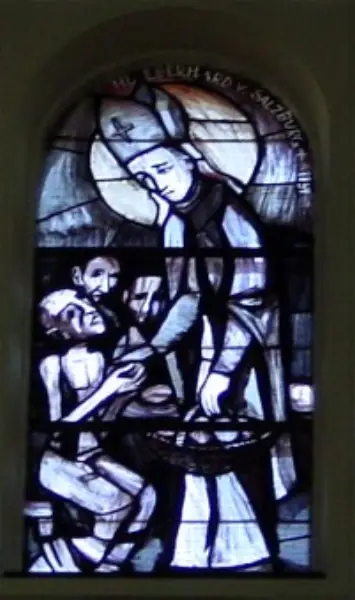
Overview
Eberhard I, Count of Hippoldstein, was Archbishop of Salzburg from 1146 until his death in 1164, and stands among the most respected churchmen of twelfth-century Germany. Born to a noble family of Nuremberg, he entered monastic life in 1125 as a Benedictine at Pruffening and afterwards governed the abbey of Biburg near Regensburg as its abbot. Pope Innocent II raised him to the metropolitan see of Salzburg in 1146. His reputation was made in an age of schism: when the disputed papal election of 1159 set Pope Alexander III against the antipope Victor IV, whom Emperor Frederick I Barbarossa championed, Eberhard stood steadily by the lawful pope while winning the emperor's own esteem. Barbarossa regarded him as a possible arbiter between the parties and, alone among Alexander's supporters, was suffered to keep his see in quiet. In the strain of those years Eberhard wrote to Hildegard of Bingen asking for her prayers. He was prevented by ill health from reaching the Council of Pavia in 1160, turning back at Treviso. Celebrated for holiness, scholarship, and rectitude, he met his death in 1164, in his seventy-ninth year, homeward bound from yet another mission of peace, at Rein Abbey in Styria. His feast is kept on 22 June.
The Complete Life
From Nuremberg Nobility to the Cloister
Eberhard was born in the imperial city of Nuremberg into a noble family, and his rank stayed with him even into his religious titles, for he is recorded as Count of Hippoldstein. The path he chose, however, led away from the prospects of a nobleman. In 1125 he became a Benedictine at Pruffening in Germany, embracing the monastic round of prayer, work, and obedience at what was already an age rather later than most novices. The Benedictine formation proved decisive for the kind of churchman he became: a man of disciplined learning, steady judgement, and institutional loyalty, formed in the oldest school of western monasticism. His abilities did not long remain hidden in the cloister. He was advanced to be Abbot of Biburg near Regensburg, a Benedictine house in Bavaria, and there he gained the administrative experience and the reputation for wisdom that would carry him, in time, to one of the great archiepiscopal thrones of the German church. By the time his wider career began, he had already given the better part of two decades to monastic governance, a training no prince's court could have supplied.
§ Life
Called to Salzburg
In 1146 Pope Innocent II appointed Eberhard Archbishop of Salzburg, the ancient and prestigious metropolitan see of the south-eastern lands of the Empire, whose territory reached across what is now Austria. The appointment lifted the Bavarian abbot directly into the first rank of German prelates; in the episcopal lists of Salzburg he stands between Conrad I, whom he succeeded, and Conrad II, who followed him, with his tenure counted from 1147 in some chronologies. The see he inherited was among the oldest and most consequential in the German-speaking church, and it demanded a man who could hold his own with dukes and emperors. Eberhard's monastic training, noble birth, and proven administration made him exactly that. Contemporaries would come to rank him with the ablest churchmen of his century, and the esteem began with his governance of Salzburg itself: a diocese stretching over Alpine valleys and disputed borders required the combination of firmness and diplomacy that was already his hallmark. For thirteen years he governed it, and the archdiocese remained at peace under him even when the church around it was torn in two.
§ Life
Mediator in the Schism
The great test of Eberhard's episcopate came with the papal election of 1159. The disputed conclave produced two claimants, and the Emperor Frederick I Barbarossa threw his weight behind the antipope Victor IV against Pope Alexander III, plunging the German church into a crisis of loyalty from which no prelate could stand aside. Eberhard's course was unambiguous: he steadily supported Alexander, the lawful pope. What makes his position remarkable is its outcome — Barbarossa, whose displeasure stripped other supporters of Alexander of their sees, left Eberhard in peaceful possession of Salzburg. The emperor saw in the archbishop a potential arbiter between the factions, a figure whose holiness, scholarship, and rectitude commended him to both camps, and whose goodwill the emperor's Italian ventures required among the German princes. Eberhard used his standing to work for peace rather than for party. In the pressure of those years he sought spiritual reinforcement in a letter to Hildegard of Bingen, the most celebrated seer of the age, asking for her prayers — a request she answered, and which survives among her correspondence. In 1160 he intended to attend the Council of Pavia, the assembly meant to resolve the schism, but ill health stopped him at Treviso, short of his goal.
§ Life
Piety, Learning, and Integrity
The sources that remember Eberhard reach instinctively for three words: piety, learning, and integrity. Each rested on the Benedictine soil of his formation. His piety was that of a monk raised on the liturgy, unshowy and constant, the kind that keeps its balance when others lose theirs; it showed itself most characteristically not in vision or ascetic spectacle but in his habit of recourse to prayer at the moments of greatest strain, as when, bearing the weight of the schism, he wrote to Hildegard of Bingen simply to ask that she pray for him. His learning was that of a house trained in Pruffening and proven as abbot of Biburg — the learning of administration, of canon law and church polity, of the scriptures and the fathers that a metropolitan needed for the councils of the age. His integrity was the sum of the other two, tested precisely where most men fail: he stood for the lawful pope when an emperor demanded the contrary, yet without rhetoric or rebellion, so that even his opponent trusted him. Frederick Barbarossa's judgement — that here was a man who might arbitrate between the warring parties of Christendom — is perhaps the finest tribute a twelfth-century churchman's character could receive.
§ Life
A Last Errand of Peace
Eberhard's death gathered up the meaning of his life. In 1164, now seventy-nine years old, he undertook yet another peacekeeping mission in the long conflict of the schism, and on the return journey his strength failed. He died at Rein Abbey near Gratwein in Styria, a Benedictine house not his own, far from Salzburg — fittingly, at a monastery, among monks, on the road home from working for peace. The chronicle of his life closes there with a simplicity that needs no embellishment: few prelates of the century matched his ability, and he fell, as it were, still in harness. His archdiocese passed to Conrad II, and the schism he had striven against would consume the remainder of the century before Alexander III's line prevailed fully. The peace he personally brokered eluded the church of his lifetime; what did not elude it was the example of a bishop who could be trusted by a pope he obeyed and an emperor he opposed, and who spent the last years of a long life travelling and negotiating when others of his age had long since withdrawn to their cathedrals.
§ Life
Veneration at Salzburg and Rein
Eberhard was honoured as a saint by the church whose affairs he had governed, without the formal processes of later centuries. He is venerated in the Roman Catholic Church, and his cult fixed his feast on 22 June, the day on which he is still remembered in the calendars of the archdiocese and of the houses with which he was connected. Medieval Salzburg ranked its archbishops carefully, and the inclusion of Eberhard among its saints reflects the memory of a administration at once faithful and independent: he had defended the freedom of the church in the schism without provoking the devastation that obedience to Rome brought upon other sees. His death at Rein Abbey gave the Styrian monastery a particular share in his memory. Later hagiographical collections preserved his life in the company of the German saints — the Monks of Ramsgate's Book of Saints carries his entry, as do the modern directories of the saints — drawing on the Catholic Encyclopedia's account of the see he governed. For the faithful of Austria and Bavaria he remains the model of the peacemaking prelate: learned, prayerful, incorruptible, and spent entirely on the unity of the Church.
§ Life
Timeline
- 1125
Became a Benedictine monk at Pruffening in Germany, leaving a noble family of Nuremberg for monastic life.
§ Life
- 1146
Appointed Archbishop of Salzburg by Pope Innocent II, having earlier served as Abbot of Biburg near Regensburg.
§ Life
- 1159
Supported Pope Alexander III against Barbarossa's antipope Victor IV in the schism of the 1159 papal election, winning fame as a mediator.
§ Life
- 1160
Set out for the Council of Pavia but was forced by ill health to stop at Treviso.
§ Life
- 1164
Died at Rein Abbey in Styria, aged seventy-nine, while returning from another peacekeeping mission.
§ Life
The Record
- Major works
- Governance of the archdiocese of Salzburg (1146–1164)·Mediation between Pope Alexander III and Emperor Frederick Barbarossa
- Symbols
- Archbishop's pallium and crozier
- Canonization
- Ancient cult; venerated as a saint in the Roman Catholic Church, with his feast kept locally on 22 June
Prayer
Bibliography
Show 5 sources
- Monks of Ramsgate. "Eberhard". Book of Saints 1921. CatholicSaints.Info. 21 November 2012
- Hildegard of Bingen. The Letters of Hildegard of Bingen, Volume I, OUP, 1994, p. 84 ISBN 9780195352979
- Freed, John B., Frederick Barbarossa: The Prince and the Myth, Yale University Press, 2016, p. 295 ISBN 9780300122763
- Wolfsgrüber, Cölestin. "Salzburg." The Catholic Encyclopedia Vol. 13. New York: Robert Appleton Company, 1912
- St. Eberbard Catholic Online
Profile text adapted from the Wikipedia article, licensed CC BY-SA 4.0.
Pray with this saint every day
Save St. Eberhard I of Salzburg to your favorites, read the full profile, and get feast-day reminders in the Saints app.
Get the Saints AppFree on the App Store for iPhone and iPad