
c. 815 – 867·Feast December 16
St. Eberhard of Friuli
Frankish Duke, Scholar-Prince, and Founder of Cysoing Abbey
Overview
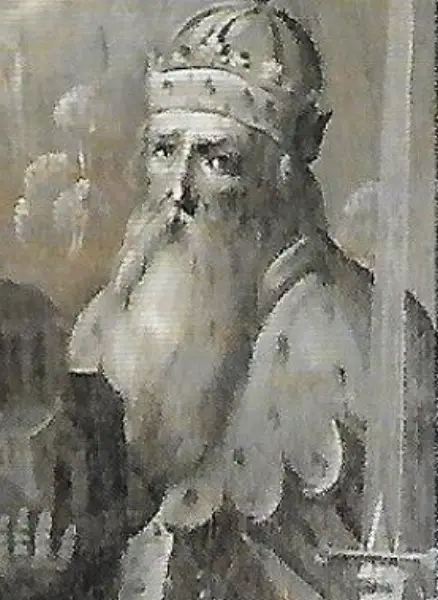
Eberhard, who wrote his own name Evvrardus, was Duke of Friuli from 846 and one of the commanding figures of the Carolingian Empire — at once soldier, diplomat, scholar, and holy man. Born around 815 into an illustrious Frankish family whose exact parentage the sources dispute, he took up arms as soon as his age allowed, defended Italy against the Bulgars, and was rewarded with the hand of Princess Gisèle, daughter of Emperor Louis the Pious, whose dowry brought him the fisc of Cysoing in Flanders. There he and Gisèle founded a monastery in honour of Saint Saviour and Mary, enshrined the relics of Pope Callixtus I, and raised a household so ordered that contemporaries likened it to a monastery rather than a castle. In the civil wars that tore the empire apart after Louis's death, Eberhard deplored the fratricide and laboured for peace, standing among the negotiators who produced the division sworn at Verdun in 843. As Duke of Friuli he then led the resistance that broke the Saracen threat to Italy by 851. A layman of real learning, he kept a great library, commissioned Latin works from Lupus Servatus and Sedulius Scottus, and corresponded with Gottschalk, Rabanus Maurus, and Hincmar. He drew up his testament at Musiestro Castle in 867 and died that same year, on 16 December.
The Complete Life
An Illustrious and Disputed Descent
Eberhard was born around 815 into an illustrious Frankish family, but the medieval sources disagree about whose son he was. The strongest tradition makes his father Unruoch II; others name Berengar, the son of Count Unroch; still others say his grandfather was the Count Unroch who left the court of Charlemagne and stood signatory to the emperor's will; and one tradition, recorded with a sigh by the old compilers, even wrote that his father was Carloman I, brother of Charlemagne. His mother is likewise debated: she was Engeltron of Paris, daughter of Begue, Count of Paris, according to one account, while Buzelin instead calls her a child of Didier, the Lombard king. Whatever the truth of his parentage, his connections placed him at the summit of Frankish society, and his abilities justified the placement. Unusually for a lay aristocrat of the ninth century, Eberhard was not only literate but a man of genuine cultivation: he assembled an extensive library, catalogued in detail in his own will, kept up correspondence with the leading theologians and churchmen of the day — Gottschalk, Rabanus Maurus, and Hincmar among them — and acted as patron to the restless theologian Gottschalk of Orbais.
§ Family
Soldier of the Frontier
As soon as his age permitted him to bear arms, Eberhard joined the military expeditions of the empire, and the soldier's trade became his first vocation. Named Duke of Friuli and Count or Marquis of Trévise, he held the march that guarded Italy's north-eastern approaches, the classic duty of the Carolingian frontier aristocracy. His first great test came against the Bulgars, whose invasion he repelled and whom he succeeded in driving entirely from the peninsula in the campaigns the sources date between 825 and 830. Yet it was in the imperial politics of the following decade that his character revealed itself. During the tragic years from 830 to 839, through the years when his own rebellious sons heaped humiliation on Emperor Louis the Pious, the count's loyalty to him never wavered. He used his influence in the circle of Lothair, the emperor's eldest son, not to press the rebellion but to end it: it was on his counsel, the record states with confidence, that in 839 Lothair went to Worms to implore his father's pardon. The emperor's gratitude fixed Eberhard's fortunes — and gave the church its future saint a family and a mission.
§ Warlike exploits and role as mediator under Louis the Pious
Pacifier of a Divided Empire
When Louis the Pious went to his death in 840, a cruel war without mercy erupted between the Emperor Lothair and his brothers Louis the German and Charles the Bald. Eberhard, who had spent a decade healing one family quarrel, grieved over this greater fratricide and strained every nerve to stop it. Once the slaughter at Fontenay on 25 June 841 had shown where the quarrel must lead, he headed the peace embassy his master Lothair sent toward the camps of his brothers. The preparatory conference met in 842 at Milin, near Châlons in Champagne, where it was resolved to divide the empire among the three brothers, and Eberhard stood among the negotiators charged with making the partition equitable. Not until August 843 did the negotiators lay their completed division before the three kings at Verdun, an award that would shape western Europe for ages. Peace restored, Eberhard hastened to Italy, where African Saracens, summoned as helpers by the Duke of Benevento in 842, had grown into a plague that menaced Rome and pillaged it repeatedly. Command of the defence fell to him as Duke of Friuli; after years of grinding war the Saracens went down to defeat in 851, the vanquished taught the Gospel — it was said — by Eberhard's own mouth.
§ Pacifier
A Home Like a Monastery
The measure of Eberhard's sanctity was his household. His household, the old life records, was so perfectly ordered that it resembled a religious house more than a fortress, with Gisèle — a woman of deep piety — taking charge of their large family's schooling. To the needy and the ailing, Cysoing guaranteed more than shelter: aid and defence were theirs for the asking. The great social wound of the age, the condition of the serfs, preoccupied him: he freed a good number, and in the very documents of manumission he expressly refrained from imposing anything that would impede their liberty; those he did not free he never forgot, and he worked to lighten their burdens. The sources catalogue the rest of his character with affection — courage without cruelty, a life spent working for peace, modesty and humility preserved amid eminence, a studied avoidance of splendour and arrogance. The whole Church heard of his burning desire to honour God, to publish the truth, and to win the infidels for the faith; and prayerfulness, love of the liturgy, honour paid to the saints, and care for the martyrs' relics marked, in the old writer's phrase, everything he did.
§ Character
Cysoing, the Testament, and Death
The centre of Eberhard's later life was Cysoing, the rich royal fisc in the country of the Pèvele that Gisèle brought him in her dowry, which the couple made one of their regular residences. There, with their chaplain Walgaire, they undertook the foundation of a monastery in honour of Saint Saviour and Mary — a project long and difficult, unfinished at the deaths of both founders — whose canons lived under the full rigour of cloister and whose special office was the solemn singing of the church's prayer, in which Eberhard himself was known to delight in taking part. After his Italian campaigns the relics of Pope Callixtus I were re-interred in the abbey. In 858 he appears once more in imperial business, among the ambassadors sent to Ulm by Louis the Younger. Then comes his testament, whose authenticity is certain, drawn up in 867 at Musiestro Castle in the county of Trévise: with Gisèle's consent he portioned his goods among seven children, allotting Lombard lands, Hesbaye estates, and the Cysoing domains, with the gems, the chapel treasures, and the library volumes shared out in equal portions. Dated to the twenty-fourth year of Louis the Younger's reign, the will was finished; Eberhard died the same year, on 16 December.
§ Testament and death
The Cult of Saint Evrard
Eberhard was honoured as a saint soon after his death, and the church keeps his feast on 16 December, the day he died. The cult flourished first at Cysoing itself, the abbey he and Gisèle had founded, where their memory and their burial drew the devotion of the region; the old lives speak of his cult and relics as the glory of the house, and the tradition of the Pas-de-Calais preserved him as Saint Evrard, founder of Cysoing. His sanctity was of the lay sort the early middle ages understood well: not withdrawal from the world, but the world's work transfigured — the frontier duke who preferred peace, the magnate who freed his serfs, the prince whose castle became a monastery in all but name. Modern scholarship has returned to him through that most revealing of documents, the will of 867, which records his lands, his chapel treasures, and his books with the precision of a soul taking stock. His children carried his line into the highest destinies of Europe: his son Berengar became King of Italy, and through his daughter Ingeltrude he is counted among the ancestors of Henry the Fowler. The Directory on saints' calendars lists him among the blessed of the Frankish church, venerated in the Catholic tradition on his December feast.
§ Canonization
Blood, Books, and Benedictions
Eberhard's legacy ran along three channels. The first was dynastic: through the children portioned in his will — Unruoch, Berengar, Adélard, Rudolf, Ingeltrude, Judith, and Heilwise — his blood entered the ruling houses of Italy, Bavaria, and Germany; his grandson in the third generation was Henry the Fowler, founder of the Saxon line of kings. The second was cultural: a layman's library large enough to be divided equally among heirs as a treasure of the house, commissions from Lupus Servatus and Sedulius Scottus, and letters exchanged with Gottschalk, Rabanus Maurus, and Hincmar place him in the very engine room of the Carolingian renaissance. The third was spiritual: the abbey of Cysoing, with the relics of Pope Callixtus I and the memory of its founders, remained for centuries the beating heart of a cult that kept Saint Evrard's feast each 16 December. Historians of the will have seen in it the ritual of a noble couple preparing death by distributing the dead's gifts to churches and kin; hagiographers have seen in it the inventory of a Christian life — books, relics, jewels, and children all assigned to their proper ends. Both are reading the same man: the duke who believed the empire and the soul were ordered by the same justice.
§ Marriage and life at Cysoing
Timeline
- 815
Born into an illustrious Frankish family, later an important figure of the Carolingian Empire.
§ Introduction
- 825
Named Duke of Friuli and Count or Marquis of Trévise; drove the invading Bulgars completely from the Italian peninsula by 830.
§ Warlike exploits and role as mediator under Louis the Pious
- 839
Persuaded Lothair, acting on his advice, to travel to Worms and beg his father's pardon.
§ Warlike exploits and role as mediator under Louis the Pious
- 25 Jun 841
After the bloody battle of Fontenay, joined the embassy of Lothair for peace negotiations with his brothers.
§ Pacifier
- 842
Took part in the preparatory peace conference at Milin near Châlons, charged with making the partition of the empire fair.
§ Pacifier
- Aug 843
With the other negotiators, presented the report on the division of the empire to the three kings at Verdun.
§ Pacifier
- 846
Held the dukedom of Friuli from this year, having received Princess Gisèle, daughter of Louis the Pious, in marriage.
§ Introduction
- 851
As leader of the Italian resistance against the African Saracens, saw the long war end in their defeat.
§ Wars with the Saracens
- 858
Appeared among the ambassadors whom Emperor Louis the Younger sent to Ulm, near his uncle Louis the German.
§ Testament and death
- 867
Made his will at Musiestro Castle in the county of Trévise, portioning his goods among his seven children.
§ Testament and death
- 16 Dec 867
Died; the same year in which he made his will, on 16 December.
§ Testament and death
In Their Own Words
Evrard has a reputation for being both a courageous soldier and able leader throughout these battles. In the tradition of Charlemagne , Evrard forced the vanquished to convert to Christianity , meritoriously teaching them the Gospel, himself.
The Record
- Major works
- Abbey of Cysoing, founded in honour of Saint Saviour and Mary·Re-interment of the relics of Pope Callixtus I at Cysoing·Commissions of Latin literature from Lupus Servatus and Sedulius Scottus·The testament of Eberhard and Gisèle (867), with its detailed inventory of lands and library
- Symbols
- Duke's sword and pilgrim's scrip·Book or library, from his testamentary bequest
- Canonization
- Canonized by popular cult in the Frankish church; his feast is kept on 16 December
Prayer
Bibliography
Show 8 sources
- Theuws, Frans (2000). Rituals of Power: From Late Antiquity to the Early Middle Ages. Christina La Rocca and Luigi Provero, THE DEAD AND THEIR GIFTS: THE WILL OF EBERHARD, COUNT OF FRIULI, AND HIS WIFE GISELA, DAUGHTER OF LOUIS THE PIOUS. Brill.
- Morby, John (1989). Dynasties of the World: a chronological and genealogical handbook. Oxford University Press.
- Louda, Jirí; MacLagan, Michael (1999). Lines of Succession: Heraldry of the Royal Families of Europe, 2nd edition. Little, Brown and Company.
- "Saint Evrard : Fondateur de L'Abbaye de Cysoing : Son Culte & Ses Reliques" by Abbott Jules BATAILLE (1902)
- Les Sires de Cysoing par Thierry Leuridan
- Chevalier. Répertoires des sources historiques au mot Eberhard. Don Boquet. Rerum gallicarum et francicarum scriptores T. VII; Acta sanctorum VIeme volume d'Octobre. Buzelin Gallo-Flandria I 102; III, 107-109
- The Royal Ancestry Bible Royal Ancestors of 300 Colonial American Families by Michel L. Call (charts 1986 & 2022) ISBN 1-933194-22-7
- Acta sanctorum II p. 971. Cartul. de Cys. p. 768, 905, 914, 919.
Profile text adapted from the Wikipedia article, licensed CC BY-SA 4.0.
Pray with this saint every day
Save St. Eberhard of Friuli to your favorites, read the full profile, and get feast-day reminders in the Saints app.
Get the Saints AppFree on the App Store for iPhone and iPad