
died before 594·Feast October 24
St. Eberigisil
Bishop of Cologne in the Migration Age
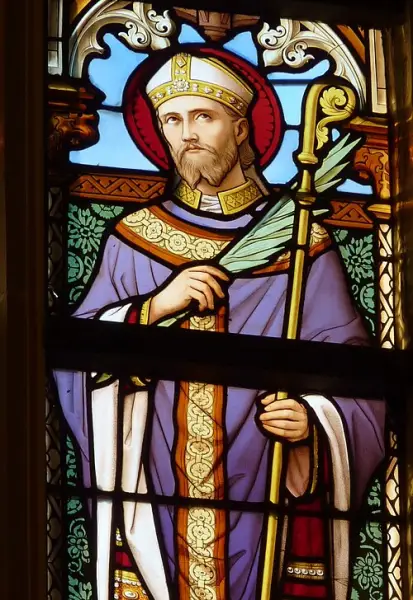
Overview
Eberigisil led the church of Cologne during one of the most unsettled stretches of the early Middle Ages, when the movement of peoples across the Rhineland disturbed town and countryside alike. Gregory of Tours names him as bishop, though always in the past tense, which is why scholars conclude that he had died by 594. He stands as the fifth bishop of Cologne whose episcopate is securely attested, and the first among them to bear a Frankish name. Within his city he worked to strengthen religious observance and to keep peace between church and people. Gregory records two of his actions: the founding of a church honouring the martyr Mallosus at Birten, close to Xanten, and a mission of arbitration in 590, when he settled quarrels inside a Poitiers nunnery at the request of King Childebert II. An eleventh-century legend traces his origins to Tongeren and tells of a martyr's death there, but the story cannot stand as history. It nonetheless kept his memory alive in the region where his relics were transferred in 954 and honoured in Cologne ever since.
The Complete Life
A Boy of Tongeren
The fullest tradition about Eberigisil's beginnings comes from a legend written down in the eleventh century, long after his death. It tells of a prosperous family in Tongeren, then counted among the towns of Flanders, where a boy conspicuous for piety attracted the attention of Bishop Severin of Cologne. Tongeren belonged to the ecclesiastical province of Cologne at the time, and when Severin came there on visitation he brought the child back with him to his episcopal city on the Rhine. There, the story runs, he gave him an education and eventually ordained him deacon. When Severin died, the young man succeeded him in the see. The legend adds a violent ending: on a later journey to his native town, Eberigisil was murdered by robbers and buried in Tongeren's Church of Our Lady. Historians cannot accept the tale as it stands, because Severin occupied the see of Cologne around the year 397, which makes a direct succession impossible. The narrative is best read as an attempt to explain the saint's bond with two cities at once, and why Tongeren claimed him as one of its own sons.
§ Legend
Fifth Bishop of Cologne
Eberigisil governed the see of Cologne at the close of the sixth century as its fifth securely documented bishop, and he was the first of that line to carry a distinctly Frankish name. His episcopate fell within the age of the migration of peoples, an era whose upheavals dominated life in the city and the surrounding country alike. Against that background he devoted himself to two aims: building up the practice of religion among his flock and establishing peace within the church. Nearly all the evidence for his activity comes from Gregory of Tours, whose choice to speak of him only in the past tense signals that the bishop was already dead when Gregory wrote, and so fixes his death before 594. A later writer, Heriger of Lobbes, listed Eberigisil among the bishops of Maastricht, but scholars treat this as probably a confusion of records rather than a second episcopal charge. Even so, the slip shows that his reputation travelled beyond the Rhineland, reaching chroniclers who concerned themselves with the episcopal lists of neighbouring sees and thought his name worth recording among them.
§ Life
Arbiter and Builder
Two acts of Eberigisil's public career survive on the pages of Gregory of Tours. The first is architectural: he raised a church at Birten, near Xanten, in honour of Mallosus, a martyr venerated in that region. Such a foundation on the lower Rhine shows a bishop caring for the faith of communities well beyond his cathedral city. The second is diplomatic. In 590 King Childebert II entrusted him with settling disputes that had broken out within a nunnery at Poitiers, and Eberigisil carried the commission through. The assignment is telling in several ways. It shows a Frankish king turning to the bishop of Cologne as a trusted and impartial figure; it shows the church of Cologne involved in affairs reaching across the Frankish lands to Poitiers; and it shows an elderly prelate undertaking a long and delicate journey for the sake of concord among religious women. Taken together, the church at Birten and the mission of 590 sketch a bishop equally concerned with the material and the moral fabric of church life, active in construction, in arbitration and in the maintenance of peace wherever the church required it.
§ Life
From Tongeren to Cologne
Eberigisil has been revered as a Catholic saint from an early date, his feast kept on 24 October. His cult took firm root in the Rhineland. In 954 Archbishop Bruno I of Cologne had what were believed to be the saint's remains moved from Tongeren to the church of Saint Cecilia in Cologne, and Eberigisil became one of that church's patron saints; the building now serves as a museum. His relics rest today in the neighbouring parish church of Saint Peter. Away from the city, the parish church of Brenig is dedicated under his name. In art he is customarily shown wearing the vestments of a bishop and holding a palm, the mark of a martyr, which reflects the legendary account of his violent death rather than any verified history. Craftsmen who worked with glass claimed him as their own: he is honoured as the patron saint of glaziers and of painters on glass, a connexion that has kept his name alive in workshops long after the details of his episcopate faded from record, and that still attaches his memory to the working traditions of the trade.
§ Veneration
Timeline
- 590
Settled disputes in a nunnery at Poitiers on behalf of King Childebert II.
§ Life
- 593
Was dead by this time: Gregory of Tours always writes of him in the past tense, so his death is placed before 593.
§ Introduction
- 954
Archbishop Bruno I moved his supposed relics from Tongeren to St. Cecilia's Church in Cologne, of which he was a co-patron.
§ Veneration
The Record
- Major works
- Church in honour of the martyr Mallosus at Birten, near Xanten
- Patron of
- Patron of glaziers and glass painters
- Symbols
- Episcopal regalia·Palm leaf
- Canonization
- Pre-congregation; revered as a Catholic saint with an ancient Rhineland cult
Prayer
Bibliography
Show 7 sources
- kirchensite.de — Heiliger Evergisil (Evergislus, Eberigisil) — 24. Oktober
- "The Cult of Saints in Late Antiquity", University of Oxford
- "Evergislus", Heilige
- Leach, Elizabeth Eva. "Medieval Repertories." Early Music, vol. 39, no. 4, 2011, pp. 627–29. JSTOR
- "Patrozinium St. Evergislus", Sankt Evergilus, Bornheim-Brenig
- Ristow, Sebastian (2003). "Eberigisil, fünfter überlieferter Bischof von Köln". In Bautz, Traugott (ed.). Biographisch-Bibliographisches Kirchenlexikon (BBKL), Vol. 22. Nordhausen: Bautz. cols. 299–304. ISBN 3-88309-133-2
- Régis de la Haye, De bisschoppen van Maastricht. Maastricht, 1985
Profile text adapted from the Wikipedia article, licensed CC BY-SA 4.0.
Pray with this saint every day
Save St. Eberigisil to your favorites, read the full profile, and get feast-day reminders in the Saints app.
Get the Saints AppFree on the App Store for iPhone and iPad