
517 – 596·Feast December 29
St. Ebrulf
Frankish courtier turned hermit and founding abbot
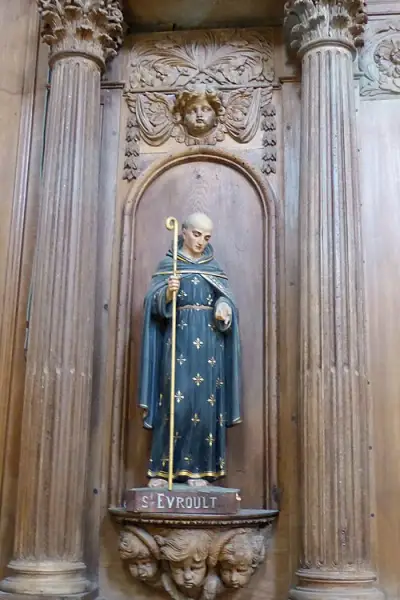
Overview
Ebrulf, remembered in French as Evroul or Evroult, lived from 517 to 596 as hermit, abbot and saint of the Frankish church. Born of noble stock at Bayeux, he spent his youth at the Merovingian court of Childebert I, where he served as the king's cup-bearer and helped administer the royal palace. His heart, however, was set on the monastic life, and when leave to leave court was finally granted he and his wife both received the religious habit. After a period in the abbey of Deux Jumeaux he withdrew as a hermit to Exmes, but crowds of visitors followed him there seeking counsel, and he moved on with three companions to the thick forests of the Pays d'Ouche in Normandy. The settlement they cleared around a spring grew into the abbey of Saint-Evroul, mother house of the fifteen monastic communities Ebrulf founded in all, each built on the discipline of manual labour. After 560 he planted several houses in the Séez diocese, one of which became the notable abbey of St-Martin-de-Séez. His cult crossed to England with the Normans, and Orderic Vitalis recorded his life in the abbey's own history.
The Complete Life
Cup-Bearer to a King
Ebrulf came into the world in 517, a child of noble birth at Bayeux, in a Normandy that still belonged to the Frankish rather than the Norse world. His abilities raised him to the Merovingian court of Childebert I, where he held two posts of trust: cup-bearer to the king himself and administrator of the royal palace. These were positions of influence and comfort, the normal foundation for a career of power. Yet the sources insist that even amid court life he lived devoutly and longed to become a monk. Permission was slow in coming. Only after a wait did he obtain release from court, and that delay shaped the form his vocation took: when he finally departed, he did not depart alone, for his wife received the monastic vow alongside him. Their marriage ended not in desertion but in a shared conversion, each entering religious life. The detail is a rare glimpse of how such transitions were negotiated in sixth-century Gaul, and it marks Ebrulf out as a man whose piety was persuasive as well as personal, able to draw another soul into the same resolve.
§ Life
Hermit at Exmes
Released at last for the religious life, Ebrulf entered the abbey of Deux Jumeaux, where he learned the discipline of communal monasticism. But the cloister did not hold him. He withdrew to Exmes to live as a hermit, seeking the solitude that the monastery's common life had only partly provided. Solitude, however, proved elusive: so many visitors came to consult him and ask his advice that the place of quiet became a place of pilgrimage, and the crowds defeated their own purpose. His response was characteristic. Rather than return to the abbey or harden himself against the people who sought him out, he withdrew deeper, taking three companions into the wooded isolation of the Pays d'Ouche in Normandy. There the remoteness of the site served a double purpose, for its seclusion spared the little community the raids of the Northmen that troubled more exposed settlements. What began as flight from fame became, by God's providence, a new foundation. The move into the forest marks the point at which the solitary Ebrulf passed from seeking his own salvation to gathering others around him for the same pursuit.
§ Life
Fifteen Houses of Working Monks
The woodland settlement that Ebrulf and his companions built near a spring was rudimentary in the extreme: an enclosure of hedge, huts of wattle and daub, little more. From these beginnings grew the abbey of Saint-Evroul, and around it a network of monastic houses that eventually numbered fifteen. Wealth flowed toward him unsought: members of the nobility came offering money, land and houses for the founding of monasteries, and he put their gifts to work. After 560 he established several communities in the Séez diocese, one of which developed into the notable abbey of St-Martin-de-Séez. What distinguished all these foundations was their insistence on manual labour, practised alike as spiritual discipline and as economic necessity. The monks of Saint-Evroul were to earn their bread by their own hands rather than depend wholly on the labour of others, an ideal that gave the houses both self-respect and resilience. In an age when monastic landholding could slide into mere estate management, Ebrulf's insistence on work kept his foundations close to their founding purpose, and it made them durable long after their founder's death.
§ Life
The Robber and the Loaves
A legend preserved in Ebrulf's story captures the spirit of his community. A robber once visited the rough settlement by the spring and warned the saint of the dangers lurking in the forest. Ebrulf answered that he feared no one. The words struck home. Confronted with a man genuinely without fear because he trusted God, the robber repented of his own sins, offered three loaves baked in ashes together with a honeycomb as gifts, and begged to be received into the community as a monk. The story is recounted with the economy of true hagiography, and its details carry the weight: the simplicity of the settlement, the freedom from fear, the bread that was all the penitent had to give. It presents Ebrulf's holiness as something visible and contagious, a quality that converted simply by being observed. The same quality explains the crowds at Exmes and the nobles at Saint-Evroul. People came to see a life that contradicted their own and found, like the robber, that they could not leave it unchanged. His penitential purpose, promised at court and practised in the forest, remained the engine of it all.
§ Life
A Saint Who Crossed the Channel
Veneration of Ebrulf passed into England in the wake of the Norman invasion, and the bond endured: four abbots of Saint-Evroul ruled English monasteries during the eleventh and twelfth centuries, and they carried some of his relics with them across the Channel. At Deeping Abbey in England a feast was kept each year on 30 August in commemoration of the translation of his relics. His cult thus became part of the spiritual traffic that followed the conquest, one more Norman saint adopted by an English church. His story, meanwhile, entered literature twice over. The earliest Life of St. Ebrulf is contained in the Historia Ecclesiastica of Orderic Vitalis, the Benedictine chronicler who wrote from the abbey Ebrulf himself had founded. And in Béroul's Tristan the hero at the fountain calls upon him by name, a small but telling proof that the forest saint of the Pays d'Ouche had become a figure familiar to readers of romance. A manuscript preserving a Life of Ebrulf, perhaps put together for the nuns of Barking Abbey, survives in Cardiff Central Library, keeping his memory on parchment as well as in stone.
§ Veneration
Timeline
- 517
Born of noble birth at Bayeux.
§ Introduction
- 560
Founded several monasteries in the diocese of Séez after this year, one becoming the abbey of St-Martin-de-Séez.
§ Life
- 596
Died after a lifetime as hermit and founding abbot of Saint-Evroul.
§ Introduction
The Record
- Major works
- Abbey of Saint-Evroul in the Pays d'Ouche·Abbey of St-Martin-de-Séez·Fifteen monastic houses founded in Normandy and the diocese of Séez
- Canonization
- Pre-congregation; ancient cult centred on the abbey of Saint-Evroul
Prayer
Bibliography
Show 6 sources
- Butler, Alban. Butler's Lives of the Saints. Liturgical Press, 2000, p. 230
- Freeman, Edward Augustus. The History of the Norman Conquest of England: Its Causes and Its Results, Volume 2. Clarendon Press for Macmillan and Company, New York, 1873, p. 150
- "Saint Patrick Catholic Church: Saint of the Day, December 29". Archived from the original on 2008-05-30. Retrieved 2012-02-26
- Orderic Vitalis. The Ecclesiastical History of Orderic Vitalis, Volume I (Chibnall, Marjorie, ed.). Oxford: Clarendon, 1969
- Béroul (1922). Ernest Muret (ed.). Tristan. p. 8 — via Wikisource
- Watt, Diane. "A Manuscript for Nuns: Cardiff, Central Library, MS 1.381", University of Surrey
Profile text adapted from the Wikipedia article, licensed CC BY-SA 4.0.
Pray with this saint every day
Save St. Ebrulf to your favorites, read the full profile, and get feast-day reminders in the Saints app.
Get the Saints AppFree on the App Store for iPhone and iPad