
died 532·Feast July 27
St. Ecclesius
Bishop of Ravenna and founder of San Vitale
Overview
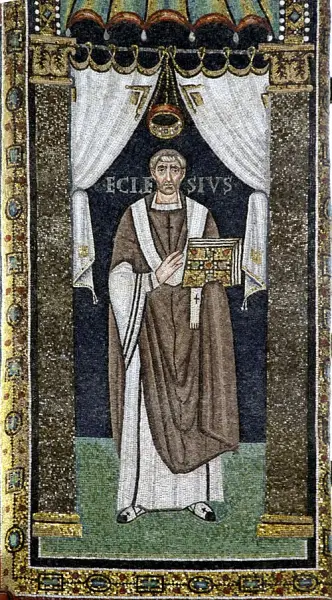
Ecclesius led the church of Ravenna as its bishop from 521 until his death in 532, and he is remembered above all as founder of the Basilica of San Vitale, one of the supreme surviving monuments of the age. In 525 he joined the embassy that Pope John I led to Constantinople, sent by Theodoric the Great to voice opposition to the edict against Arian Christianity issued by the emperor Justin I. Returning home, he fell foul of a party among his own clergy, who carried their complaints against him to Pope Felix IV; the pope rebuked the accusers and confirmed Ecclesius in his authority, in a letter that the Ravennate historian Andreas Agnellus preserved. After his return from the east he set in hand, with the backing of Julian the Banker, Julius Argentarius, the great church of San Vitale, and about the same time he began the church of Santa Maria Maggiore. He died in 532, was buried in San Vitale itself, and was succeeded in the see by Ursicinus. Portraits of him survive in mosaic at Sant'Apollinare in Classe and within San Vitale, where he appears alongside Christ and Saint Vitalis.
The Complete Life
Bishop of Ravenna
Ecclesius took charge of the see of Ravenna in 521 and held it until his death eleven years later. The city he governed was no ordinary bishopric: in his own lifetime it was the seat of Theodoric the Great, and its church stood amid the machinery of a royal court. A bishop of Ravenna therefore carried obligations that reached into politics as well as pastoral care, and the record of Ecclesius's decade in office shows a man prepared to carry them. He travelled east on business of church and state; he built two churches; he defended his authority when clergy of the city contested it; and he obtained from the pope a judgement that confirmed his position. When he died in 532, the succession passed to Ursicinus, and the church he left was visibly stronger in stone than he had found it. Whatever else may be said of him, his tenure joined the see of Ravenna more closely to the great affairs of Italy and the east, and it left the city with buildings that would make its name immortal in the history of art.
§ Biography
Embassy to Constantinople
In 525 Ecclesius joined one of the most delicate missions of his generation. Theodoric the Great dispatched Pope John I to Constantinople, there to voice opposition to the edict against Arian Christianity that the Byzantine emperor Justin I had issued, and Ecclesius was among the bishops who accompanied him on the journey. Whatever its diplomacy achieved, the journey had consequences at home. Back in Ravenna the bishop ran into opposition from a faction of local priests, who carried their protests against him to Pope Felix IV. The pope's answer was to rebuke the dissenting clergy and reaffirm Ecclesius's authority in a letter that the historian Andreas Agnellus copied into his book of the pontiffs of Ravenna, thereby preserving both the quarrel and its settlement for later generations. The same years after his return from the east produced the works for which he is chiefly remembered. With the support of Julian the Banker, known as Julius Argentarius, he set in hand the Basilica of San Vitale, and about the same time he began the church of Santa Maria Maggiore. Embassy, discipline and construction: his episcopate joined the diplomatic, pastoral and material labours that his city required of its chief shepherd.
§ Biography
Dying as the Church Rose
Ecclesius did not live to see his greatest work finished. He died in 532, while the Basilica of San Vitale was still being built, and his remains were laid to rest within the church he had founded — an honour that bound his memory to the building permanently. His successor was Ursicinus, who took up the see in the years that followed. Death in the midst of building is the common fate of founders, but few founders have been so fortunate in what survived them: the structure that outlived Ecclesius became one of the artistic wonders of the Mediterranean world, and his place of burial kept his name before every generation that entered the church. He is honoured as a saint by both the Roman Catholic and the Eastern Orthodox churches, with his feast kept on 27 July, a veneration that arose locally and was never subjected to a formal process. Nearly fifteen centuries later, visitors to Ravenna still meet his face: a mosaic portrait of the bishop survives in the Basilica of Sant'Apollinare in Classe, and he stands in the apse of San Vitale alongside Christ and Saint Vitalis.
§ Biography
A Founder Remembered in Glass
Ecclesius belongs to the small company of early medieval bishops whose face can still be looked upon, for two mosaic portraits of him survive in Ravenna. One appears in the Basilica of Sant'Apollinare in Classe; the other, more famous, stands in the Basilica of San Vitale itself, where Ecclesius is depicted alongside Christ and Saint Vitalis, robed as a bishop at the far right of the sacred company. The double portrait is at once a memorial and a claim: it asserts that the man who began the church belongs to it as surely as its stones. His historical afterlife owes as much to parchment as to mosaic. The letter of Pope Felix IV that vindicated him against his accusing clergy survived because Andreas Agnellus wrote it into his book of the pontiffs of Ravenna, and modern students of the city, working from that text and from the archaeology of his churches, still reconstruct his career from it. A bishop remembered by stone, by glass and by manuscript has been well served by those who came after him, and the basilica of San Vitale remains the richest of all the monuments to his eleven years of office.
§ Biography
Timeline
- 521
Became bishop of Ravenna, an office he held until 532.
§ Introduction
- 525
Joined Pope John I's embassy to Constantinople, sent by Theodoric the Great to oppose Justin I's edict against Arian Christianity.
§ Biography
- 532
Died at Ravenna; his remains were housed in the Basilica of San Vitale and Ursicinus succeeded him as bishop.
§ Biography
The Record
- Major works
- Basilica of San Vitale, Ravenna·Church of Santa Maria Maggiore, Ravenna
- Canonization
- Pre-congregation; venerated by the Roman Catholic and Eastern Orthodox churches
Prayer
Bibliography
Show 3 sources
- Menzies, Lucy (1924). The Saints in Italy: A Book of Reference to the Saints in Italian Art and Dedication. Medici Society Limited. p. 144
- Deliyannis, Deborah Mauskopf (2010). Ravenna in Late Antiquity. Cambridge University Press. pp. 198–200. ISBN 978-0-521-83672-2
- Agnellus of Ravenna; Deliyannis, Deborah Mauskopf (2004). The Book of Pontiffs of the Church of Ravenna (Medieval Texts in Translation). Catholic University of America Press. pp. 171–177. ISBN 978-0-8132-1358-3. JSTOR j.ctt284wdr
Profile text adapted from the Wikipedia article, licensed CC BY-SA 4.0.
Pray with this saint every day
Save St. Ecclesius to your favorites, read the full profile, and get feast-day reminders in the Saints app.
Get the Saints AppFree on the App Store for iPhone and iPad