
died 766·Feast November 19
St. Ecgbert of York
Archbishop of York and founder of its famed school
Overview
Ecgbert (also spelled Egberht or Ecgberht) was an eighth-century Northumbrian churchman who led the church of York for more than three decades and secured its elevation to an archdiocese in 735. He was born into the Northumbrian royal line: through his father, Eata, he counted kin with the first kings of Bernicia. As a young man Ecgbert travelled to Rome and was ordained deacon there. His cousin, King Ceolwulf, appointed him to the see of York around 732, and Pope Gregory III granted him the pallium in 735, making York a metropolitan see. When his brother Eadberht took the Northumbrian throne in 737, the siblings governed church and kingdom in close partnership, and the papacy forbade them to move church lands into lay hands. Ecgbert raised a school and a library at York that historians rank among the finest in western Europe, exchanged letters with Bede and Boniface, and composed the Dialogus ecclesiasticae institutionis, a legal code for the clergy. He died on 19 November 766 and was laid to rest in the cathedral church of York.
The Complete Life
A Nobleman's Son in the Church
Ecgbert came from the highest rank of Northumbrian society. His father, Eata, sprang from the same royal stock as Bernicia's first kings, in the northern half of the Northumbrian realm. One brother, Eadberht, would reign as king of Northumbria from 737 to 758, which meant that Ecgbert's long tenure at York ran alongside an unusually intimate partnership between throne and altar within a single family. In his youth Ecgbert made the journey to Rome with another brother, and it was in the city of the apostles that he was ordained deacon. Later tradition made him a pupil of the venerable Bede, and Bede did travel north to visit him at York in 733; modern scholars caution, however, that the claim of direct teaching may mean only that Ecgbert knew Bede's writings closely rather than sitting under him as a formal student. Either way, the intellectual world of the great Northumbrian monasteries formed him, and from that formation he would build at York an institution of learning that scholars have judged the peer of any in England of its day.
§ Early life and career
Bishop and Archbishop of York
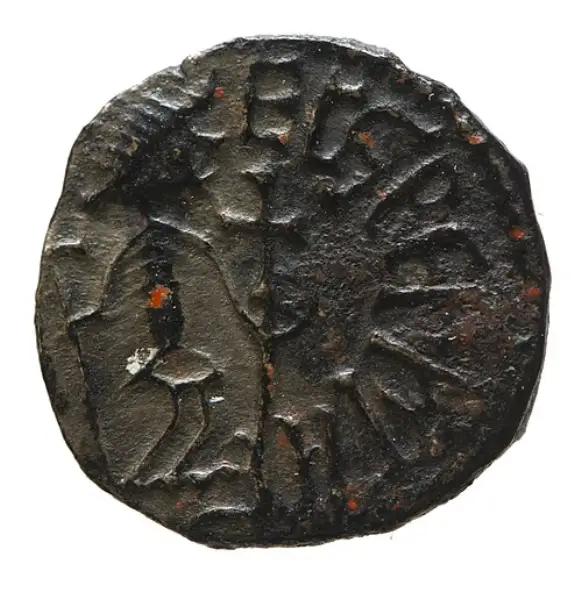
Around 732 King Ceolwulf, Ecgbert's cousin, named him to the see of York, though some chronologies place the appointment in 734. In 735 Pope Gregory III sent him the pallium, the badge of an archbishop's authority, and York was raised from a bishopric to an archdiocese — the institutional achievement for which Ecgbert is chiefly remembered. When Eadberht succeeded to the Northumbrian throne in 737, church and kingdom were governed by brothers, and they acted accordingly. Together they confronted the frictions that had grown up between ecclesiastical and royal government, and their cooperation was visible even on the coinage: some of Eadberht's pieces carried Ecgbert's image on the opposite face. The papacy, under Pope Paul I, forbade the pair to transfer church lands into secular control. The ruling answered a widespread abuse by which noble families founded monasteries on their own estates so that land could be held as book-land, exempt from royal service, while the family kept its profitable use. Protecting the monasteries of his diocese from this kind of capture became a recurring labour of Ecgbert's long administration.
§ Archbishop
A School That Enlightened Europe
The school Ecgbert founded at York became one of the intellectual wonders of its age. The historian Peter Hunter Blair judged that it equalled or surpassed the celebrated monasteries of Wearmouth and Jarrow, and described the library gathered there as one whose contents were unmatched anywhere in the western Europe of its day. Its classrooms served not only the cathedral clergy but also the sons of nobles, binding the Northumbrian aristocracy to the life of the church. The most famous pupil was Alcuin, entrusted to Ecgbert by his family, who would carry York learning to the court of Charlemagne. Two figures of the Continental mission also studied there: Liudger, later the first Bishop of Münster, and Aluberht, who became a bishop in Germany. Ecgbert kept learned company abroad as well. Bede addressed to him the letter now known as the Epistola ad Ecgberhtum episcopum, written in 734, urging reform of the Northumbrian church on Gregory the Great's model and commending the division of its vast territory — counsel Ecgbert notably declined to follow, leaving the suffragan sees at Hexham, Lindisfarne and Whithorn. Boniface wrote from Germany asking his support against Æthelbald of Mercia and requesting some of Bede's books, sending wine in return.
§ Educational activities
The Legal Code for the Clergy
Ecgbert's surviving literary monument is the Dialogus ecclesiasticae institutionis, a legal code composed for the clergy, probably after 735, since one of its titles speaks of his archiepiscopal rank. It sets out proper procedures for a wide range of ecclesiastical questions: the compensation owed when clerics were slain, entrance to the clerical orders, deposition from office, the handling of criminal monks, the standing of clergy in the courts, and much besides. The work survives complete in a single manuscript of the Cotton Library, with excerpts in others. Once Nothhelm's death in 739 made Ecgbert the longest-serving metropolitan in England, the Dialogus may well have been meant to govern the church throughout the country, not merely in Northumbria. The historian Simon Coates observed that the code does not especially exalt monks above the laity, suggesting a discipline ordered for clergy living and working in the midst of society. A penitential, a pontifical and a collection of canons bearing his name circulated in the Middle Ages, but modern scholarship traces none of these to his hand; the attributions grew from his fame rather than from his pen.
§ Writings
Death at York
Ecgbert governed the northern province from his appointment around 732 until his death on 19 November 766, a tenure of more than three decades. He was buried in his own cathedral at York, the church whose dignity as a metropolitan see he had done so much to secure. The diocese he declined to divide remained the largest in England, its suffragans still just three in number: the bishops of Hexham, Lindisfarne and Whithorn — a shape that owed as much to his resistance as to Gregory the Great's original plan for the English church. Later assessments of his episcopate are strikingly warm. The historian D. P. Kirby described him simply as a great archbishop, while Henry Mayr-Harting judged him one of the master builders of the eighth-century English church. Alcuin, his most celebrated pupil, added a more intimate memory: that Ecgbert had a name as a teacher of singing. By the time of his death the institution he had built — a cathedral, a school, and a library without rival in the West — stood ready to carry his learning forward through the generation that followed him.
§ Death and legacy
Reputation After Death
After his death Ecgbert's reputation grew rather than faded. In his native England and on the European mainland alike he was honoured as a foremost authority on canon law and church legislation, a standing rooted in the Dialogus and in a lifetime spent governing the largest diocese in the country. The school he founded carried his influence far beyond Northumbria: through Alcuin, the learning of York passed into the palace of Charlemagne and helped shape the Carolingian renaissance, while Liudger bore something of the same formation into the German mission as first Bishop of Münster. Even the erroneous attributions testify to his fame. Penitentials, pontificals and canon collections were fathered on his name for centuries because any book that carried it gained weight; the collection once called the Excerptiones Ecgberhti is now known to be the work of the later archbishop Wulfstan, and an Old English confessional ascribed to him dates from the ninth or tenth century. Historians have kept the high estimate. Kirby's verdict was succinct, and Mayr-Harting's verdict ranked Ecgbert among the master builders of the eighth-century church. He lies at York Minster still.
§ Death and legacy
Timeline
- 732
Named to the see of York by his cousin Ceolwulf, king of Northumbria; some sources date the appointment to 734.
§ Archbishop
- 733
Bede, much later, travelled north and visited Ecgbert at York.
§ Early life and career
- 734
Bede wrote him the reforming letter now known as the Epistola ad Ecgberhtum episcopum.
§ Correspondents
- 735
Received the pallium from Pope Gregory III, the symbol of archiepiscopal authority, establishing the archdiocese of York.
§ Archbishop
- 737
His brother Eadberht became king of Northumbria, and the siblings worked together on ecclesiastical issues.
§ Introduction
- 739
Became the senior archbishop in England upon the death of Nothhelm of Canterbury.
§ Writings
- 19 Nov 766
Died at York, where he was laid to rest in the Minster.
§ Death and legacy
The Record
- Major works
- Dialogus ecclesiasticae institutionis, a legal code for the clergy·The cathedral school and library at York
- Canonization
- Pre-congregation; venerated from the early medieval period, though the source article records no formal canonization
Prayer
Bibliography
Show 6 sources
- Mayr-Harting, Henry (2004). "Ecgberht (d. 766)". Oxford Dictionary of National Biography. Oxford University Press. doi:10.1093/ref:odnb/8580.
- Blair, Peter Hunter (1990). The World of Bede. Cambridge, UK: Cambridge University Press. ISBN 0-521-39819-3.
- Stenton, F. M. (1971). Anglo-Saxon England (Third ed.). Oxford, UK: Oxford University Press. ISBN 978-0-19-280139-5.
- Ryan, Martin J. (2012). "Archbishop Ecgberht and his Dialogus". In Rumble, Alexander R. (ed.). Leaders of the Anglo-Saxon Church From Bede to Stigand. Woodbridge, UK: Boydell Press. pp. 41–60. ISBN 978-1-84383-700-8.
- Coates, Simon (April 1996). "The Role of Bishops in the Early Anglo-Saxon Church: A Reassessment". History. 81 (262): 177–196. doi:10.1111/j.1468-229X.1996.tb02256.x.
- Yorke, Barbara (1997). Kings and Kingdoms of Early Anglo-Saxon England. New York: Routledge. ISBN 0-415-16639-X.
Profile text adapted from the Wikipedia article, licensed CC BY-SA 4.0.
Pray with this saint every day
Save St. Ecgbert of York to your favorites, read the full profile, and get feast-day reminders in the Saints app.
Get the Saints AppFree on the App Store for iPhone and iPad