
c. 944 – 975·Feast July 8
St. Edgar, King of England
The Peaceful, patron of English monastic reform
Overview
Edgar, remembered as Edgar the Peaceful, ruled the English as their king from 959 until his death in 975, having previously governed the Mercians from 957, when the kingdom was divided between him and his elder brother Eadwig. A younger son of Edmund I, born to Ælfgifu, he was raised in the household of Æthelstan Half-King and educated at Abingdon by Æthelwold, experiences that bound him to the Benedictine reform movement. When Eadwig died on 1 October 959, Edgar became king of all England and presided over the momentous expansion of English monasticism, championing Dunstan, Oswald, and Æthelwold, expelling secular canons from the New Minster at Winchester with papal authority, and commissioning the Regularis Concordia, a single monastic rule for the whole country. His reign also produced a standardized coinage struck at some forty mints, law codes devoted chiefly to enforcing justice, and a court celebrated for its learning and art. No Viking attacks are recorded in his time, and in 973 he was consecrated at Bath in a ceremony of imperial grandeur before receiving, by chronicle tradition, the submission of six or eight kings at Chester. He died on 8 July 975, aged thirty-one or thirty-two, and was buried at Glastonbury Abbey. Later generations remembered his reign as a golden age, though the peace collapsed immediately after his death, and his cult, though never widespread, is attested in modern Catholic lists.
The Complete Life
A Prince of the Reforming Households
Edgar was born in 943 or 944, a younger son of Edmund I by Ælfgifu, his first wife, and it was in that same year that his mother died. She had been a benefactor of Shaftesbury Abbey, where she was buried and honored as a saint, while her own mother Wynflæd, a vowess, had also supported the nunnery. The orphaned prince was brought up by Ælfwynn, wife of Æthelstan Half-King, the great ealdorman of East Anglia whose family was so powerful that kings were said to depend on his advice. This fosterage placed Edgar at the center of a network committed to monastic reform, and the historian Robin Fleming judged that his lifelong devotion to Benedictine monasticism must have been acquired in that household, among the Half-King's brothers and sons. His education continued at Abingdon, where shortly before his death King Eadred had installed Æthelwold, the future Bishop of Winchester, as abbot of the converted minster. Under so rigorous a scholar the boy's convictions about monastic life were reinforced at their roots. Neither Edgar nor Eadwig appears in contemporary documents before 955, when they first attested charters, and it was in that year, on Eadred's death, that their elder brother took the throne and Edgar became the understudy to a reign already straining the loyalties of the court.
§ Early life
From Underking to King of the English
The path to Edgar's kingship ran through the troubled reign of his brother. Eadwig succeeded in November 955, quarrelled with the old guard of counsellors, and exiled Dunstan, Abbot of Glastonbury, abroad. Edgar, by contrast, cut a prominent figure at his brother's court from 955 to 957, witnessing numerous charters and figuring in one as regulus, an underking. In 957 the kingdom split along the Thames: Eadwig kept Wessex, Edgar took Mercia, and whether this followed a coup or an agreed partition has divided historians ever since. A partisan of Dunstan wrote that the people north of the river abandoned Eadwig because he despised the wise and promoted the foolish, while other scholars see the division as the revival of an older joint kingship. Eadwig retained a formal seniority, styling himself king of the English while Edgar went usually by king of the Mercians, and all coinage stayed in Eadwig's name. But Edgar recalled Dunstan from exile and soon gave him the Mercian sees of London and Worcester, signaling the church policy he would pursue. When Eadwig died on 1 October 959, Edgar succeeded without recorded opposition to the whole kingdom, dismissed Eadwig's too-gentle appointee to Canterbury, and raised Dunstan to the archbishopric, the alliance upon which his reign's great religious work would be built.
§ King of Mercia, 957 to 959
Law, Coin, and the Machinery of Peace
Edgar's government gave the young English state some of its most precocious instruments. His two genuine law codes, the Andover Code and IV Edgar, concerned themselves less with new rules than with making existing law actually work: courts were to sit regularly, judgments to be just, punishments appropriate, weights and measures standard, and, in the words of his legislation, one coinage was to run throughout all the king's dominion. IV Edgar went further, recognizing the separate customs of York, the former Viking kingdom, and addressing all his nation, whether Englishmen, Danes or Britons, while demanding sworn witnesses in every borough, hundred, and wapentake to make the sale of stolen goods difficult. In the early 970s he carried this passion for uniformity into the currency itself: for the first time every one of the roughly forty mints struck a single design, a crowned bust and small cross of remarkably high and even fineness, about ninety-six percent silver. Levi Roach calls the reform one of the high points of kingship in late Anglo-Saxon England, and it remained in force for more than a century and a half. The same firmness governed his justice: in 974 he stripped the people of Thanet of their property and executed some for robbing merchants, and Lantfred of Winchester recorded a terrible penal law against thieves attributed to his command. It was peace kept by strict control, as even his admirers concede.
§ Law
The King Who Rebuilt the Monasteries
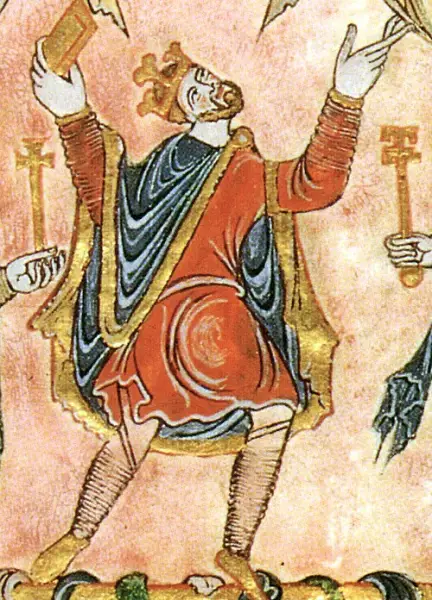
In church affairs Edgar's reign brought momentous change. Only two Benedictine monasteries stood in England when he took the throne; through his support the reform became a dominant religious and social force, and Stenton called his enthusiasm the decisive factor in the re-establishment of English monasticism. He favored all three leaders of the movement, Dunstan at Canterbury, Oswald at Worcester and York, and his old tutor Æthelwold at Winchester, and pushed their cause further than they alone could have dared. When Æthelwold converted the New Minster at Winchester into a house of monks in 963, Edgar obtained papal authority for the forcible removal of the married canons and sent an armed official to see it done; in 966 he confirmed the new community with a charter of gold, the only illuminated charter surviving from Anglo-Saxon England, in which he presents the book to Christ enthroned. He ordered a synod at Winchester to draw up one monastic usage for the whole nation, producing the Regularis Concordia, which prescribed daily psalms for the king and queen in every monastery and required royal consent for elections of abbots, so that the king is there compared to the Good Shepherd. His patronage flowed outward too: the refounded Ely received a jewelled cross and gospel book, Romsey Abbey his steady support, Abingdon his greatest generosity, and at Winchester the relics of Saint Swithun were raised at his command in solemn, barefoot processions to a shrine of gold, silver, and rubies.
§ Religion
Consecration, Chester, and Death
The year 973 has been called an annus mirabilis for the English kingdom. On Whit Sunday, 11 May, Edgar and Queen Ælfthryth were consecrated at Bath in a ceremony of unprecedented ritual splendor, perhaps informed by what his embassy to Otto the Great had seen at the German court. Why a king sixteen years into his reign should be crowned then is debated: some hold it a first coronation delayed until his thirtieth year, the canonical age of priestly consecration, others that he waited until the passions of youth had passed, and others still that it was a second crowning staged to display his claim to imperial overlordship of Britain. The Chronicle recorded it in verse, which suggests something extraordinary. Soon afterward, by the northern version of the Chronicle, he sailed with his fleet to Chester, where six kings swore to be his allies by land and sea; Ælfric says eight kings of this island came to him in a single day, and twelfth-century writers describe them rowing the king on the Dee while he took the helm. Whether submission, parley, or theater, the scene fixed his legend. Two years later, on 8 July 975, he died at thirty-one or thirty-two and was buried at Glastonbury, the monastery of Dunstan and his father. The peace he had imposed broke at once: the succession of his sons was disputed, and Edward the Martyr, chosen with Dunstan's backing, was murdered three years later.
§ The events of 973
A Cult Amid Complicated Memories
Edgar's burial at Glastonbury helped make that abbey a leading royal cult center, yet his own veneration was strangely modest for a king who had done so much for the monks. There is no evidence that he was honored as a saint before the mid-eleventh century, and the historian David Rollason judged his cult to have had surprisingly little success, presumably weakened by tales of his sexual adventures, notably with nuns. The record of his marriages was genuinely tangled: a first consort who was mother of Edward the Martyr, Wulfthryth, mother of Saint Edith of Wilton, who returned to Wilton Abbey by 964, and finally Ælfthryth, consecrated queen in 973. William of Malmesbury preserved a tale in which Cnut mocked the sanctity of Edith by calling her father vicious and a slave to lust, an anecdote modern historians read as evidence of the dark shadow his private life cast over his memory. Even so, some modern Catholic sources list him among the saints, keeping his feast on 8 July, the day of his death. Two of his children outshone him in holiness: Edward the Martyr, murdered in 978, and Edith of Wilton, both widely revered shortly after their deaths, so that the house of Edgar gave the English church two saints where it gave the king himself only an uncertain cult.
§ Death and aftermath
Golden Age and Its Critics
Within a generation of his death, Edgar's reign had become the benchmark against which misrule was measured. Monastic writers who owed their flourishing to him praised him extravagantly, comparing him to Christ the Good Shepherd, and three poems in the Anglo-Saxon Chronicle commemorated his accession, coronation, and death. After the disasters of his sons' reigns, the age was remembered as a golden one: Cnut proclaimed in 1020 that all should steadfastly observe the law of Edgar, the Danes and English agreed in 1018 to live according to Edgar's law, and twelfth-century historians spoke of his holy laws. His byname Pacificus appears first in John of Worcester, and modern scholars prefer to render it peacemaker rather than peaceful, since he preserved order through strict control backed by force rather than through serenity of character. Historians still rank the reign the pinnacle of Anglo-Saxon culture, its learning and art, from the Benedictional of St Æthelwold downward, among the highest achievements ever produced in England. Yet they also note the cost: monasteries had seized estates with royal help, and when his overbearing control was removed the kingdom slid into the disorders that ended with the Danish conquest under Æthelred the Unready. Edgar remains an enigma, the king about whom little was recorded, and of whom both the best and the worst must be believed together.
§ Assessment
Timeline
- 944
Born in England, the younger son of King Edmund I and his first wife Ælfgifu, who died about then.
§ Early life
- 955
First appears in contemporary records, attesting the charters of his uncle King Eadred alongside his elder brother Eadwig.
§ Early life
- 957
The kingdom split at the Thames: Eadwig kept Wessex while Edgar took the kingship of the Mercians.
§ King of Mercia, 957 to 959
- 958
Granted land to St Werburgh's Minster at Chester and recalled Dunstan from exile, giving him the London and Worcester bishoprics.
§ King of Mercia, 957 to 959
- 958
Gave an estate at Sutton in Nottinghamshire to Oscytel, Archbishop of York, supporting royal policy in the Viking-settled north.
§ King of Mercia, 957 to 959
- 959
Dismissed Byrhthelm of Wells as too gentle and installed Dunstan as Archbishop of Canterbury at the start of his reign.
§ Religion
- 1 Oct 959
Became King of the English over the whole country on the death of his brother Eadwig.
§ Administration
- 963
Appointed Æthelwold Bishop of Winchester and, with papal authority, sent an armed force expelling the New Minster's secular canons.
§ Religion
- 964
Married Ælfthryth, widow of Ealdorman Æthelwold, as his third consort after Wulfthryth had withdrawn to Wilton Abbey as a nun.
§ Consorts and children
- 966
Issued the illuminated New Minster Charter granting the Winchester house to Christ, with Ælfthryth attesting as legitimate wife.
§ Religion
- 966
Thored, son of Gunnar, ravaged Westmorland, perhaps resisting the southward expansion of the kingdom of Strathclyde.
§ Warfare and foreign relations
- 967
Became chief patron of Romsey Abbey, a Benedictine nunnery founded or refounded this year; his son Edmund was later buried there.
§ Religion
- 967
Sent Ælfhere to ravage the north Welsh kingdom of Gwynedd amid dissension between its princes.
§ Warfare and foreign relations
- 970
Backed Æthelwold's re-founding of Ely Abbey for monks, endowing it with a gilded cross and a jewelled gospel book.
§ Religion
- 971
Ordered the relics of Saint Swithun translated from their tomb into the Old Minster at Winchester, beginning a major cult.
§ Religion
- 972
Sent Abbot Æscwig and thegn Wulfmær with splendid gifts to Emperor Otto the Great; they returned with a peace treaty.
§ Warfare and foreign relations
- 973
Sailed to Chester, where the Chronicle says six kings pledged alliance by land and sea; later writers describe them rowing him on the Dee.
§ The events of 973
- 11 May 973
Consecrated king at Bath alongside Ælfthryth on Whit Sunday; the Regularis Concordia for English monasteries dates to about now.
§ The events of 973
- 974
Ordered the people of Thanet stripped of their property, and some executed, for robbing passing merchants from York.
§ Administration
- 974
Swithun's relics received a second translation into a reliquary of gold, silver and rubies made at his command.
§ Religion
- 8 Jul 975
Died aged thirty-one or thirty-two and was buried at Glastonbury Abbey alongside his father, Edmund I.
§ Death and aftermath
In Their Own Words
Nor was there fleet so proud nor host so strong that it got itself prey in England as long as the noble king held the throne.
he skilfully steered it through the course of the River Dee
he would never credit the sanctity of the daughter of King Edgar, a vicious man, an especial slave to lust, and more tyrant than king
The Record
- Major works
- A standardized national coinage struck at about forty mints·The Andover Code (II and III Edgar) and the law code IV Edgar·The Regularis Concordia, a single monastic rule for all England, drafted at his command·Sponsorship of Æthelwold's English translation of the Rule of Saint Benedict
- Patron of
- Listed as a saint in some modern Catholic sources
- Symbols
- Crowned royal bust, as on his reformed silver penny·Depicted presenting a charter to Christ, as in the New Minster Charter frontispiece
- Canonization
- No early formal canonization; venerated as a saint from at least the mid-eleventh century and listed in some modern Catholic sources with a feast day of July 8.
Prayer
Bibliography
Show 7 sources
- Abels, Richard (1988). Lordship and Military Obligation in Anglo-Saxon England. Berkeley, California: University of California Press. ISBN 978-0-520-05794-4.
- Barrow, Julia (2001). "Chester's Earliest Regatta? Edgar's Dee-rowing Revisited". Early Medieval Europe. 10 (1): 81–93.
- Blair, John (2005). The Church in Anglo-Saxon Society. Oxford, UK: Oxford University Press. ISBN 978-0-19-921117-3.
- Blunt, Christopher; Stewart, Ian; Lyon, Stewart (1989). Coinage in Tenth-Century England: From Edward the Elder to Edgar's Reform. Oxford, UK: Oxford University Press. ISBN 978-0-19-726060-9.
- Biggs, Frederick (2008). "Edgar's Path to the Throne". In Scragg, Donald (ed.). Edgar King of the English: New Interpretations. Woodbridge, UK: The Boydell Press. pp. 124–139. ISBN 978-1-84383-399-4.
- Crick, Julia (2008). "Edgar, Albion and Insular Dominion". In Scragg, Donald (ed.). Edgar King of the English, 595–975. Woodbridge, UK: The Boydell Press. pp. 158–170. ISBN 978-1-84383-928-6.
- "Saint Edgar the Peaceful". Our Lady of Lebanon Maronite Catholic Church. 2013. Retrieved 15 November 2025.
Profile text adapted from the Wikipedia article, licensed CC BY-SA 4.0.
Pray with this saint every day
Save St. Edgar, King of England to your favorites, read the full profile, and get feast-day reminders in the Saints app.
Get the Saints AppFree on the App Store for iPhone and iPad