
c. 961 – 984·Feast September 16
St. Edith of Wilton
Royal daughter, Wilton nun, and wonder-working patron
Overview
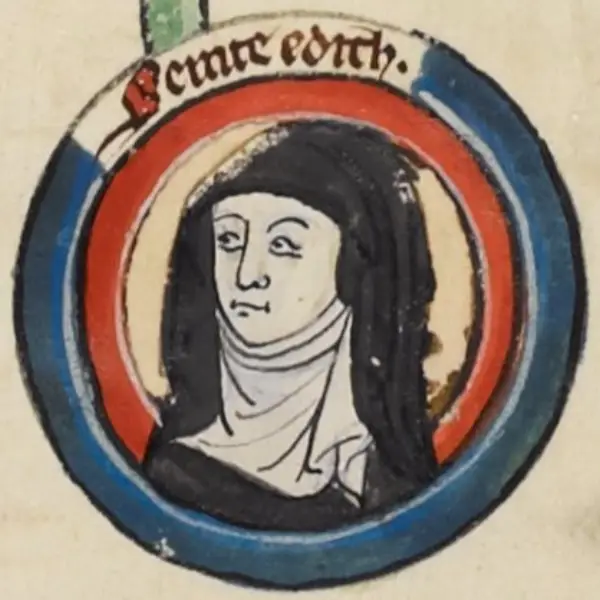
Edith of Wilton (c. 961 – 984) was an English saint who belonged to the Wilton Abbey community, the child of King Edgar of England and of Wulfthryth, who was herself later canonized. Her parents' union was dissolved while she was an infant, and Edith grew up at Wilton alongside her mother, who became the abbey's abbess. Dedicated to God at the age of two in a ceremony her hagiographer calls a major state occasion, Edith received a superb education from foreign chaplains brought in by her father. She lived in the style of a princess — magnificent clothing, a private menagerie, learned accomplishments in music, embroidery, calligraphy and writing — yet refused the authority that was repeatedly offered her: the abbessship of three convents at fifteen, and, tradition says, the English crown itself once her half-brother Edward the Martyr had been assassinated in 978. In 984 she built and endowed a chapel to St Denys at Wilton; at its dedication St Dunstan foretold her death within three weeks and the incorruption of her right thumb. She died on 16 September 984 aged twenty-three, was buried in her chapel, and was elevated to sainthood thirteen years later. Her posthumous cult, rich in miracles of protection and mercy, made Wilton one of the great religious houses of England.
The Complete Life
A King's Daughter Given to God
Edith was born, probably in 961, in the royal vill of Kemsing in Kent, the child of King Edgar of England and Wulfthryth, a noblewoman educated at Wilton Abbey. Whether Wulfthryth was Edgar's wife or concubine has divided scholars: Goscelin calls her the king's wife, Susan Ridyard writes of a wife or concubine, and the Oxford Dictionary of Saints calls her a concubine outright. In either 963 or 964 the union was dissolved, permitting Edgar to remarry and leaving Wulfthryth free to return to Wilton, where she became abbess shortly after Edith's birth. Neither mother nor daughter would ever leave Wilton again. At about the age of two Edith was dedicated to the religious life in a ceremony attended by her father and royal officials, which Barbara Yorke describes as a major state occasion. Goscelin preserves a telling scene from that visit: the king laid before his daughter the finest royal clothes and jewellery, while her mother set out religious objects, and the child chose what her mother offered. Ridyard notes that the story follows a familiar hagiographic pattern, dramatizing a royal saint's renunciation of worldly glory. Edgar secured his daughter an exceptional education at Wilton, engaging two foreign chaplains, Radbod of Rheims and Benno of Trier, to teach her.
§ Birth and childhood
Refusing Abbeys and a Throne
Edith's vocation was marked less by what she accepted than by what she declined. According to Goscelin, at fifteen her father named her to head three convents; she initially refused the positions, preferring, as David Hugh Farmer puts it, the obscurity of the cloister, and insisted on remaining under her mother's authority not from any sense of incompetence but from an overabundance of humility. Modern historians are sceptical: Sarah Foot calls the appointments somewhat implausible and suspects Goscelin confused Edith of Wilton with other women of the same name, and Ridyard likewise doubts that she ever governed a convent. Goscelin, for his part, claims she administered the three houses effectively from a distance and visited them often. An even more startling tradition holds that in 978, her half-brother King Edward the Martyr having been killed, opponents of Æthelred II reportedly proffered her the crown of England — a dignity she likewise declined. Ridyard dismisses the offer as a hagiographic invention of the eleventh century, while Yorke argues it may not be so far-fetched: Edith's upbringing at Wilton, like that of other well-born Anglo-Saxon women, would have prepared her for a public role, perhaps even marriage should circumstances require. Either way, the refusals became the centrepiece of her legend.
§ Political and religious influence
The Princess at the Heart of the Kingdom
Within the Wilton community Edith lived as a royal princess, and her splendour was itself a kind of ministry to the abbey's fortunes. She dressed magnificently, explained Goscelin, because her status demanded it and because the court's continued patronage of Wilton depended on such display; a community that might have rivalled a royal court in affluence needed a visible patroness. Her accomplishments were extraordinary: music, embroidery, calligraphy, painting, writing, composing and prayer, together with what Goscelin calls a blazing intellect in reading. She designed and embroidered a sumptuous linen alb worn on great feast days, copied the community's manual of prayers, kept a menagerie of native and imported animals along the convent's north wall, and helped carry stones in her sleeves for the builders of her chapel. Her influence reached far beyond the cloister. Nobles and foreign ambassadors sought her favour with letters and gifts, ecclesiastics sought her intercession, and petitioners of every rank crowded to her because she could persuade Edgar to overturn judgements or enrich churches; envoys from Rome, France and Germany came to her first when they wanted favours from the king. Yorke argues that Goscelin's claim that mother and daughter played a real part in the intrigues over Edgar's succession deserves to be taken seriously.
§ Political and religious influence
Humility Beneath the Gold
Beneath the gold and gems, Edith's spirituality was one of humility and hidden service. Her splendid dress, her share in royal politics and her appearances at her father's court, Goscelin maintains, never raised a barrier between her and ordinary people, and he points to her care for lawbreakers, the ill and the destitute as proof of her lowliness of heart. A miracle vindicated her wardrobe against those who murmured at it: when a candle fell into the chest holding her clothes, the chest burned and the garments inside were untouched, and it remained in the convent as a standing reminder. Her embroidered alb, which Goscelin saw and described with awe, showed golden images of the apostles around the enthroned Lord, where Edith herself lay prostrate as the penitent supplicant, her lips pressed to the Lord's footprints — an identification with the penitent woman of the Gospel that Katie Ann-Marie Bugyis reads as her vision of monastic leadership as foot-washing service. She copied out the prayer book used by the Wilton nuns. After her death her mother built an almshouse in her memory, and in her visions Edith continued this ministry of mercy: healing the sick, receiving the dying, and obtaining pardon for sinners, even asserting that bonds laid on sinners by the priesthood lay within her power to undo at the last.
§ Dress and response to criticism
The Chapel, the Prophecy, and Death
In about 984, shortly before her death, Edith spent her own funds building a chapel at Wilton dedicated to St Denys. Though made of wood, it was fitted lavishly with gold and semiprecious stones and painted with a cycle of wall-paintings — a final display of the wealth that had marked her whole life, and, as Ridyard observes, her last and most spectacular act of patronage. Goscelin places its dedication beside her rejection of an earthly kingdom as a deliberate contrast between her love of the heavenly kingdom and the crowns she refused. St Dunstan, perhaps her spiritual mentor, consecrated the chapel; towards the end of the ceremony, moved by her manner of signing herself with the cross, he took her right hand in his own and, weeping, foretold that she would die within three weeks and that the thumb with which she signed herself would never see corruption. She died three weeks later, on 16 September 984, at the age of twenty-three. At the moment of her death a nun looking into the abbey church saw angels standing in ranks and singing, and was told to go back, for the angels awaited the good maiden. She was buried in the chapel she had built, as she had instructed, amid a state funeral that gathered the nobility of the realm, and thirty days later she appeared to her mother in a vision, graciously welcomed by her king into everlasting grace.
§ Death
Elevation, Translation, and Miracles
Thirteen years after her death, her brother King Æthelred II, backed by Dunstan and other churchmen, raised her to the honours of the altar, and her cult was consolidated by the translation of her remains on 3 November 987, at which Dunstan presided and her right thumb was found incorrupt, exactly as he had foretold. Ridyard explains the delay by noting that her promotion was taken from the Wilton nuns and driven by prominent individuals who all received visions of Edith urging them to raise her body: the king, an official second in rank only to the monarch, an unnamed magnate, and Dunstan himself, who was also directed by a vision of St Denys. Politics and piety were intertwined. Æthelred and later Cnut supported her cult to establish their legitimacy and to bind themselves to the lineage of King Edgar's children; David Rollason sees the cults of Edith and Edward as contributions to the prestige of the English crown. Her miracles after death were chiefly of protection: relics too heavy for thieves to lift, a nun's headband saved by the menacing rise of the saint's own head, a Glastonbury monk's knife drawing blood as from a living vein, and craft workers struck blind for stealing gold from the shrine. Cnut, saved from a sea storm through her intercession, endowed a golden shrine for her body, and William of Malmesbury records how, after the king jeered at her sanctity and ordered her tomb opened, he repented in terror and her feast was widely kept thereafter.
§ Canonisation and miracles
Memory at Wilton and Beyond
Edith's afterlife at Wilton was as eventful as her short life. Goscelin's Vita Edithe, written between 1078 and 1087 at the request of the community, its abbess Godiva, and Bishop Herman of Salisbury, rests on the oral testimony of the nuns and stands as one of the only near-contemporary accounts of a female religious community in late Anglo-Saxon England, though Ridyard reads the work as an ambitious piece of monastic advocacy. Through the nun Eve of Wilton and the abbess Brihtgifu, whom Edith had chosen as godmother though she died a month before the child's birth, the community's devotion deepened, and visions of the saint guided the choice of later abbesses. Her cult was not uncritical: after the Norman Conquest the nuns complained she had failed to protect them, and were answered in a dream vision with the reminder that she served everyone who asked because she regarded no one as an outsider, and that their trials were the road by which they would become unsullied brides of Christ.. Her memory endures geographically: St Edith's Church at Bishop Wilton in Yorkshire keeps its village feast on her day of 16 September, St Editha's Church at Baverstock near Wilton bears her name, and a church at Limpley Stoke was dedicated to her for five hundred years. In 2023 a pastoral area of the Catholic Diocese of Clifton was named in her honour.
§ Legacy
Timeline
- 961
Born around this year at the royal village of Kemsing in Kent, daughter of King Edgar and the noblewoman Wulfthryth.
§ Birth and childhood
- 963
The union of her parents was dissolved, in either 963 or 964; Wulfthryth brought her back to Wilton and soon became its abbess.
§ Birth and childhood
- 976
At about fifteen, according to Goscelin, her father offered her the leadership of three convents, which she declined.
§ Political and religious influence
- 978
Legend relates that after the killing of her half-brother Edward the Martyr, opponents of Æthelred II proffered her the crown, which she likewise declined.
§ Political and religious influence
- 984
Built a chapel at Wilton Abbey dedicated to St Denys, consecrated by St Dunstan, who foretold her death within three weeks.
§ Death
- 16 Sep 984
Died at Wilton Abbey aged twenty-three and was buried in the chapel she had built, as she had instructed.
§ Death
- 3 Nov 987
Her remains were translated, with Dunstan presiding; her right thumb, as he had foretold, was found undecomposed.
§ Death
- 997
Elevated to sainthood by her brother King Æthelred II, thirteen years after her death and with Dunstan's support, following visions urging the raising of her remains.
§ Canonisation and miracles
- 1016
Cnut, who became king of England this year, cherished a devotion to her after she was believed to have saved him from a sea storm, and later endowed a golden shrine for her relics.
§ Canonisation and miracles
- 1040
By about this time her cult had taken root at Wilton, beginning with nearly identical dreams given to Ælfgifu, wife of Æthelred II.
§ Prophecies and dreams
- 1080
The Wilton abbess Godiva commissioned Goscelin to write the Vita Edithe, the principal source for her life.
§ Legacy
- 1539
Wilton Abbey was dissolved; her personal seal had served as the community's official emblem until then.
§ Political and religious influence
- 2023
A pastoral area of the Catholic Diocese of Clifton was named in her honour.
§ Legacy
In Their Own Words
Never shall this thumb which makes the sign of our salvation see corruption.
Go back; the angels await the good maiden.
Always dressed magnificently.
The Record
- Major works
- The chapel of St Denys at Wilton Abbey, built at her own expense (984)·A copied manual of prayers used at Wilton Abbey·A sumptuous embroidered alb, designed and worked by her own hands·Her personal seal, later adopted as the emblem of Wilton Abbey
- Patron of
- Wilton Abbey
- Symbols
- Learning·beauty
- Canonization
- Elevated to sainthood by her brother King Æthelred II, with the support of St Dunstan, thirteen years after her death (c. 997)
Prayer
Bibliography
Show 7 sources
- Bugyis, Katie Ann-Marie (2019). The Care of Nuns: The Ministries of Benedictine Women in England During the Central Middle Ages. New York: Oxford University Press. ISBN 978-0-19-085128-6.
- Ridyard, Susan J. (1988). The Royal Saints of Anglo-Saxon England: A Study of West Saxon and East Anglian Cults. New York: Cambridge University Press. ISBN 0-521-30772-4.
- Hollis, Stephanie (2004). "Goscelin's Writings and the Wilton Women". In Writing the Wilton Women: Goscelin's Legend of Edith and Liber confortatorius. Turnhout, Belgium: Brepols Publishers. pp. 217–244. ISBN 2-503-51436-7.
- Yorke, Barbara (2003). "The Legitimacy of St Edith". Haskins Society Journal. 11: 97–113. ISSN 0963-4959.
- Farmer, David Hugh (2011). Oxford Dictionary of Saints (5th ed.). Oxford, England: Oxford University Press. pp. 135–136. ISBN 978-0199596607.
- Rollason, David (1989). Saints and Relics in Anglo-Saxon England. Cambridge, Massachusetts: Basil Blackwell. ISBN 0-631-16506-1.
- Foot, Sarah (2019). Veiled Women: Volume II: Female Religious Communities in England, 871-1066. London: Routledge. ISBN 978-1-138-25086-4.
Profile text adapted from the Wikipedia article, licensed CC BY-SA 4.0.
Pray with this saint every day
Save St. Edith of Wilton to your favorites, read the full profile, and get feast-day reminders in the Saints app.
Get the Saints AppFree on the App Store for iPhone and iPad