
1891 – 1942·Feast August 9
St. Teresa Benedicta of the Cross
Philosopher, Carmelite nun, and Auschwitz martyr
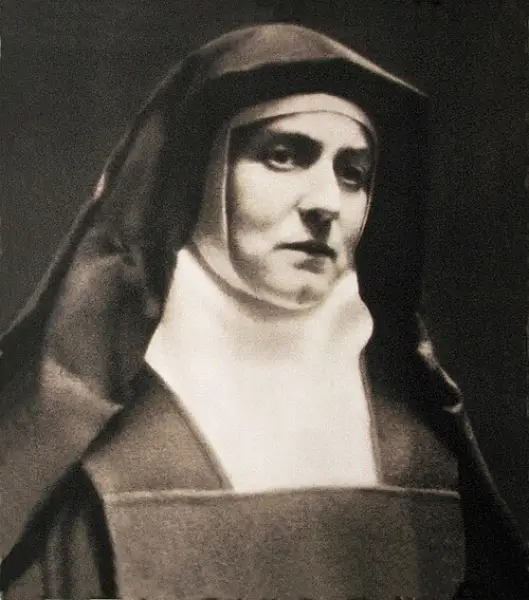
Overview
Edith Stein, who took the name Teresa Benedicta of the Cross in religion, was a German philosopher who embraced Catholicism and became a Discalced Carmelite nun before perishing in the gas chambers of Auschwitz-Birkenau on 9 August 1942. Born in Breslau into a devout Jewish family on Yom Kippur, the youngest of eleven children, she lost her faith as a teenager and pursued philosophy with brilliance, writing a doctoral dissertation on empathy under Edmund Husserl that earned the highest honours in 1916. Her reading of Teresa of Ávila's autobiography in 1921 drew her to Christianity, and she was baptized on New Year's Day 1922. Anti-Jewish legislation forced her from a teaching post in Münster in 1933, and she entered the Carmel of Cologne that October. Transferred to Echt in the Netherlands for safety, she was nevertheless arrested there by the SS on 2 August 1942 in retaliation for the Dutch bishops' public condemnation of Nazi racism, and deported to Auschwitz with her sister Rosa. The Church honours her as a martyr and ranks her among Europe's six patron saints. Pope John Paul II beatified her in 1987 and canonized her in 1998.
The Complete Life
Youngest of Eleven, Born on Yom Kippur
Edith Stein was born in Breslau, in Lower Silesia, on 12 October 1891, into a family of observant Jews. She was the youngest of eleven children, and because her birth fell on Yom Kippur, the most solemn day of the Hebrew calendar, this fact together with her place as the last child made her a particular favourite of her mother. She grew up gifted and hungry for learning, in a household where her widowed mother encouraged critical thinking, and Edith deeply admired the unshaken religious faith her mother carried through hardship after her father's early death. By her teenage years, however, Edith herself had drifted into agnosticism, a loss of belief she would not resolve for more than a decade. Determined that her children receive a thorough education despite the family's circumstances, her mother sent her to study at the Schlesische Friedrich-Wilhelms-Universität in Breslau. At nineteen Edith moved with her family into a house her mother had bought, a home she would later describe in her autobiography. The building survives today as the Edith Stein House, a museum that keeps the memory of the family and of the city's Jewish life before its destruction.
§ Early life
From Husserl's Assistant to the Carmel
Stein's road to Carmel passed through the seminar rooms of German phenomenology. In April 1913 she went to Göttingen to study under Edmund Husserl, chose empathy as her dissertation theme, and completed the doctorate at Freiburg in 1916 with the highest distinction, afterward serving as his assistant until 1918. The tragedies of the First World War, which she had witnessed as a volunteer Red Cross nurse, and the rigour of her philosophical work prepared the ground of her conversion. The decisive moment came in 1921 at Bad Bergzabern, when she read the autobiography of Teresa of Ávila during summer holidays and recognized in it the truth for which she had been searching. She was baptized on 1 January 1922. Her first impulse was to enter the Discalced Carmelites at once, but her spiritual mentors, among them the archabbot Raphael Walzer of Beuron, persuaded her to wait, and she spent the following decade teaching at the Dominican sisters' school in Speyer and later lecturing in Münster. When Nazi legislation removed her from that post in 1933, the way was clear: she entered the Carmel of Cologne-Lindenthal in October 1933 and received the habit the following April as Teresia Benedicta a Cruce.
§ Academic career
Philosopher and Witness Against Nazism
Stein's intellectual mission unfolded in three phases: an early phenomenological period devoted to the questions raised by Husserl's thought, a middle period of comparison between phenomenology and the philosophy of Thomas Aquinas, and a late Christian period in Carmel. As Husserl's assistant she edited the manuscripts later published as Ideas II and III, and her own treatises on psychic causality and community appeared in his yearbook in 1922. Encouraged to bring Aquinas into conversation with the phenomenological movement, she translated De Veritate into German and produced major studies of potency and act and of the human person, while lecturing to large audiences on women's education and vocation. Her greatest works, Finite and Eternal Being and The Science of the Cross, belong to the years in Carmel. She also became a public witness. In a letter to Pope Pius XI written in 1933 she denounced the persecution unfolding in Germany, asking that the Pope raise his voice to put a stop to what she called an abuse of Christ's name. No answer came, and it is uncertain whether he ever saw her words, though his 1937 encyclical Mit brennender Sorge would condemn Nazism and antisemitism in German.
§ Philosophy
The Science of the Cross
In the Cologne Carmel and later at Echt, Stein's spirituality matured into a deliberate offering of herself. She had always felt that the Lord reserved something for her in Carmel that she could find nowhere else, and the order gave her intellectual work as well as prayer: her first assignment was readying Potency and Act for the press, a task that instead blossomed into a new book, Finite and Eternal Being, a Christian doctrine of being that wove together Aquinas, Duns Scotus and Husserl. At Echt she wrote her study of John of the Cross, the Science of the Cross, developing the Carmelite understanding of the soul's deepest life. In a testament dated 9 June 1939 she begged the Lord to take her life and death for the intentions of the hearts of Jesus and Mary, for the safety of her order and of the Carmels at Cologne and Echt, in expiation of the Jewish people's unbelief, for Germany's salvation and for peace across the world, and for everyone she loved, that not one of them should wander from God. Even before the occupation of the Netherlands she believed she would not survive the war, asked her prioress to let her give herself to the heart of Jesus as a vicarious offering for genuine peace, and after May 1940 quietly trained herself for camp life by enduring cold and hunger.
§ Discalced Carmelite nun and martyr
Arrest, Deportation, and Death at Auschwitz
The Netherlands proved no refuge. On 20 July 1942 the Dutch Bishops' Conference had a public condemnation of Nazi racism read in every church of the country, and in retaliation the Reichskommissar Arthur Seyss-Inquart ordered the arrest of Jewish converts who had until then been spared. On Sunday 2 August 1942 an SS detachment took Teresa Benedicta from the Echt Carmel, together with her sister Rosa, who had followed her into the Carmelite life as an extern sister, and with 243 other baptized Jews. The sisters passed through the camps at Amersfoort and Westerbork, where a Dutch official, struck by her serenity and faith, offered her a plan of escape. She refused it, saying that to be snatched from sharing the fate of her brothers and sisters would be utter annihilation. On 7 August a transport of 987 Jews left for Auschwitz. Birkenau's gas chambers claimed the sister-saints — Teresa Benedicta, that is, and Rosa — along with so many other deportees, most likely on 9 August 1942. The Church numbers her among the martyrs precisely because she died in reprisal for the bishops' public defence of the moral teaching of the gospel.
§ Discalced Carmelite nun and martyr
Beatified and Canonized by John Paul II
In Cologne on 1 May 1987 Pope John Paul II declared Teresa Benedicta of the Cross blessed as a martyr, and eleven years later, on 11 October 1998, he enrolled her among the saints in Rome. The miracle recognised for her canonization centred on a young girl, Benedicta McCarthy, who had ingested a dangerous dose of paracetamol and suffered hepatic necrosis. Her father, Emmanuel Charles McCarthy, a priest of the Melkite Greek Catholic Church, gathered the family in prayer for Teresa Benedicta's intercession, and the nurses of the intensive care unit then watched the child sit up, entirely recovered. Ronald Kleinman, the paediatric specialist at Massachusetts General Hospital in Boston who had treated her, testified before the church tribunals that he was willing to call the recovery miraculous; he later attended the canonization. The beatification was not without controversy. Some observers argued that honouring a Jewish convert as a martyr seemed to carry a quiet message encouraging conversionary activity. The Church's position, stated at the time, was that Teresa Benedicta died also because the Dutch episcopate had publicly condemned Nazi racism — that is, she died for the moral teaching of the Church, and is therefore a true martyr. She is venerated in the Catholic Church and the Anglican Communion alike.
§ Legacy and veneration
Patron of Europe and of Thinkers
Teresa Benedicta of the Cross stands among the six patron saints of Europe, alongside Benedict of Nursia, Cyril and Methodius, Bridget of Sweden, and Catherine of Siena — a Jewess of Germany who became a Catholic martyr honoured across the continent. Her philosophical writings, gathered since 2000 in a critical German edition with English and Polish translations, continue to shape phenomenology, Christian philosophy and the theology of the human person, and a scholarly association founded in 2009 promotes their study internationally. Her memory is kept in many forms: schools bear her name in Lubliniec, Darmstadt, Hengelo and Mississauga; university buildings in Tübingen, Worcester and Vienna are dedicated to her; museums in Wrocław and Lubliniec preserve her family's homes. A memorial sculpture by Bert Gerresheim was dedicated in Cologne in 1999, showing her in three perspectives of her Jewish and Christian faith above a pile of empty shoes for the victims of the Holocaust; the first Stolperstein laid in Poland, in 2008, stands near her childhood home in Wrocław, and her bust was installed at the Walhalla memorial near Regensburg in 2009. A bell named for her hangs in Bayeux Cathedral. In 2024 the Discalced Carmelites formally asked Pope Francis to declare her a Doctor of the Church.
§ Legacy and veneration
Timeline
- 12 Oct 1891
Born in Breslau, Lower Silesia, on 12 October, the youngest of eleven children in an observant Jewish family.
§ Introduction
- Apr 1913
Enrolled at Göttingen in April for the summer semester, studying under Edmund Husserl.
§ Academic career
- Jul 1914
Her studies were interrupted in July by the outbreak of the First World War.
§ Academic career
- 7 Apr 1915
Served as a volunteer wartime Red Cross nurse at a hospital for infectious diseases from 7 April to 1 September.
§ Academic career
- 1916
Received her Freiburg doctorate summa cum laude for a dissertation on empathy and became Husserl's teaching assistant.
§ Academic career
- 1917
Her doctoral thesis was published in book form under the title On the Problem of Empathy.
§ Academic career
- 1919
The University of Göttingen rejected her habilitation thesis, an outcome she attributed to attempts failing because she was a woman.
§ Academic career
- 1921
Read the autobiography of Teresa of Ávila during a summer holiday at Bad Bergzabern, prompting her conversion.
§ Academic career
- 1 Jan 1922
Baptized into the Catholic Church on New Year's Day.
§ Academic career
- 1923
Took a position teaching at the Dominican nuns' school in Speyer, where she remained until 1931.
§ Academic career
- Apr 1929
Visited Husserl and Heidegger at Freiburg in April, the month Heidegger addressed Husserl on his seventieth birthday.
§ Academic career
- 1932
Took up a lectureship at the church-affiliated Münster institute devoted to scientific pedagogy.
§ Academic career
- 1933
Forced to resign under Nazi antisemitic legislation, she wrote to Pope Pius XI denouncing the regime and asking him to speak out.
§ Discalced Carmelite nun and martyr
- Oct 1933
Entered the Discalced Carmelite monastery in Cologne-Lindenthal in October, taking the name Teresia Benedicta a Cruce.
§ Discalced Carmelite nun and martyr
- Apr 1934
Received the habit as a novice in April, taking the religious name Teresia Benedicta a Cruce.
§ Discalced Carmelite nun and martyr
- 21 Apr 1935
Made her temporary vows on 21 April.
§ Discalced Carmelite nun and martyr
- 1938
For safety from the Nazi threat, she and her sister Rosa were transferred to the Carmelite monastery at Echt in the Netherlands.
§ Discalced Carmelite nun and martyr
- 21 Apr 1938
Professed perpetual vows on 21 April.
§ Discalced Carmelite nun and martyr
- 9 Jun 1939
Signed a testament on 9 June offering her life and death for the church, for Germany, and for the peace of the world.
§ Discalced Carmelite nun and martyr
- May 1940
Following Germany's May invasion of the Netherlands, she began readying herself, through cold and hunger, for camp existence.
§ Discalced Carmelite nun and martyr
- 20 Jul 1942
A statement condemning Nazi racism, issued by the Dutch bishops, was read in churches across the nation.
§ Discalced Carmelite nun and martyr
- 2 Aug 1942
Arrested by the SS on 2 August with 243 baptized Jewish Catholics, in reprisal ordered by Reichskommissar Seyss-Inquart.
§ Discalced Carmelite nun and martyr
- 9 Aug 1942
Deported to Auschwitz on 7 August; probably killed in a Birkenau gas chamber on 9 August with her sister Rosa.
§ Discalced Carmelite nun and martyr
- 1 May 1987
Beatified as a martyr in Cologne by Pope John Paul II.
§ Legacy and veneration
- 11 Oct 1998
Canonized by Pope John Paul II in Rome, eleven years after her beatification.
§ Legacy and veneration
In Their Own Words
It always seemed to me as if the Lord had reserved something for me in Carmel that I could only find there.
I beg the Lord to take my life and my death … for all concerns of the sacred hearts of Jesus and Mary and the holy church.
If somebody intervened at this point … that would be utter annihilation.
The Record
- Major works
- On the Problem of Empathy (dissertation, 1916/1917)·Philosophy of Psychology and the Humanities (1922)·Potency and Act (1931)·Finite and Eternal Being (1935/1936)·The Science of the Cross (1941/1942)·German translation of Thomas Aquinas, De Veritate (published 1932)
- Patron of
- Europe·loss of parents·converted Jews·martyrs·World Youth Day
- Symbols
- Discalced Carmelite nun's habit·cross·book or scroll with Hebrew letters·burning bush·martyr's palm
- Canonization
- Beatified 1 May 1987 in Cologne by Pope John Paul II; canonized 11 October 1998 in Vatican City by Pope John Paul II
Prayer
Bibliography
Show 7 sources
- "Teresa Benedicta of the Cross Edith Stein (1891-1942) - biography". www.vatican.va.
- Thomas Szanto, Dermot Moran. "Edith Stein". In Zalta, Edward N. (ed.). Stanford Encyclopedia of Philosophy. ISSN 1095-5054.
- Stein, Edith (1989). On the Problem of Empathy. The Collected Works of Edith Stein, vol. 3 (Third revised ed.). Washington, D.C.: ICS Publications. ISBN 9780935216110.
- MacIntyre, Alasdair C. (2006). Edith Stein: A Philosophical Prologue, 1913–1922. Lanham, MD: Rowman & Littlefield. ISBN 9780742559530.
- Scaperlanda, María Ruiz (2001). Edith Stein: St. Teresa Benedicta of the Cross. Huntington, Indiana: Our Sunday Visitor Press.
- Posselt, Teresia Renata (1952). Edith Stein: The Life of a Philosopher and Carmelite. Sheed and Ward.
- Mosley, J. (2006). "The Ultimate Sacrifice". In Edith Stein: Modern Saint and Martyr (pp. 43–52). Mahwah, N.J.: HiddenSpring.
Profile text adapted from the Wikipedia article, licensed CC BY-SA 4.0.
Pray with this saint every day
Save St. Teresa Benedicta of the Cross to your favorites, read the full profile, and get feast-day reminders in the Saints app.
Get the Saints AppFree on the App Store for iPhone and iPad