
1540-1581·Feast December 1
St. Edmund Campion
Jesuit Priest and Martyr
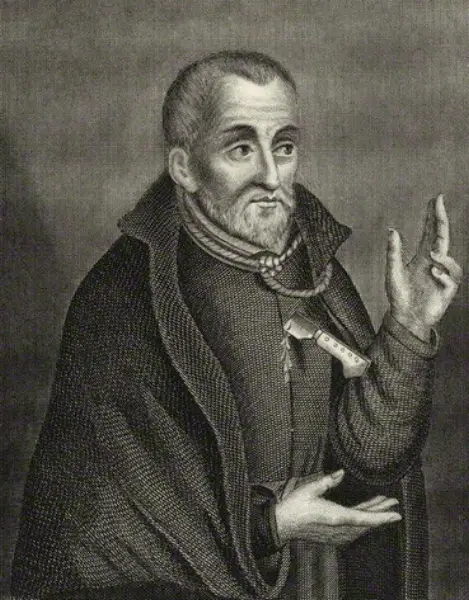
Overview
Edmund Campion was born in London on 25 January 1540, son of a bookseller whose shop stood in Paternoster Row close to St Paul's. A prodigy of Christ's Hospital school and of St John's College, Oxford, he became junior fellow in 1557, won his master's degree in 1564, and delighted Queen Elizabeth when she visited the university, earning the patronage of Cecil and Leicester. Yet the brilliant orator was increasingly drawn to the old faith; after a reluctant Anglican diaconate he withdrew to Ireland in 1569, writing a history of the country while eluding arrest as 'Mr Patrick'. In 1571 he slipped to Douai, was reconciled to the Catholic Church, and taught rhetoric at William Allen's English College. Walking to Rome as a pilgrim, he became the first novice received by the Jesuit General Mercurianus in April 1573, and then taught rhetoric and philosophy for six years in Brünn and Prague, where he was ordained priest in 1578. In June 1580 he entered England disguised as a jewel merchant and began a hunted ministry of preaching and the sacraments, issuing his famous Brag and the Decem Rationes. Betrayed by the spy George Eliot at Lyford Grange in July 1581, he was racked in the Tower, held four public disputations, and on 20 November was convicted of treason. The execution — hanging, drawing and quartering — was carried out at Tyburn on 1 December 1581; Campion was forty-one.
The Complete Life
Early Life
Edmund Campion was born in London on 25 January 1540, born to a bookseller of Paternoster Row, hard by St Paul's — a childhood spent among the tools of learning, in a city where the books themselves were being rewritten around him. A prodigy at the new Christ's Hospital school, he went up to St John's College, Oxford, became a junior fellow in 1557 at seventeen, and won his master's degree in 1564. When Queen Elizabeth visited the university he delighted her with an oration, and the patronage of Cecil and Leicester seemed to open before him. He took Anglican deacon's orders reluctantly, pressed by the Bishop of Gloucester, while inwardly unconvinced. The most promising young don in England was, by his own account, a man being pulled in two directions at once.
§ Early years and education (1540–1569)
Conversion and Vocation
Campion resolved the division by leaving. In 1569 he withdrew to Ireland, where he wrote a history of the country while moving under the name of 'Mr Patrick' to elude arrest. In 1571 he slipped to Douai in the Spanish Netherlands, was reconciled to the Catholic Church, and taught rhetoric at William Allen's English College, the seminary built to supply priests for the reconversion of England. Then, characteristically, he walked to Rome as a pilgrim; in April 1573 he became the first novice received into the Society of Jesus by the Jesuit General Mercurianus, and spent the next six years teaching rhetoric and philosophy at Brünn and Prague. He was ordained a Catholic priest in Prague in 1578, saying his first Mass on 8 September. He had found, late and by a long road, the two things his nature wanted: the old faith, and an order vowed to fight for it.
§ Rome, Brünn and Prague (1573–1580)
Mission and Ministry
In June 1580 Campion entered England disguised as a jewel merchant and began the hunted ministry that made his name. He preached and administered the sacraments from Catholic houses across the country, moving by night, saying Mass in bedrooms and attics, while the government's pursuivants hunted the author of two extraordinary documents. The first, Campion's Brag, written even before he landed, announced his presence to the Privy Council as a challenge: he had come to preach the faith, and if his opponents were so confident, let them dispute with him. The second, the Decem Rationes — ten reasons demonstrating the Catholic religion — was printed secretly and laid on the benches of the university church of St Mary's in Oxford, an assault on his own beloved alma mater, which the authorities answered with a manhunt.
§ Mission to England (1580–1581)
Spirituality and Teaching
Campion's genius was to make the intellectual case for Catholicism under conditions that made argument itself a crime. The Brag and the Decem Rationes established the terms on which the Elizabethan persecution would be argued for centuries: not rebellion, which he explicitly disclaimed, but disputation — an appeal to history, patristics, and reason against a settlement imposed by statute. His Jesuit spirituality joined this intellectual confidence to a plain acceptance of death; the Brag closes with the famous prophecy that his death would be the beginning of the controversy's resolution. In his person the two cultures of the old and new learning met: the Oxford orator and the hunted priest, each sharpening the other.
§ Mission to England (1580–1581)
Trial and Final Years
Betrayed by the priest-hunter George Eliot at Lyford Grange in July 1581, Campion was taken to the Tower and racked — the first of a series of examinations conducted, with the government's characteristic combination of cruelty and publicity, as four public disputations in which the prisoner, fresh from torture, was required to debate divines with free access to libraries. On 20 November 1581 he was convicted of treason at Westminster. The execution at Tyburn — hanging, drawing and quartering — took place on 1 December 1581, when Campion, forty-one years old, died alongside Ralph Sherwin and Alexander Briant. The crowd's hostile mood turned as the three died, and Campion's last words — that he was condemned for being a Catholic priest, and that he died forgiving — were heard through the crowd in silence. He was the most famous judicial killing of Elizabeth's reign.
§ Trial, sentence and execution
Canonization
Campion was among the English martyrs beatified by Leo XIII in December 1886, the cohort that first gave formal recognition to the Reformation dead. On 25 October 1970 Pope Paul VI canonized him among the Forty Martyrs of England and Wales, the collective canon of priests and laity of the English persecution. He is also counted among the Douai Martyrs, the seminary priests trained at his own first refuge. His feast is kept with the Forty on 25 October, and he remains the best known of them all. He is counted also among the Douai Martyrs, the seminary priests of the college that had sheltered him, whose memorial is kept on 29 October.
§ Introduction
Legacy
Campion's legacy is literary as much as devotional: the Brag and the Decem Rationes have never been out of the Catholic argument, and his life became the template of the Elizabethan Jesuit mission as his contemporaries told it — the brilliant convert who came home to die. Churches, schools, and colleges across the English-speaking world bear his name. In Oxford, the scene of his provocation, a permanent private hall now exists under his patronage, a fact he would have relished: the university that saw his Ten Reasons scattered on its benches now teaches theology under the name of the man who scattered them.
§ Mission to England (1580–1581)
Timeline
- 25 Jan 1540
Born in London, son of a bookseller of Paternoster Row near St Paul's Cathedral.
§ Early years and education (1540–1569)
- Aug 1553
Chosen, at thirteen, to give the welcoming address when Queen Mary came to the city.
§ Early years and education (1540–1569)
- 1557
Became junior fellow of St John's College, Oxford, sponsored by William Chester.
§ Early years and education (1540–1569)
- 1560
Took the required Oath of Supremacy, probably on receiving his B.A. degree.
§ Early years and education (1540–1569)
- 1564
Took his master's degree at Oxford and won the lasting regard of Queen Elizabeth.
§ Early years and education (1540–1569)
- 1564
Ordained deacon in the Anglican Church at the persuasion of Richard Cheyney, Bishop of Gloucester.
§ Rejecting Anglicanism
- 1569
Left Oxford for Ireland, where he studied privately and wrote A Historie of Ireland under the name Mr Patrick.
§ Ireland (1569–1570)
- 1571
Escaped secretly to Douai, was reconciled to the Catholic Church, and taught rhetoric at the English College.
§ Douai (1571–1573)
- 21 Jan 1573
Granted the degree of Bachelor of Divinity by the University of Douai.
§ Douai (1571–1573)
- Apr 1573
In Rome, entered the Society of Jesus as the first novice whom its Superior General, Mercurianus, accepted.
§ Rome, Brünn and Prague (1573–1580)
- 8 Sep 1578
Said his first Mass after ordination as deacon and priest by the Archbishop of Prague.
§ Rome, Brünn and Prague (1573–1580)
- 24 Jun 1580
Entered London disguised as a jewel merchant with Robert Persons' mission, and at once began to preach.
§ Mission to England (1580–1581)
- 27 Jun 1581
His Decem Rationes, printed secretly at Stonor Park, was found in 400 copies on the benches of St Mary's, Oxford.
§ Mission to England (1580–1581)
- 14 Jul 1581
Preached at Lyford Grange on this day and the next, then was betrayed there by the spy George Eliot.
§ Mission to England (1580–1581)
- 1 Sep 1581
Held the first of four public disputations with Anglican adversaries, the others following on 18, 23 and 27 September.
§ Imprisonment, torture and disputations
- 14 Nov 1581
Arraigned at Westminster with several others on a charge of conspiring to raise sedition and dethrone the Queen.
§ Imprisonment, torture and disputations
- 20 Nov 1581
Tried and found guilty of treason; sentence of hanging, drawing and quartering was read against him.
§ Trial, sentence and execution
- 1 Dec 1581
Dragged to Tyburn with Ralph Sherwin and Alexander Briant and hanged, drawn and quartered, aged forty-one.
§ Trial, sentence and execution
- 9 Dec 1886
Beatified in Rome by Pope Leo XIII.
§ Veneration and feast day
- 25 Oct 1970
Canonised by Pope Paul VI among the group honoured as the Forty Martyrs of England and Wales.
§ Veneration and feast day
In Their Own Words
In condemning us, you condemn all your own ancestors, all our ancient bishops and kings, all that was once the glory of England—the island of saints, and the most devoted child of the See of Peter.
The Record
- Major works
- Campion's Brag (Challenge to the Privy Council)·Decem Rationes (Ten Reasons)·A Historie of Ireland·Ambrosia (play, staged Prague 1578)
- Symbols
- Jesuit habit·Rope and hurdle of Tyburn·Paper inscribed 'Campion, the Seditious Jesuit'
- Canonization
- Beatified 9 December 1886 by Pope Leo XIII; canonized 25 October 1970 by Pope Paul VI as one of the Forty Martyrs of England and Wales
Prayer
Bibliography
Show 1 sources
- ↑ It has often been reported that the Queen herself was present at this meeting, based upon second-hand reports, contained in letters sent after the supposed meeting, from people who were not present. More recently, however, correspondence
Profile text adapted from the Wikipedia article, licensed CC BY-SA 4.0.
Pray with this saint every day
Save St. Edmund Campion to your favorites, read the full profile, and get feast-day reminders in the Saints app.
Get the Saints AppFree on the App Store for iPhone and iPad