
c. 1567 – 1591·Feast October 25
St. Edmund Gennings
Priest and Martyr of the English Reformation
Overview
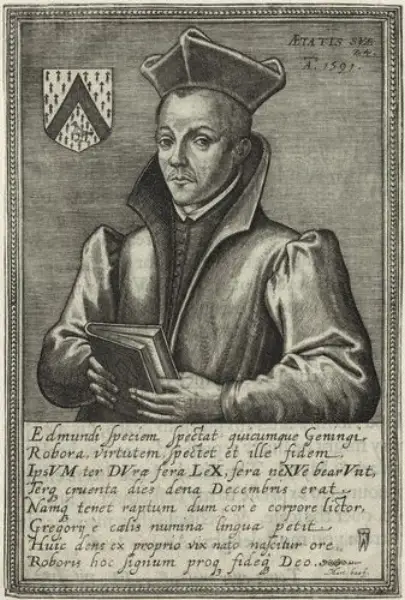
Edmund Gennings was an English Roman Catholic priest executed under Elizabeth I during the persecution that followed the English Reformation. Born at Lichfield around 1567, he was a serious, faith-minded boy who at sixteen entered the household of the Catholic gentleman Richard Sherwood as a page. Sherwood's example drew him toward the old faith, and when his master left England to train for the priesthood, Gennings followed him abroad. He studied at the English College at Rheims and was ordained at Soissons in 1590, aged only about twenty-three. Returning secretly to England under the alias Ironmonger, he landed at Whitby and made a month-long search of London for his estranged younger brother, who refused his overtures out of fear. In November 1591 he was captured by the priest-hunter Richard Topcliffe while celebrating Mass at the house of Swithun Wells in Gray's Inn. Condemned for his priesthood, he died on the scaffold outside that same Gray's Inn house on 10 December 1591, calling on Saint Gregory with his last breath. His witness converted his brother John, who became a priest and wrote his biography. Gennings was beatified in 1929 and canonized among the Forty Martyrs of England and Wales in 1970.
The Complete Life
A Serious Boy of Lichfield
Edmund Gennings was born at Lichfield in Staffordshire in 1567, into a generation raised entirely under the religious settlement of Elizabeth I, a generation after the old faith had been outlawed. Even as a boy he stood out as thoughtful and serious, with a natural inclination toward matters of faith that set him apart from his surroundings. The decisive turn came when he was about sixteen, when he entered the service of Richard Sherwood, a Catholic gentleman, as a page. In Sherwood's household the boy encountered at first hand the quiet fidelity of recusant Catholicism, and his master's example left a deep impression on him. When Sherwood resolved to leave England and pursue ordination on the continent, Gennings made the momentous choice to follow him. The path led him to the English College at Rheims, the seminary that trained missionary priests for the dangerous English mission. There he prepared for the priesthood with such speed that he was ordained at Soissons in 1590, still only about twenty-three years old. Ordination was not for him a quiet career but a sentence to perpetual hazard: newly made a priest, he immediately turned back toward the perils of England, travelling under the assumed name of Ironmonger to disguise his identity from the authorities who hunted seminary priests.
§ Life
Following Sherwood to the Priesthood
Gennings's vocation unfolded through the influence of another man's fidelity. As page to Richard Sherwood, he watched a Catholic gentleman live his faith under legal disability, and the observation ripened into conviction. When Sherwood left England to become a priest, Gennings went after him, presenting himself to the English College at Rheims, the principal seminary serving the missionary enterprise in England. His progress was rapid: ordained a priest at Soissons in 1590 at roughly twenty-three years of age, he belonged to the cohort of seminary priests whose very existence was high treason under the statutes of the Elizabethan regime. He returned at once to the dangers of his homeland under the alias Ironmonger, landing at Whitby on the Yorkshire coast. Family ties, severed by his conversion, pulled at him: almost all of his Lichfield kin were dead, and his one surviving brother had moved to London. Gennings spent a whole month combing the city, visiting every place where the young man might be found, until on the point of giving up he achieved his purpose. But the reunion brought heartbreak rather than reconciliation. The brother, far from being won to the old faith, begged Gennings to go away, lest association make him suspect. Gennings returned to France, but not for long.
§ Life
A Brief and Hazardous Mission
Gennings came back to London in 1591 to exercise the ministry for which he had been formed. His missionary career lasted only months. The capital was the centre of the government's campaign against seminary priests, directed in practice by informers and priest-hunters such as Richard Topcliffe. On 7 November 1591, Gennings and a fellow priest, Polydore Plasden, were seized by Topcliffe and his officers at the very moment of celebrating Mass inside the home of Swithun Wells at Gray's Inn. The capture of priests at the altar, together with the household that sheltered them, exposed everyone present to the capital statutes against Catholic worship and the priesthood. Wells himself, though an old man who had not said Mass, was implicated by the discovery in his own home. Gennings was condemned to the traitor's death of hanging, drawing and quartering, to be carried out outside the house where he had been arrested. His months of ministry thus closed where they had been exercised: in a London transformed into a mission field, where the Mass could be celebrated only in secret rooms, and where the price of the sacraments was paid at the gallows.
§ Mission
Martyrdom at Gray's Inn
Gennings suffered on 10 December 1591, aged about twenty-four, outside the house of Saint Swithun Wells at Gray's Inn where he had been taken a month earlier. The execution was marked by exceptional cruelty. His dying words so infuriated Topcliffe that he commanded the rope be severed while the young priest hung barely unconscious, so that he suffered the remaining horrors of the sentence while still conscious. Even under the knife he did not fall silent: his reported cry, even under the knife, was Sancte Gregori ora pro me — the words mean, Saint Gregory, pray for me. The executioner, so the same account runs, swore that Gregory's name still filled the mouth whose heart he held, and taunted the dying man as an egregious Papist; Wells followed him to the gallows at once. The spectacle did not produce the deterrence intended. Among the extraordinary incidents that followed the martyrdom, the chief was the conversion of Gennings's younger brother John, the very brother who had once begged him to stay away for fear of suspicion. John became a priest himself and wrote his brother's biography, published at Saint-Omer in 1614, ensuring that the story of the young martyr of Gray's Inn would survive.
§ Arrest and Execution
Beatification and Canonization
The recognition of Gennings's martyrdom came centuries after his death, in the long process by which the Church honoured the priests and laypeople executed under the Elizabethan and early Stuart regimes. He was beatified by Pope Pius XI on 15 December 1929, one of a large group of English martyrs advanced in that era. The culminating act came on 25 October 1970, when Pope Paul VI canonized him as one of the Forty Martyrs of England and Wales, the representative body of men and women put to death for the Catholic faith between the reigns of Elizabeth I and Charles II. The Forty Martyrs share a common feast day of 25 October, on which Gennings is liturgically remembered, in addition to the date of his execution, 10 December. He is honoured in iconography with a priest's biretta and a book of hours, the signs of his priesthood and of the prohibited worship for which he died. His canonization placed the young priest of Lichfield permanently among the saints of the universal Church, confirming the judgment of those who had venerated his memory since the seventeenth century.
§ Veneration
Memory and Continuing Influence
Gennings's legacy began with the testimony of those who watched him die and with the pen of his brother. John Gennings's conversion, prompted by his brother's martyrdom, gave the Church both a priest and a biographer: the life published at Saint-Omer in 1614 fixed the facts of the martyr's career for later generations and passed into the tradition collected by Richard Challoner in his Memoirs of Missionary Priests. In modern times his memory has taken institutional form in the English Midlands not far from his native Lichfield. In 1967 a Catholic Mass centre was opened in the New Invention district of Willenhall in the West Midlands, and in time it was rebuilt as a church bearing Saint Edmund Gennings's name, making his name a living presence in the worship of the region. Within the communion of the Forty Martyrs of England and Wales, canonized together in 1970, he represents the seminary priests of Rheims and Douai who slipped back into England under false names to keep the old faith alive. His story is told alongside those of his fellow captives of November 1591, Swithun Wells and Polydore Plasden, as part of the memory of a Church that survived persecution through the endurance of its youngest clergy.
§ Veneration
Timeline
- 1567
Born at Lichfield, Staffordshire, into a family that would later be estranged by his conversion.
§ Life
- 1583
At about sixteen, became a page to the Catholic gentleman Richard Sherwood, whose example shaped his faith.
§ Life
- 1590
Followed Sherwood abroad to the English College at Rheims and was ordained a priest at Soissons, aged about twenty-three.
§ Life
- 1590
Returned at once to England under the assumed name Ironmonger, landing at Whitby.
§ Life
- 1591
Came back to London after a stay in France, opening a missionary phase that would prove short-lived.
§ Mission
- 7 Nov 1591
Seized by Richard Topcliffe while saying Mass at Swithun Wells's house in Gray's Inn, London, together with Polydore Plasden.
§ Arrest and Execution
- 10 Dec 1591
Hanged, drawn and quartered outside the same Gray's Inn house, aged about twenty-four; Swithun Wells was hanged immediately afterwards.
§ Arrest and Execution
- 1614
His converted brother John, who later became a priest, published a biography of him at Saint-Omer.
§ Arrest and Execution
- 15 Dec 1929
Beatified by Pope Pius XI.
§ Veneration
- 1967
A Catholic Mass centre opened at New Invention, Willenhall, was later rebuilt and dedicated to him.
§ Veneration
- 25 Oct 1970
Canonized by Pope Paul VI as one of the Forty Martyrs of England and Wales.
§ Veneration
In Their Own Words
Sancte Gregori ora pro me
The Record
- Major works
- Missionary priesthood in penal England (no writings survive; his biography was written by his brother John)
- Patron of
- Forty Martyrs of England and Wales·persecuted Catholics
- Symbols
- priest's biretta·book of hours
- Canonization
- Canonized by Pope Paul VI on 25 October 1970 as one of the Forty Martyrs of England and Wales; beatified by Pope Pius XI on 15 December 1929.
Prayer
Bibliography
Show 4 sources
- Hess, Lawrence. "Edmund and John Gennings." The Catholic Encyclopedia Vol. 6. New York: Robert Appleton Company, 1909.
- Baier, Ronny (2010). "Edmund Gennings". In Bautz, Traugott (ed.). Biographisch-Bibliographisches Kirchenlexikon (BBKL). Vol. 31. Nordhausen: Bautz. cols. 486–488. ISBN 978-3-88309-544-8.
- Challoner, Richard. Memoirs of Missionary Priests.
- "New Invention – St Edmund Gennings". Catholic Trust for England and Wales and English Heritage. 2011.
Profile text adapted from the Wikipedia article, licensed CC BY-SA 4.0.
Pray with this saint every day
Save St. Edmund Gennings to your favorites, read the full profile, and get feast-day reminders in the Saints app.
Get the Saints AppFree on the App Store for iPhone and iPad