
died 20 November 869·Feast November 20
St. Edmund the Martyr
King of East Anglia Slain by Vikings
Overview
Edmund the Martyr, also called St Edmund and Edmund of East Anglia, was king of the East Angles from about 855 until his death on 20 November 869. Almost nothing of his life survives in contemporary record: the Viking devastation of his kingdom destroyed the charters that might have referred to him, and the only contemporary mentions are notices of his death in Asser's life of Alfred and the Anglo-Saxon Chronicle. Coins minted in his name, shared moneyers with his predecessor Æthelweard, and the legend Edmund, King of the Angles show that he ruled for some years and likely succeeded peacefully. Modern scholars take him for an East Anglian by birth, though later medieval writers invented elaborate genealogies for him. In the autumn of 865 the Great Heathen Army landed in East Anglia; Edmund bought peace with horses and supplies until the Vikings moved on to York. In 869 they returned, wintering at Thetford. The Chronicle records that Edmund fought them, that the Danes won, killed the king, and conquered the land; whether he fell in battle or was murdered after refusing to renounce Christ became the subject of divergent medieval traditions. Abbo of Fleury's influential account, written about 986, portrays a king who threw away his weapons and died a martyr. A popular cult arose immediately: memorial coins hailed him as a saint, his relics were translated to Bury St Edmunds, and his shrine became one of the wealthiest in medieval England.
The Complete Life
A King of Shadowy Origins
Edmund emerges from history almost entirely through his coins and his death. East Anglia was so thoroughly devastated by the Vikings that any contemporary charters referring to his reign were destroyed, and his existence is known chiefly from moneyers' coins and from two notices of his end: Asser's life of Alfred the Great and the Anglo-Saxon Chronicle. Three of his moneyers — Dudda, Eadmund, and Twicga — had also minted for his predecessor Æthelweard, which suggests that power passed smoothly between the two kings. The volume of coinage struck in his name points to a reign of several years. His coins bear the letters AN for 'Anglia', found on those of only one other ninth-century East Anglian king, in the phrase Edmund, King of the Angles, later shortened to Edmund, King. The 12th-century Annals of St Neots adds that he succeeded on Christmas Day 855 at the age of fourteen and was crowned by Bishop Hunberht at the royal vill of Burna in Suffolk on Christmas Day 856, though no source for these statements is known. No ruling dynasty can claim him. The tenth-century monk Abbo of Fleury described him as sprung from the ancient nobility of the Saxons, a phrase modern historians take as an acknowledgement that his true origins were unknown. Later accounts imagining a Saxon father named Alcmund or a birth at Nuremberg are outright fictions of hagiographers.
§ Accession and rule
Ruling a Kingdom Beneath the Storm
Edmund ruled the East Angles during the generation in which Viking raiding turned into conquest. For decades after the attack on Lindisfarne in 793, Scandinavian fleets had struck mainly at isolated monasteries, but a larger-scale assault came around 844, and by the end of that decade the Vikings had begun to over-winter in England. Into this gathering storm the king of the East Angles governed a wealthy, exposed coastal kingdom, and his coinage testifies to an organized administration: a variety of issues were struck during his reign by a body of moneyers whose craft would soon serve his memory. In the autumn of 865 an invading host of well over 5,000 warriors — the great heathen army of the Anglo-Saxon Chronicle — landed in East Anglia. Edmund chose not to contest their landing. He made peace with the invaders and supplied them with horses and other provisions, and they remained in his kingdom until the following summer, when they marched north against York. Before 867 closed, the Danes fell upon Mercia and concluded terms with the Mercians. The respite Edmund purchased could not last: a year later the Vikings turned back toward East Anglia, and the king who had once bought peace with tribute and horses would face them at last on his own soil.
§ Death and burial
The Great Heathen Army Returns
The Anglo-Saxon Chronicle, which otherwise says little of the East Angles and their rulers, gives the bare outline of the catastrophe: the Danish host swept across Mercia into East Anglia and made its winter quarters at Thetford; in the fighting that winter Edmund joined battle with them, the Danes carried the day, slew the king, and overran the whole country. The place of his death, and whether he fell in the fighting or was slaughtered by the Danes once it was lost, can no longer be established. The medieval traditions diverged on precisely this point: some versions give a warrior king who fell fighting the invaders, while others, above all Abbo of Fleury's Passio Sancti Eadmundi of about 986, tell of a king who shunned battle with the Danes, choosing a martyr's death over any denial of Christ. Historians such as Susan Ridyard caution that Edmund's martyrdom cannot be proven from the Chronicle, and that the story of his armour-bearer may belong to the realm of hagiographical fantasy — though the surviving tale of a sword-bearer witness implies a king prepared for war. After the victory, the Great Heathen Army pushed on into Wessex in late 870, where Æthelred and his brother, the future Alfred the Great, confronted it. Edmund's kingdom passed under Danish rule; the conquered land would not return to English hands until Wessex absorbed East Anglia in 918.
§ Death and burial
The Martyr of the Passio
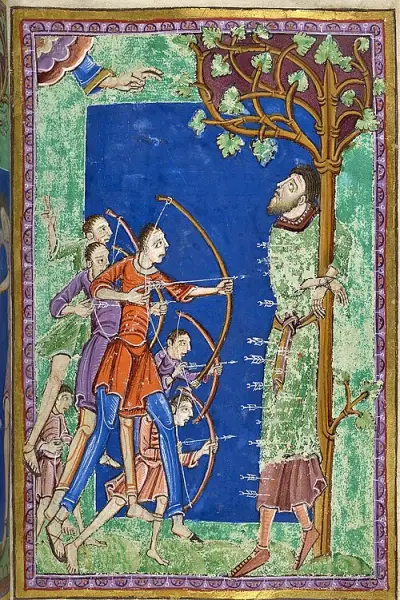
The spiritual portrait of Edmund rests on Abbo of Fleury's Passio Sancti Eadmundi, written around 986 at the request of the monks of Ramsey Abbey, who had heard the story from St Dunstan through an old man who swore he had been Edmund's sword-bearer. In Abbo's telling, the king refused to fight, threw away his weapons in imitation of Christ, who had forbidden Peter to take up the sword, and allowed himself to be bound. The Viking leader Hinguar — probably identifiable with Ivar the Boneless, son of Ragnar Lodbrok — had him beaten with rods and whips, tied to a tree, and shot with spears until his body bristled like a hedgehog, in deliberate echo of the martyrdom of St Sebastian. Edmund called on Christ between the blows, and his constancy so enraged the heathens that Ivar ordered him beheaded. Ælfric of Eynsham's Old English paraphrase preserves the scene for English readers, down to the detail that the king's soul journeyed happily to Christ. The Passio continues with legend: the severed head, thrown into the wood, answered his searching followers' cries until it was found guarded by a wolf, protected from other animals and uneaten. When the body was exhumed for translation, the arrow wounds had healed and the head reattached. Critics such as Antonia Gransden judge the work a mosaic of hagiographical commonplaces drawn from saints like Sebastian and Denis, yet concede that the wolf guarding the head has no exact parallel anywhere else.
§ Passio Sancti Eadmundi
Death, Burial, and First Translation
Edmund was killed on 20 November 869 — or possibly 870 by the reckoning of the Anglo-Saxon Chronicle, which sometimes began its year in September. He was buried in a wooden chapel close to the place of his death, at a site named Haegelisdun by Abbo, which has never been conclusively identified: candidates include Hoxne in Suffolk, where a stone cross marks an ancient oak that fell in 1848 with an arrowhead in its trunk, as well as Dernford in Cambridgeshire and Bradfield St Clare near Bury St Edmunds. At a date historians generally set within the reign of Æthelstan, ruler of the Anglo-Saxons from 924, the body was translated from Haegelisdun to Beodricesworth, the modern Bury St Edmunds; Abbo believed the relics had arrived there by about 926, when Theodred became Bishop of London. In 925 Æthelstan founded a monastery at Beodricesworth to care for the shrine. The last recorded inspection of the body at Bury occurred in 1198. In 1010, with renewed Viking threat, the remains were moved to London for three years before returning; legend adds a resting place for the body at the wooden church of Greensted-juxta-Ongar on the 1013 journey. After 1539 the shrine's destruction scattered the relics, some of which were claimed at Toulouse and later partially returned to England.
§ Death and burial
The Coin That Proclaimed a Saint
Edmund's canonization belongs to the age before formal process: he was acclaimed a saint by the acclaim of the Church and the striking evidence of money. Following the death of the Danish king Guthrum around 890, the very moneyers who had coined for the Danish ruler began producing coins in commemoration of Edmund, their designs based on the issues of his own reign. All the pennies and rarer half-pennies read 'O St Edmund the king!', and they are the first surviving proof that men honoured him as a saint — and striking evidence that the Danish settlers of East Anglia themselves honoured the king their forebears had killed. The coins were minted in great quantities by more than 70 moneyers, many apparently of continental origin, and over 1,800 specimens surfaced when the Cuerdale Hoard was found in Lancashire in 1840; they circulated widely within the Danelaw. Though coin production ceased around 910 and the saint vanished from liturgical calendars for three centuries, Abbo's Passio revived and fixed his cult. At Bury, the Danish king Canute, converted to Christianity, was instrumental in founding the abbey; the stone church was completed in 1032, and Edward the Confessor's Liberty of Saint Edmund of 1044 made the abbot a prince over western Suffolk. Pilgrims made the shrine one of the wealthiest and best known in all England until its destruction in 1539.
§ Memorial coinage
Patron Saint of England Lost and Claimed
Through the central Middle Ages Edmund stood alongside Edward the Confessor as England's patron saints, until St George displaced them in the fifteenth century; of the several saints nationally venerated, Edmund remained the most consistently popular with English kings. Around him grew a rich artistic legacy: an illustrated copy of Abbo's Passio made at Bury around 1130, now in the Morgan Library; John Lydgate's Lives of Saints Edmund and Fremund, written for the twelve-year-old Henry VI when he visited Bury in 1433; church wall paintings across England, from Stoke Dry in Rutland onward; and above all the Wilton Diptych, painted under Richard II, which shows Edmund and Edward the Confessor presenting the king to the Virgin and Child. His banner of three crowns on blue became the arms of Bury St Edmunds, the crowns standing for his martyrdom, virginity, and kingship. Around fifty-five parish churches of the Church of England today bear his dedication, most notably St Edmund, King and Martyr on Lombard Street in London. His relics led an afterlife of their own: claimed by Toulouse from 1664, venerated there for two centuries, seized in the Revolution, restored in 1845, partly transferred toward Westminster Cathedral in 1901 but retained at Arundel Castle amid doubts raised by Montague James and Charles Biggs. Modern campaigns in 2006 and 2013 sought to reinstate him as England's patron saint; he was at least named patron of Suffolk, and Tony Blair's government declined the wider petition.
§ Commemoration and attributes
Timeline
- 25 Dec 855
Succeeded Æthelweard as king of the East Angles, traditionally on Christmas Day, according to the 12th-century Annals of St Neots.
§ Accession and rule
- 25 Dec 856
Traditionally crowned by Bishop Hunberht at the royal vill of Burna in Suffolk, though no early source confirms this.
§ Accession and rule
- 865
Made peace with the Great Heathen Army on its arrival in East Anglia, providing horses and supplies.
§ Death and burial
- 866
The Viking army, having wintered in East Anglia, moved on to York.
§ Death and burial
- 869
Buried in a wooden chapel near the place where he was killed.
§ Death and burial
- 20 Nov 869
The Danes returned to East Anglia and wintered at Thetford; Edmund fought them and was killed.
§ Death and burial
- 890
After Guthrum's death, Edmund's former moneyers began striking memorial pennies reading 'O St Edmund the king!', the earliest evidence of his veneration.
§ Memorial coinage
- 925
King Æthelstan founded the monastery at Beodricesworth (Bury St Edmunds) to care for Edmund's shrine, following the translation of his relics.
§ Death and burial
- 986
Abbo of Fleury, commissioned by the monks of Ramsey Abbey, wrote the Passio Sancti Eadmundi recounting the martyrdom.
§ Passio Sancti Eadmundi
- 1010
Edmund's remains were moved to London for safekeeping from the Vikings and kept there three years before returning to Bury.
§ Cult at Bury St Edmunds
- 1032
A new stone abbey church, probably commissioned by the Danish king Canute, was completed at Bury St Edmunds.
§ Cult at Bury St Edmunds
- 1044
Edward the Confessor established the Liberty of Saint Edmund, granting the abbey jurisdiction over western Suffolk.
§ Cult at Bury St Edmunds
- 1095
A larger abbey church was built at Bury, into which Edmund's relics were translated.
§ Cult at Bury St Edmunds
- 1198
The last recorded inspection of Edmund's body while it rested at Bury St Edmunds.
§ Passio Sancti Eadmundi
- 1425
A relic list of the Basilica of Saint-Sernin in Toulouse includes St Edmund, first evidence of the claimed French relics.
§ Cult at Toulouse
- 1539
Edmund's shrine at Bury was defaced and destroyed during the dissolution of the monasteries, with over 5,000 marks of silver and gold removed.
§ Cult at Bury St Edmunds
- 1644
Toulouse, crediting its deliverance from plague to St Edmund, completed a silver reliquary for his remains there.
§ Cult at Toulouse
- 1901
Relics sent from Saint-Sernin for Westminster Cathedral were housed at the Fitzalan Chapel, Arundel Castle, where questions of authenticity arose.
§ Relics at Arundel
- 1966
Three teeth from the French relic collection were given to Douai Abbey in Berkshire.
§ Relics at Arundel
- 2013
A renewed campaign, backed by the brewer Greene King, sought to restore Edmund as patron saint of England.
§ Patronages
In Their Own Words
When Ivar the impious pirate saw that the noble king would not forsake Christ, but with resolute faith called after Him, he ordered Edmund beheaded, and the heathens did so.
The Record
- Major works
- No writings; his reign is attested by coinage and the notices of his death, and his story preserved in Abbo of Fleury's Passio Sancti Eadmundi and Herman the Archdeacon's Miracles of St Edmund
- Patron of
- kings·pandemics·wolves·torture victims·protection from the plague·Catholic diocese of East Anglia·Douai Abbey
- Symbols
- arrow·sword·hand-held orb and sceptre·wolf
- Canonization
- Pre-congregation canonization; venerated as a saint from the time of the memorial coinage struck after his death, around 890.
Prayer
Bibliography
Show 6 sources
- Young, Francis (2018). Edmund: In Search of England's Lost King. London: Bloomsbury. ISBN 978-17867-3-361-0.
- Ridyard, Susan J. (1988). The Royal Saints of Anglo-Saxon England: a Study of West Saxon & East Anglian Cults. Cambridge: Cambridge University Press. ISBN 978-0-521-30772-7.
- Farmer, David Hugh (2011). The Oxford Dictionary of Saints (5th revised ed.). Oxford, UK: Oxford University Press. ISBN 978-0-19-959660-7.
- Swanton, Michael (1997). The Anglo-Saxon Chronicle. London: Routledge. ISBN 978-0-415-92129-9.
- Gransden, Antonia (2004). "Edmund [St Edmund] (d. 869)". Oxford Dictionary of National Biography. Oxford University Press. doi:10.1093/ref:odnb/8500. ISBN 978-0-19-861412-8.
- Licence, Tom, ed. (2014). Herman the Archdeacon and Goscelin of Saint-Bertin: Miracles of St Edmund. Oxford, UK: Clarendon Press. ISBN 978-0-19-968919-4.
Profile text adapted from the Wikipedia article, licensed CC BY-SA 4.0.
Pray with this saint every day
Save St. Edmund the Martyr to your favorites, read the full profile, and get feast-day reminders in the Saints app.
Get the Saints AppFree on the App Store for iPhone and iPad