
c. 1003 – 1066·Feast October 13
St. Edward the Confessor
Last Anglo-Saxon King of England
Overview
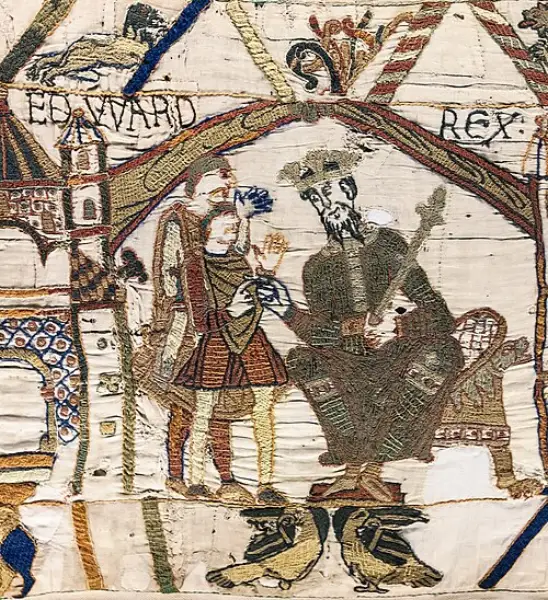
Edward the Confessor reigned over the English from 1042 until 1066, the last ruling king of the House of Wessex. Born between 1003 and 1005 at Islip in Oxfordshire, the seventh son of Æthelred the Unready and the eldest child of that king's second marriage, to Emma of Normandy, he endured some twenty-five years of banishment, most of it in Normandy, while Danish kings held England. Recalled in 1041 by his half-brother Harthacnut, he succeeded peacefully in 1042 and was crowned at Winchester on Easter Sunday 1043. His twenty-four-year reign was dominated by his uneasy relationship with Earl Godwin and the rising Godwin family, whom he briefly banished in the crisis of 1051-52 before being forced to restore them. By 1057 the Godwin brothers controlled nearly all of England, and Edward withdrew from active politics toward hunting and church. Yet he ruled energetically in his early years, commanding the fleet against Magnus of Norway, intervening in Scotland on behalf of Malcolm Canmore, and directing policy in Wales. His enduring monument was Westminster Abbey, the first Norman Romanesque church in England, consecrated days before his death. Dying childless on 5 January 1066, he left a disputed succession that precipitated the Norman Conquest. Canonized in 1161, he was England's national saint until St George displaced him, and his shrine remains in Westminster Abbey.
The Complete Life
A Childhood Amid Invasion
Edward was born between 1003 and 1005 at Islip in Oxfordshire, the seventh son of Æthelred the Unready and the eldest child of Æthelred's second wife, Emma of Normandy. His name first appears among the witnesses of two charters in 1005. Alfred was his only full brother, Godgifu his sister; in the formal documents the boy always stood behind his elder half-brothers, a plain sign of his slight place in the succession. His childhood coincided with the crescendo of Viking attack under Sweyn Forkbeard and his son Cnut. When Sweyn seized the throne in 1013, Emma took ship for Normandy; Edward and Alfred went after her, and Æthelred at last followed them. Sweyn died in February 1014, and the English invited Æthelred back on condition that he promised to rule more justly; Edward was sent back with the ambassadors. Æthelred died in April 1016, and the struggle passed to Edward's half-brother Edmund Ironside, who fought Cnut until his own death that November. Cnut became undisputed king; in 1017 Edward's mother married the conqueror, and in the same year Cnut executed Eadwig, Edward's last surviving elder half-brother. Edward went into exile once more with his brother and sister, beginning the quarter century of banishment, spent probably mainly in Normandy, that would shape his Norman sympathies for the rest of his life.
§ Early years and exile
Twenty-Five Years of Exile
Edward's long exile left him with few resources but some standing. His sister Godgifu, wedded around 1024 to Drogo of Mantes, count of Vexin, likely helped to sustain him. In the early 1030s he witnessed four charters in Normandy, signing two as king of England, a title without a kingdom. According to the Norman chronicler William of Jumièges, Duke Robert I of Normandy attempted an invasion of England in about 1034 to place Edward on the throne, but the fleet was blown off course to Jersey. Continental churchmen backed his claim, above all Robert, abbot of Jumièges, who would later follow Edward to England and become Archbishop of Canterbury. Later medieval writers claimed Edward developed an intense personal piety in these years, but modern historians see this as a product of the later canonization campaign; Frank Barlow judged that he lived as any country gentleman of his class might have lived. With a slim prospect of the throne, and his ambitious mother favouring her son Harthacnut by Cnut, Edward waited. In 1036 he and Alfred came separately to England, likely at their mother's invitation: Alfred was captured by Earl Godwin, handed to Harold Harefoot, blinded with red-hot pokers, and died of his wounds. Edward fought a successful skirmish near Southampton and prudently retreated to Normandy, carrying ever after his hatred of Godwin.
§ Early years and exile
Restoring the House of Wessex
When Harthacnut died suddenly on 8 June 1042, Godwin, foremost among the English earls, threw his weight behind Edward's accession; the Anglo-Saxon Chronicle relates that even before Harthacnut lay in his grave, the whole people of London had chosen Edward for their king. He was crowned at Winchester Cathedral, royal seat of the West Saxons, on Easter Sunday 1043. His position was weak: attachment to the old West Saxon royal line had worn thin under Danish rule, and he depended on three great earls, Leofric, Siward, and Godwin. Yet in his early years Edward restored a vigorous and traditional strong monarchy. He married Godwin's daughter Edith on 23 January 1045, and her family came to rule much of southern England — a dominance Edward tolerated but checked, banishing the violent Sweyn Godwinson and later exploiting his crimes. In 1050-51 he disbanded his small standing navy and abolished its tax. In foreign affairs he acted independently: he commanded the fleet at Sandwich in 1045 and 1046 against the threatening Magnus I of Norway, received the submission of Sweyn II of Denmark, and pursued generally successful policies in Scotland and Wales, sending Siward against Macbeth in 1054 and imposing vassalage on Welsh princes after the fall of Gruffydd ap Llywelyn. In church appointments he favoured men without local ties, chief among them his old friend Robert of Jumièges — preferences that would collide catastrophically with the Godwins in 1051.
§ Early reign
The Man Behind the Halo
The Vita Ædwardi Regis, commissioned by his widow, paints an idealized portrait: a man of outstanding height, milk-white in hair and beard, full-faced and rosy-cheeked, with slender white hands and long translucent fingers, pleasant yet dignified, walking with eyes downcast, gracious to all, terrible as a lion when aroused but never railing in anger. Historians see in this the stock ideal ruler couched in flattery — tall, affable, dignified, just. The saintly image grew slowly and, in large measure, deliberately. Edward loved hunting, pursuing it daily after attending church even as he withdrew from politics; he was prone to fits of rage; and the Ramsey Liber Benefactorum records a lawsuit won by bribing the king with twenty marks of gold and his queen with five. His church appointments were worldly: he preferred clerks to monks for the richest bishoprics, stood by the goldsmith Spearhafoc against a papal prohibition, tolerated the pluralism of Archbishop Stigand, and seized lands from Pershore Abbey for his own Westminster foundation. Most historians regard him as an unlikely saint and his canonization as political, though some argue a cult that began so early must have built on something credible. His genuine religious legacy was architectural and dynastic: Westminster Abbey, and the perpetual memory of a king in whom sanctity and power were negotiated together.
§ Appearance and character
The Godwins Ascendant and the Quiet End
The crisis of 1051-52 marked the high point of Edward's power and its reversal. When Godwin defied the king's order to punish Dover after an affray involving the men of Eustace of Boulogne, Archbishop Robert accused Godwin of plotting murder as he had murdered Alfred; deserted by his own vassals, Godwin and his sons fled abroad, and Edward repudiated Queen Edith. Within a year Godwin returned with an army and broad support, and Edward, fearing civil war on the eve of foreign invasion, was forced to restore the family and accept Stigand as Archbishop of Canterbury. Godwin died in 1053, but a succession of deaths among the great earls between 1055 and 1057 left the Godwin brothers controlling all England but Mercia. Whether Edward approved or merely acquiesced is unknown, but from this time he withdrew from active politics, devoting himself to hunting after daily church. The last blow came in October 1065, when the Northumbrian thegns rebelled against his favourite, Tostig: no one would fight for Tostig, and Edward was forced to accept his banishment, a humiliation that may have brought on the strokes that killed him. Illness kept him from being present when Westminster Abbey was consecrated on 28 December 1065. In his last hours he seems to have commended the realm to Harold and Edith before dying at Westminster on 5 January 1066; Harold was crowned the following day.
§ Later reign
From Royal Tomb to Altar
Edward's road to sainthood began modestly. After 1066 there was a subdued cult at Westminster, perhaps discouraged by the early Norman abbots, which grew through the early twelfth century. The prior Osbert of Clare then campaigned deliberately for canonization, his object being to enlarge the Abbey's riches and standing: by 1138 he had refashioned the Vita Ædwardi Regis into a conventional saint's life, and from an ambiguous passage in that work he derived the claim that Edward's marriage had been chaste and the king celibate. In 1139, with the support of King Stephen, Osbert petitioned at Rome, but Pope Innocent II postponed, judging the testimonials of holiness insufficient. The opportunity came with the disputed papal election of 1159: Henry II's support helped secure recognition for Pope Alexander III, and when the new abbot of Westminster renewed the petition in 1160 with the full backing of king and hierarchy, a grateful pope issued the bull of canonization on 7 February 1161. Edward was the only king of England canonized by a pope, honoured as a confessor — one who lived a saintly life without dying a martyr — in succession to Anglo-Saxon royal saints like Edward the Martyr. His first translation followed in 1163, and in the 1230s Henry III embraced the cult, commissioning Matthew Paris's new life, naming his heir Edward, and in 1269 translating the body to its grand new shrine.
§ Veneration
Abbey, Shrine, and National Saint
Edward's most tangible legacy is Westminster Abbey, begun between 1042 and 1052 to serve as a church of royal burial, the first Norman Romanesque church in England and closely modelled on Jumièges Abbey, with Robert of Jumièges probably involved in both. Though demolished in 1245 for Henry III's new building, it helped decisively to shape the course of Romanesque building in England and shows Edward as an innovative and generous patron. His shrine remains in the present abbey, where it was placed after the final translation of his body on 13 October 1269; each October the abbey keeps an octave of observance and prayer in his memory, and its flag carries the gold ring of St Edward. Until about 1350 he ranked with Edmund the Martyr and Gregory the Great among England's national saints, depicted presenting Richard II to the Virgin and Child in the Wilton Diptych; Edward III's preference for the more warlike St George, patron of the new Order of the Garter, displaced him. He remained important to the Norman and later dynasties as the last legitimate Anglo-Saxon king from whom they claimed succession — his name living on in the line of English Edwards. He is remembered on 13 October, a Lesser Festival in the Church of England and an optional memorial in Catholic dioceses of England, and on 5 January in the Martyrologium Romanum; he is invoked as patron of England and of difficult marriages.
§ Veneration
Timeline
- 1003
Born at Islip, Oxfordshire, between 1003 and 1005, seventh son of Æthelred the Unready and Emma of Normandy.
§ Early years and exile
- 1013
Fled to Normandy with his mother Emma and brother Alfred after Sweyn Forkbeard seized the English throne.
§ Early years and exile
- 1016
Went into exile again after the deaths of Æthelred and Edmund Ironside left Cnut undisputed king of England.
§ Early years and exile
- 1036
Returned briefly to England; his brother Alfred was captured, blinded, and killed, deepening Edward's hatred of Earl Godwin.
§ Early years and exile
- 1041
Invited back to England by Harthacnut, probably as heir, and received as king by the thegns at Hursteshever.
§ Early years and exile
- 8 Jun 1042
Succeeded Harthacnut as King of the English, chosen by the people of London before Harthacnut's burial.
§ Early reign
- 3 Apr 1043
Crowned in Winchester's cathedral, seat of the West Saxon royal house, on Easter Sunday.
§ Early reign
- Nov 1043
Rode with his three chief earls to Winchester to strip his mother Emma of her property.
§ Early reign
- 1045
Took command of the fleet at Sandwich in 1045 and 1046 fearing invasion by Magnus I of Norway.
§ Early reign
- 23 Jan 1045
Married Edith, daughter of Earl Godwin, binding the crown to the most powerful family in England.
§ Early reign
- 1051
Banished Earl Godwin and his sons after the Dover affray, repudiated Queen Edith, and appointed Robert of Jumièges Archbishop of Canterbury.
§ Crisis of 1051–52
- 1052
Forced to restore Godwin and Harold to their earldoms when Godwin returned with an army; Edith was reinstated as queen.
§ Crisis of 1051–52
- 1054
Sent Earl Siward to invade Scotland against Macbeth, securing southern Scotland for the exile Malcolm Canmore.
§ Later reign
- 1057
By this year the Godwin brothers controlled all of England except Mercia; Edward began withdrawing from active politics.
§ Later reign
- Oct 1065
Forced to banish his favourite Tostig after the Northumbrian revolt against his rule.
§ Later reign
- 28 Dec 1065
Was by then too frail to be present when his new Westminster church, largely finished, was consecrated.
§ Later reign
- 5 Jan 1066
Died at Westminster after entrusting the kingdom, in all likelihood, to Harold and Edith.
§ Later reign
- 6 Jan 1066
Buried in Westminster Abbey while Harold was crowned king the same day.
§ Later reign
- 1139
Osbert of Clare went to Rome to petition for Edward's canonization, but Pope Innocent II postponed the decision.
§ Veneration
- 7 Feb 1161
Canonized by Pope Alexander III with the full support of Henry II and the English hierarchy.
§ Veneration
- 13 Oct 1163
First translation of his relics took place on 13 October.
§ Veneration
- 13 Oct 1269
Henry III moved Edward's body to a chapel beyond the sanctuary's eastern end in the rebuilt Westminster Abbey.
§ Veneration
In Their Own Words
[H]e was a very proper figure of a man – of outstanding height, and distinguished by his milky white hair and beard, full face and rosy cheeks, thin white hands, and long translucent fingers
The Record
- Major works
- Westminster Abbey, the first Norman Romanesque church in England, begun between 1042 and 1052 as a royal burial church
- Patron of
- England·difficult marriages
- Symbols
- enthroned king with ring (the ring of St Edward)·sceptre and orb·depicted in the Wilton Diptych with Edmund the Martyr and John the Baptist
- Canonization
- Canonized by Pope Alexander III on 7 February 1161, after a campaign led by Osbert of Clare of Westminster Abbey.
Prayer
Bibliography
Show 6 sources
- Barlow, Frank (1970). Edward the Confessor. University of California Press. ISBN 978-0-520-01671-2.
- Barlow, Frank (25 May 2006). "Edward (St Edward; known as Edward the Confessor)". Oxford Dictionary of National Biography. Oxford University Press. doi:10.1093/ref:odnb/8516.
- Baxter, Stephen (2009). "Edward the Confessor and the Succession Question". In Mortimer, Richard (ed.). Edward the Confessor: the man and the legend. Woodbridge: Boydell Press. ISBN 978-1-84383-436-6.
- Rex, Peter (2008). King & Saint: The Life of Edward the Confessor. Stroud: History Press. ISBN 978-0-7524-4602-8.
- Bozoky, Edina (2009). "The Sanctity and Canonisation of Edward the Confessor". In Mortimer, Richard (ed.). Edward the Confessor: the man and the legend. Woodbridge: Boydell Press. ISBN 978-1-84383-436-6.
- Mortimer, Richard, ed. (2009). Edward the Confessor: the man and the legend. Woodbridge: Boydell Press. ISBN 978-1-84383-436-6.
Profile text adapted from the Wikipedia article, licensed CC BY-SA 4.0.
Pray with this saint every day
Save St. Edward the Confessor to your favorites, read the full profile, and get feast-day reminders in the Saints app.
Get the Saints AppFree on the App Store for iPhone and iPad