
c. 962 – 978·Feast March 18
St. Edward the Martyr
Boy King of England Murdered at Corfe
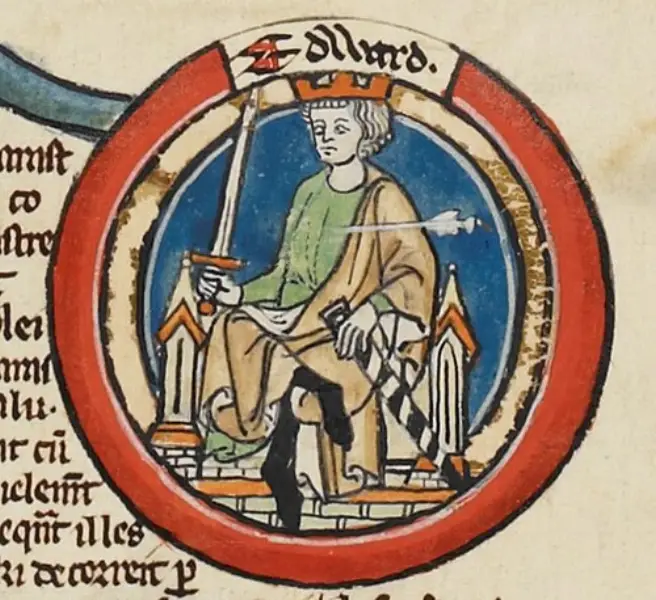
Overview
Edward the Martyr ruled the English from 8 July 975 until his violent end on 18 March 978. Born around 962, he was the firstborn of King Edgar's four recorded children, and probably the son of Æthelflæd, Edgar's first wife, who is thought to have died shortly after his birth. On Edgar's death the succession was contested between factions backing the teenage Edward and those backing his six-to-nine-year-old half-brother Æthelred, whose mother Queen Ælfthryth and Bishop Æthelwold championed his cause. The dispute was settled within a fortnight: Edward was elected and crowned by Archbishop Dunstan at Kingston upon Thames, while Æthelred received lands traditionally allocated to a king's eldest son. Edward's short reign unfolded amid the so-called anti-monastic reaction, as nobles moved to recover estates Edgar had forced from them for the reformed monasteries, though historians doubt the strife amounted to warfare. In March 978 Edward was killed at the Gap of Corfe in Dorset while visiting Ælfthryth's estate, and buried without royal honour at Wareham. A year later his body, reportedly found incorrupt, was translated with ceremony to Shaftesbury Abbey. The killing shocked a society that held kings sacrosanct; Edward was soon revered as a martyr, his feast commanded across England, though historians note he was known in life for abusing his companions and judge his veneration undeserved.
The Complete Life
A Birth Wrapped in Doubt
Edward was born around 962, the firstborn of the four children of King Edgar known to history, but no contemporary source names his mother, and the question of his parentage and legitimacy shadowed his whole life. The earliest account, Osbern of Canterbury's life of Dunstan of about 1090, claimed Edward was the son of a nun of Wilton Abbey whom Edgar had seduced, a story later chroniclers and modern historians reject. Eadmer, writing in the early twelfth century on the authority of Nicholas of Worcester's research into ancient chronicles, recorded that Edward's mother was Æthelflæd, called 'the white', daughter of an ealdorman named Ordmær; John of Worcester likewise named Æthelflæd, adding her curious byname 'the duck'. Almost all modern historians accept Æthelflæd as the mother, most as Edgar's first wife, and she probably died shortly after Edward's birth. Nicholas Brooks argued that Edgar must have married her, since Dunstan, an uncompromising opponent of irregular unions, backed Edward's succession; yet Cyril Hart still describes Edward as of doubtful legitimacy. Edgar's second consort Wulfthryth bore him the daughter Edith, and in 964 he married Ælfthryth, widow of Æthelwold, son of Æthelstan Half-King, who bore Edmund, dead in 971, and the future Æthelred the Unready. Edward's tutor in religion was Sideman, Bishop of Crediton.
§ Family
The Contested Crown of a Boy
Edward first appears in the record as a witness to the Winchester New Minster Charter of 966, where Queen Ælfthryth attested as the king's 'legitimate wife' and her son Edmund as 'legitimate son', while Edward was described merely as 'begotten by the same king' — phrasing that either expressed Edgar's wish to cut him from the succession or Bishop Æthelwold's opportunistic pleading for his friend Ælfthryth. A genealogy produced at Dunstan's Glastonbury Abbey around 969 restored Edward's precedence. When Edgar died on 8 July 975, the throne was disputed, though the claimants were children of thirteen and of six to nine — figureheads, as Sean Miller observes, rather than active participants. Dunstan, Archbishop of Canterbury, was Edward's chief supporter, joined by Oswald of York and the great ealdorman Æthelwine; Ælfthryth, Bishop Æthelwold, and probably Ealdorman Ælfhere backed Æthelred. Byrhtferth of Ramsey uncharitably portrayed Edward as a violent youth whose tongue-lashings and beatings terrified his own household, which Frank Stenton thought may have moved nobles toward the milder brother. The dispute was settled quickly: a calendar entry dates Edward's election to 19 July, and a later charter records his unanimous choice by the leading men of both orders, with Æthelred compensated by the lands of a king's eldest son. Dunstan crowned him at Kingston upon Thames, possibly the same day, while the later Passio has the archbishop fixing the cross-banner in the ground and forcing the coronation through.
§ Disputed succession
A Short Reign in a Fractured Realm
Edward's reign of three years and nine months was dominated by what historians call the anti-monastic reaction. Edgar had been an overbearing king who compelled the lay aristocracy and the secular clergy to give up estates cheaply to the new monasteries; on his death the nobles moved to recover their estates, chiefly through legal action but sometimes by force. The Anglo-Saxon Chronicle describes Ælfhere and other nobles as attacking monasteries, while Byrhtferth painted Æthelwine as the friend of God defending the monks and lamented that abbots were expelled, clerics with wives installed, and monks made to cart burdens like beasts. Most modern historians are sceptical of the religious framing, attributing the disturbances to personal rivalries and to sellers' heirs seeking fair market value for lands acquired under pressure. Ælfhere and Æthelwine came close to open warfare but never fought; a renegade thegn named Leofsige laid waste the Peterborough country so thoroughly that its fields went unsown for two harvests before he was killed. Witans met at Kingston, Kirtlington, and Calne, where the floor of the council chamber collapsed with deadly effect, sparing Dunstan alone. Edward appointed three new ealdormen to the south of England, whose governance had previously rested on Edgar's personal authority. Five charters survive from the reign, and his coinage faithfully continued Edgar's uniform Small Cross reform, with high, stable fineness that deteriorated only after his death.
§ The "anti-monastic reaction"
Murder at the Gap of Corfe
Edward was killed on the evening of 18 March 978 at the Gap of Corfe in the Purbeck Hills of Dorset, on the estate of his stepmother Ælfthryth. Byrhtferth gives the only detailed pre-Conquest account: the young king rode to the house where his brother lived with the dowager queen, seeking brotherly consolation; magnates who had agreed a wicked plot surrounded him with armed men as he sat fearless on his horse, trusting in the Lord. One seized his right hand as if to kiss him, another struck the death blow from the left, and the king fell dead, crying out at the breaking of his hand. His body was carried to a poor man's house, covered with a cheap blanket, without chant or lament. Later that version continues — he was buried at Wareham without royal honour. No pre-Conquest source names the murderer; a contemporary poem will say only that envy moved his own kinsmen to destroy him. After the Conquest, chroniclers almost universally blamed Ælfthryth: the Passio and John of Worcester say she ordered the killing, William of Malmesbury has her servant stabbing him while she distracted him with a drink, and Henry of Huntingdon makes her the killer with her own hand. Modern historians divide: some credit her guilt, others see the thegns of Æthelred acting without orders, and Ann Williams suggests a fatal, unplanned confrontation with a violent young king whom too many were secretly relieved to lose.
§ Death
From Cheap Blanket to Shrine
The murder of the Lord's anointed was, in Levi Roach's summary, more than a crime — a sin of the first order — and England's tradition of venerating murdered kings made Edward's eventual sainthood almost certain, though it did not come at once. He had not been regarded as saintly in life and did not die defending Christianity; almost a year passed before he received royal burial, suggesting an argument over the treatment of his body. ASC D and E record that he was first buried at Wareham without honour. Then, about 979, Ealdorman Ælfhere, the senior lay magnate, came with a great retinue, disinterred the body, found it incorrupt — taken as a miraculous sign — and conveyed it with great ceremony to the nunnery of Shaftesbury Abbey, making Edward the only tenth-century king buried in a nunnery. The cult was recognized soon after his death, with Æthelred himself apparently its chief sponsor: Sigeric of Canterbury secured the monastery of Cholsey in Edward's honour, the cult was honoured at Canterbury and promoted by Wulfstan, and in 1001 Æthelred granted Bradford on Avon church to God and to 'his saint, my brother Edward, whom the Lord has been pleased to magnify in our own days by many miracles'. The law code of 1008 commanded his feast on 18 March throughout England, Cnut continued the patronage, and of twenty-five pre-Conquest calendars, eighteen list his death date — more than all but nine saints.
§ Early cult
An Enduring and Contested Cult
Edward's cult gave Shaftesbury wealth and standing: by the close of the Anglo-Saxon age it was the wealthiest community of Benedictine nuns in England, the town itself was sometimes called Edwardsstowe, 'the holy place of Edward', and a medieval saying joked that a marriage of Glastonbury's abbot and Shaftesbury's abbess would produce an heir richer than the king. Under the Normans, Lanfranc's scepticism about Anglo-Saxon saints reduced the cult to 'rustic' status, honoured mainly where Shaftesbury had particular reason; it revived in the later Middle Ages, chiefly in southern England, and survived the Reformation as a low-key observance — the 1662 Book of Common Prayer still carries his feast of 18 March. Historians have been blunt about the paradox: Frank Barlow observed that popular detestation of the crime transformed an unpleasant youth into a royal martyr, and Tom Watson marvelled that for an obnoxious teenager with no evidence of sanctity, the cult has endured mightily well. His bones led a strange modern afterlife: excavated from Shaftesbury's ruins between 1930 and 1932 by John Wilson-Claridge, examined in 1963 by the pathologist Thomas Stowell, disputed by the British Museum's Don Brothwell, they were granted by the High Court in 1988 to the Russian Orthodox Church Abroad's church of St Edward the Martyr at Brookwood — though historians doubt both identifications. Churches dedicated to him stand from Cambridge to Corfe Castle, Goathurst, Liverpool, and New York.
§ Later cult
Timeline
- 962
Born around this year, firstborn of King Edgar's four recorded children; his mother was probably Æthelflæd, Edgar's first wife.
§ Family
- 966
First recorded as a witness to the Winchester New Minster charter, described there as 'begotten by the same king' rather than as legitimate.
§ Disputed succession
- 969
A genealogy produced at Glastonbury Abbey around this date gave him precedence over his half-brothers Edmund and Æthelred.
§ Disputed succession
- 8 Jul 975
Became King of the English on the death of his father Edgar, amid a contested succession.
§ Introduction
- 19 Jul 975
Elected king, according to a calendar entry, and crowned by Archbishop Dunstan at Kingston upon Thames, possibly the same day.
§ Disputed succession
- 976
A severe famine struck England during his reign.
§ Administration
- 977
Royal councils met at Kirtlington after Easter and at Calne, where an upper storey collapsed, injuring and killing many counsellors.
§ Administration
- 18 Mar 978
Killed in the evening at the Gap of Corfe in Dorset, on the estate of his stepmother Ælfthryth, while visiting his half-brother.
§ Death
- 978
Buried at Wareham without royal honour, almost a year passing before he received a royal burial.
§ Burial and translation
- 979
Ealdorman Ælfhere disinterred the body, reportedly found incorrupt, and conveyed it with great ceremony for burial at Shaftesbury Abbey.
§ Burial and translation
- 989
According to Byrhtferth, the first wonders at his tomb occurred about eleven years after the murder.
§ Early cult
- 990
While Sigeric was Archbishop of Canterbury, he persuaded Æthelred to found a monastery at Cholsey in Edward's honour, with Germanus as abbot.
§ Early cult
- 1001
Æthelred granted a minster church and land at Bradford on Avon as a refuge for nuns and Edward's relics against Viking attack.
§ Early cult
- 1008
The law code V Æthelred commanded that his martyrdom be kept on 18 March throughout England.
§ Early cult
- 1014
Æthelred's eldest son Æthelstan, dying, left six pounds to the Holy Cross and St Edward at Shaftesbury in his will.
§ Early cult
- 1539
Shaftesbury Abbey was dissolved and its buildings almost wholly dismantled.
§ Dispute over Edward's bones
- 1931
Excavating the abbey ruins between 1930 and 1932, John Wilson-Claridge claimed to have found Edward's bones, a discovery praised in The Times.
§ Dispute over Edward's bones
- 1963
Pathologist Thomas Stowell judged the bones those of a young man of seventeen to nineteen, injured as the murder account describes.
§ Dispute over Edward's bones
- 1980
Wilson-Claridge reached agreement with the Russian Orthodox Church Abroad to accept the bones as the saint's true relics.
§ Dispute over Edward's bones
- 1988
A High Court hearing ruled the bones could go to the ROCA church of St Edward the Martyr at Brookwood.
§ Dispute over Edward's bones
In Their Own Words
What are you doing, breaking my right hand?
The Record
- Major works
- Five surviving charters from his reign of three years and nine months; continuation of Edgar's Small Cross reform coinage
- Symbols
- crowned young king as depicted in the medieval Genealogical Roll of the Kings of England
- Canonization
- Pre-congregation canonization; recognized as a saint soon after his murder in 978, with his cult promoted chiefly by his brother King Æthelred.
Prayer
Bibliography
Show 6 sources
- Hart, Cyril (2007). "Edward [St Edward; called Edward the Martyr] (c. 962–978)". Oxford Dictionary of National Biography. Oxford University Press. doi:10.1093/ref:odnb/8515. ISBN 978-0-19-861412-8.
- Stenton, Frank (1971). Anglo-Saxon England (3rd ed.). Oxford: Oxford University Press. ISBN 978-0-19-280139-5.
- Roach, Levi (2016). Æthelred the Unready. New Haven, CT: Yale University Press. ISBN 978-0-300-22972-1.
- Yorke, Barbara (1999). "Edward, King and Martyr: A Saxon Murder Mystery". In Keen, Laurence (ed.). Studies in the early history of Shaftesbury Abbey. Dorchester, UK: Dorset County Council. pp. 99–116. ISBN 978-0-85216-887-5.
- Fell, Christine (1971). Edward, King and Martyr. Leeds, UK: University of Leeds School of English. ISBN 978-0-902296-07-7.
- Williams, Ann (2003). Æthelred the Unready: The Ill-Counselled King. London: Hambledon and London. ISBN 978-1-85285-382-2.
Profile text adapted from the Wikipedia article, licensed CC BY-SA 4.0.
Pray with this saint every day
Save St. Edward the Martyr to your favorites, read the full profile, and get feast-day reminders in the Saints app.
Get the Saints AppFree on the App Store for iPhone and iPad