
c. 586 – 633·Feast October 12
St. Edwin of Northumbria
Bretwalda and First Christian King of Northumbria
Overview
Edwin, also known as Eadwine or Æduinus, was King of Deira and Bernicia — the kingdoms later called Northumbria — from around 616 until his death, the second monarch to rule both and the first to convert to Christianity. Born around 586, a son of Ælle, first recorded ruler of the Deirans, he spent the reign of Æthelfrith of Bernicia, who had conquered Deira and married Edwin's sister Acha, as an exile, moving through Gwynedd by late tradition, Mercia under King Cearl, whose daughter Cwenburg he married, and finally the court of Rædwald of East Anglia. When Æthelfrith was defeated and killed at the Battle of the River Idle in 616, Rædwald installed Edwin on the Northumbrian thrones. After Rædwald's death around 624, Edwin stood as the strongest ruler in Britain: Bede numbers him among the kings who exercised imperium, and the Anglo-Saxon Chronicle styles him bretwalda, ruler of Britain. In 625 he married Æthelburh of Kent, a Christian princess, and on Easter 626 survived an assassination attempt by an agent of Cwichelm of Wessex. He was baptized on 12 April 627 through the influence of his queen and the Roman missionary Paulinus, first Bishop of York, and his realm expanded over eastern Mercia, the Isle of Man, and Anglesey. Defeated and killed at the Battle of Hatfield Chase in 633 by Cadwallon ap Cadfan and Penda of Mercia, he was venerated as a saint, his head buried at York and his body at Whitby.
The Complete Life
The Exile of the Deiran Prince
Edwin was born around 586, one of the sons of Ælle, the earliest ruler of Deira known to history, and probably had at least two brothers or sisters. Acha, one of his sisters, became the wife of Æthelfrith, who ruled neighbouring Bernicia — the marriage that bound the families of Edwin's protector and his enemy. An otherwise unknown sibling fathered Hereric, whose daughters were the great Abbess Hilda of Whitby and Hereswith. The Anglo-Saxon Chronicle relates that when Ælle died, power passed to one Æthelric, whose identity remains uncertain — perhaps Ælle's own brother, perhaps an older brother of Edwin himself, or the father of Æthelfrith himself. By no later than 604 Æthelfrith appears to have been king of both Deira and Bernicia, and Edwin became an exile. Where he passed his childhood is unknown, though late tradition — preserved by Reginald of Durham and by Geoffrey of Monmouth — would set him in Gwynedd, fostered by King Cadfan ap Iago — a story that later let hagiographers draw biblical parallels from his struggle with the man they called his foster-brother, Cadwallon. In the 610s, however, he is found for certain at the Mercian court, sheltered by King Cearl, whose daughter Cwenburg he married. Around 616 he reached the court of Rædwald of East Anglia, where Æthelfrith's ambassadors pressed the East Anglian king to murder his unwanted rival. Bede relates that Rædwald intended to comply until his wife, prompted by God, persuaded him otherwise.
§ Early life and exile
Thrones Won at the River Idle
The exile's turn came in battle. Æthelfrith, unwilling to let his rival live, met Rædwald in battle at the River Idle in 616, where he was beaten and killed; Rædwald's son Rægenhere may have fallen in the fighting. Rædwald installed Edwin as king of Northumbria, while Æthelfrith's sons fled into exile among the Gaels of Dál Riata and the Picts. That Edwin won mastery not only of his own Deira but of Bernicia besides was probably owing to his patron's backing, and he may have remained subject to Rædwald during the early years of his reign. His accession confirmed Rædwald as bretwalda, and Edwin's rule marked an interruption of the otherwise consistent Bernician domination of Northumbria — what one historian has called conduct contrary to the prevailing tendency. With Æthelfrith and the powerful Æthelberht of Kent both dead in the same year, Rædwald and his client were well placed to dominate England. Edwin expelled Ceretic from the small British kingdom of Elmet in 616 or 626, and allied himself with Eadbald of Kent, arranging to wed Eadbald's sister Æthelburh. Bede notes that Eadbald would part with his sister only on condition that Edwin accept the Christian faith: just as the marriage of Kent's queen Bertha had converted Kent, Æthelburh's marriage was meant to convert Northumbria.
§ As king
The Baptism of the Hesitant King
Bede's account of Edwin's conversion turns on two deliverances: Paulinus's saving of Edwin's life during his exile, and the attempted assassination at York at Easter 626 by an agent of Cwichelm of Wessex. Bede paints an indecisive king, unwilling to take risks, long unable to choose between his ancestral gods and the new doctrine — though the influence of his half-Merovingian queen and the letters Pope Boniface V sent to Edwin and Æthelburh weighed upon him, and behind Kent stood Frankish interest in converting their fellow Germans. On 12 April 627 Edwin was baptized with his chief men. Bede preserves the council scene: when Paulinus had explained the faith, the pagan high priest Coifi admitted that no one had served the old gods more devoutly than he, yet he had seen no benefit from his devotion; an unnamed counsellor compared human life to the flight of a sparrow through a warm lamplit hall from the winter storm outside, out of the dark and back into it, arguing that if the new doctrine contained something more certain it deserved to be followed. Coifi then called for the destruction of the idols, seized arms and a stallion, and personally cast a spear into the temple at Goodmanham, profaning it before the assembled crowd. Bede adds that Edwin's zeal carried Rædwald's son Eorpwald to conversion as well.
§ Conversion to Christianity
Peace, Sparrow, and a Shallow Harvest
Bede crowned his portrait of Edwin with a proverbial eulogy of his peace: so much peace reigned in Britain, he wrote, that where Edwin's power extended, a woman with a newborn child could walk the island from sea to sea unharmed. Modern scholars read the claim carefully — Paul Kershaw sees in its proverbial phrasing a chilling insight into the lawlessness accepted in eighth-century England, and notes that such peace meant freedom from robbery, rape, and violence, security to travel and to go in peace. The king's routine of kingship involved regular, probably annual wars against neighbours for tribute, submission, and slaves, and the royal household moved from vill to vill — Yeavering with its timber amphitheatre, Campodunum, Sancton, Goodmanham — consuming food renders and dispensing justice. Yet the conversion itself proved shallow. Edwin's baptism and Eorpwald's were both reversed by their successors, and the Roman mission of Paulinus appears to have had little impact beyond the royal court; almost no Roman clergy are known in Northumbria of that time except James the Deacon, who remained long after his master had fled. The driving out of British churchmen from Elmet and other parts of the realm may even have weakened the Church. Historians judge that the conversion extended little beyond Edwin's circle — a king's personal faith, sincere but unable to root itself before the kingdom fell.
§ Conversion to Christianity
Overlordship and the Fall at Hatfield
The first challenge to Edwin's overlordship followed the marriage pact with Kent, sealed at Canterbury in the middle of 625. By stretching his protection over minor rulers — among them the king of Wight — Edwin checked the designs of Cwichelm of Wessex, whose answer was an assassin's blade at York. Edwin did not respond at once — whether from inability or from the indecision Bede attributed to him — but he committed himself to Christianity on condition of victory over Cwichelm. From about 627 he towered above every other Anglo-Saxon ruler, his sway stretching over Bernicia and Deira, wide lands of eastern Mercia, the Isle of Man, and Anglesey; success confirmed what Bede called his imperium, later equated with the West Saxon idea of the Bretwalda. His supposed foster-brother Cadwallon ap Cadfan entered the record around 629, was defeated, and either submitted or went into exile, leaving Edwin's authority apparently unchallenged for several years. Then, in 632-633, Penda of Mercia and Cadwallon rose together. At the Battle of Hatfield Chase, fought on 12 October 633, Edwin was defeated and killed at about forty-six years of age, together with his grown son Osfrith; his other son Eadfrith was captured by Penda and killed later. For a time his body was hidden in Sherwood Forest, at the place that became Edwinstowe — Edwin's resting place — before his head was buried at York and his body at Whitby.
§ As overlord
A Martyr-King and His Divided Realm
Edwin's death shattered the world he had built. His realm divided again: Deira passed to Osric, son of Edwin's paternal uncle Ælfric, and Bernicia to Eanfrith, whom Æthelfrith had fathered on Edwin's sister Acha. Each forsook the faith for the old gods, and each died at Cadwallon's hands, until Eanfrith's brother Oswald defeated the British king, avenged Edwin, and united Northumbria once more. Queen Æthelburh fled to Kent with Paulinus, taking her son Uscfrea, her daughter Eanflæd, and Osfrith's boy Yffi; the two boys were sent to the Frankish court of Dagobert I but died soon afterwards, while Eanflæd lived to marry her cousin King Oswiu. Edwin himself was in time numbered among the saints by at least a part of the Church, sometimes listed as a martyr because he fell in battle against the pagan Penda, and his cult was kept in the Eastern Orthodox, Roman Catholic, and Anglican traditions, with a feast on 12 October, the day of his death. Yet the cult was eventually overshadowed by the more successful one of Oswald, killed in 642 in battle against similar foes. Bede's treatment makes the difference plain: he regarded Oswald as an unambiguously saintly figure, a status he never fully accorded to Edwin, whose belated and politically entangled conversion left the hagiographers with less to work with.
§ Death and legacy
Edwin's Renown and His Failures
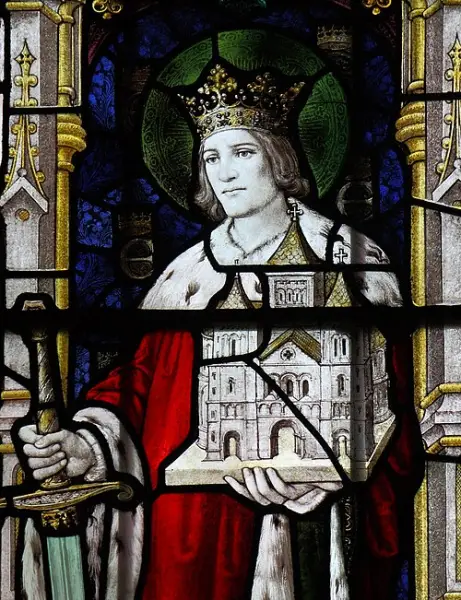
Edwin's renown rests almost entirely on the long account Bede devoted to him, composed from a resolutely English and Christian standpoint, and on the drama of his conversion — the sparrow simile that has been called the most poetic in Bede, which inspired Wordsworth, and the blazing temple of Coifi. But the achievements did not outlast him. His united kingdom in the north dissolved at his death, his conversion was renounced by his successors, and measured against his pagan brother-in-law Æthelfrith, against Æthelfrith's sons Oswald and Oswiu, or against the resolutely pagan Penda, Edwin can appear something less than the key figure of early seventh-century Britain. Historians find his lasting mark in what went wrong: the ascent of Penda and the growth of Mercia into the great rival power, and the return from Irish exile of Æthelfrith's sons, which bound Northumbria into the Irish Sea world for generations. His memory survived in place and image — the village of Edwinstowe named for his hidden body, the head shrine at York, stained glass at Sledmere in Yorkshire, and John Speed's 1611 engraving of the Saxon Heptarchy. He is invoked as patron of converts, of hoboes and homeless people, of kings, and of parents of large families, a strange heavenly portfolio for a wandering exile who ended as a bretwalda of Britain.
§ Death and legacy
Timeline
- 586
Born around this year in Deira, a son of Ælle, the earliest recorded king of the Deirans.
§ Early life and exile
- 604
By no later than this year Æthelfrith ruled both Deira and Bernicia, forcing Edwin into exile.
§ Early life and exile
- 610
By the 610s he was at the Mercian court under King Cearl's protection, and married Cearl's daughter Cwenburg.
§ Early life and exile
- 616
By around this year he was under the protection of Rædwald of East Anglia, who refused Æthelfrith's demand for his murder.
§ Early life and exile
- 616
Æthelfrith was defeated and killed at the Battle of the River Idle; Rædwald installed Edwin as king of Northumbria.
§ Early life and exile
- 623
Irish annals record the siege or storming of Bamburgh in 623–624, in the context of his war with Fiachnae mac Báetáin of the Ulaid.
§ As king
- 625
His marriage alliance with Kent was concluded at Canterbury in mid-625; he wed Eadbald's sister Æthelburh on condition of accepting Christianity.
§ As overlord
- 626
Survived an assassination attempt at York at Easter by an agent of Cwichelm of Wessex, afterwards pledging himself to Christianity if victorious.
§ Conversion to Christianity
- 12 Apr 627
Baptized with his chief men; his high priest Coifi then profaned the idols, and Rædwald's son Eorpwald also converted.
§ Conversion to Christianity
- 627
From about this year stood as the most powerful Anglo-Saxon ruler, over Bernicia, Deira, eastern Mercia, Man, and Anglesey.
§ As overlord
- 629
Defeated his supposed foster-brother Cadwallon ap Cadfan, who either submitted to him or went into exile.
§ As overlord
- 12 Oct 633
Routed and slain at Hatfield Chase, fighting the allied forces of Penda of Mercia and Cadwallon; his grown son Osfrith fell in the same battle.
§ As overlord
- 633
His body was for a time hidden in Sherwood Forest at Edwinstowe; his head was eventually buried at York and his body at Whitby.
§ As overlord
- 633
His queen Æthelburh returned to Kent with Paulinus and the royal children; the realm divided between pagan kings.
§ Death and legacy
In Their Own Words
The present life man, O king, seems to me, in comparison with that time which is unknown to us, like to the swift flight of a sparrow through the room wherein you sit at supper in winter
I will do this myself, for now that the true God has granted me knowledge, who more suitably than I can set a public example, and destroy the idols that I worshipped in ignorance?
The Record
- Major works
- Unification of Deira and Bernicia under one ruler; establishment of York as a royal and ecclesiastical centre with Paulinus as first Bishop of York
- Patron of
- converts·hoboes·homeless people·kings·parents of large families
- Symbols
- crowned king in stained glass and early modern engravings·associated with the tufa standard-bearer of Bede's account
- Canonization
- Pre-congregation canonization; venerated as a saint after his death in battle against the pagan king Penda of Mercia in 633.
Prayer
Bibliography
Show 6 sources
- Stenton, Sir Frank. Anglo-Saxon England. Oxford University Press, Oxford, 1971 (3rd edn). ISBN 0-19-280139-2.
- Higham, N. J. The Kingdom of Northumbria AD 350–1100. Sutton, Stroud, 1993. ISBN 0-86299-730-5.
- Kirby, D. P. (2000). The Earliest English Kings. London: Unwin. ISBN 0-415-24211-8.
- Yorke, Barbara (1990). Kings and Kingdoms of Early Anglo-Saxon England. London: Seaby. ISBN 0-415-16639-X.
- Barrow, Julia (2011). "How Coifi Pierced Christ's Side: A Re-Examination of Bede's Ecclesiastical History, II, Chapter 13". The Journal of Ecclesiastical History. 62 (4): 693–706. doi:10.1017/S0022046911001631.
- Kershaw, Paul J. E. (2011). Peaceful kings: peace, power, and the early Medieval political imagination. Oxford: Oxford University Press. ISBN 978-0-19-820870-9.
Profile text adapted from the Wikipedia article, licensed CC BY-SA 4.0.
Pray with this saint every day
Save St. Edwin of Northumbria to your favorites, read the full profile, and get feast-day reminders in the Saints app.
Get the Saints AppFree on the App Store for iPhone and iPad