
1729 – 1812·Feast February 7
St. Egidio Maria of Saint Joseph
Franciscan Brother and Consoler of Naples
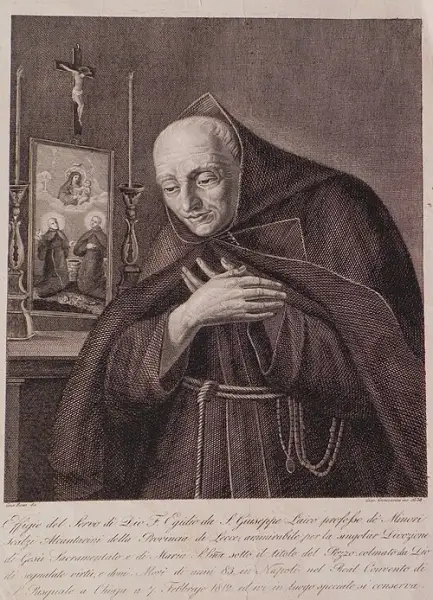
Overview
Egidio Maria of Saint Joseph — in the world Francesco Pontillo — was an Italian lay brother of the Friars Minor who spent nearly six decades serving the poor and sick of southern Italy. Born in Taranto on 16 November 1729, first child of Cataldo Postillo and his wife Grazia Procaccio, he lost his father in 1747 and worked as a rope maker to support his widowed mother and siblings. His lack of formal education barred him from the priesthood, so he entered the Franciscans as a lay brother, applying on 27 February 1754 and professing solemn vows a year later, on 28 February 1755, in the Galatone convent of Santa Maria delle Grazie, taking the name Egidio of the Mother of God, later changed to Egidio Maria of Saint Joseph. He served as porter and gatekeeper, cooked at the convent of Squinzano, and worked among lepers, going beyond the convent walls to beg alms for those shunned and isolated. In 1759 he was assigned to the convent of San Pasquale in Chiaia near Naples, where his tireless charity toward the sick and outcast earned him the title Consoler of Naples. He died there on 7 February 1812 after years of sciatica, asthma, and dropsy. Declared venerable in 1868 and beatified in 1888, he was canonized by Pope John Paul II in 1996 and named patron of Taranto.
The Complete Life
A Rope Maker's Burden
Francesco Pontillo was born at Taranto, in Apulia in the Kingdom of Naples, on 16 November 1729, the eldest of the children of Cataldo Postillo and Grazia Procaccio; three siblings followed him. He was baptized with the long devotional name Francesco Domenico Antonio Pasquale Pontillo, a mark of the piety of his southern Italian household. His boyhood ended abruptly when his father died in 1747. As the eldest son of a widowed mother, Francesco was obliged to seek work to provide for her and his younger siblings, and for a brief period he laboured as a rope maker — a trade of the ordinary working poor of the Kingdom of Naples. The family's poverty had another, decisive consequence: the boy had received no proper education, and the lack of schooling meant that the path to the priesthood, the usual road to religious distinction, was closed to him. What might have been merely an economic hardship became, in the economy of his later life, the shape of his vocation. Since he could not be a priest, he would serve God as a brother — one of the unnamed religious who cook, keep the gate, and beg for the bread of a community. In 1754, in his mid-twenties, he sought admission to the Order of Friars Minor, the Franciscans.
§ Life
A Lay Brother of the Friars Minor
Pontillo presented himself to the Friars Minor on 27 February 1754, and a year and a day afterward, on 28 February 1755, pronounced his solemn vows within the convent of Santa Maria delle Grazie at Galatone. On entering religious life he assumed the name Egidio of the Mother of God, which he later altered to Egidio Maria of Saint Joseph — the name by which he is honoured as a saint, joining his own baptismal Francesco to the guardianship of the earthly father of Jesus. His lack of education determined his role within the friars: he was never ordained, remaining a professed religious of the lay brother's state. The convents assigned him the humble offices on which community life depended. He served as porter and gatekeeper at his convent, the post that put him daily at the meeting point between the friars and the poor who came to their door, and he worked as a cook at the convent of Squinzano while also labouring among lepers, the most feared and isolated of the sick. In 1759, after spending almost a week at a convent at Capuso near Bari, he received the assignment that would define the rest of his life: the convent of San Pasquale in Chiaia, then near Naples.
§ Life
The Consoler of Naples
At San Pasquale in Chiaia, Egidio Maria's charity took the form for which he is remembered. He continued to serve as porter and beggar, but he regularly went out beyond the convent gates in search of alms and, more remarkably, to seek out the people whom the city had abandoned: those shunned and isolated by sickness and poverty. In the Naples of the eighteenth century — crowded, poor, and periodically scourged by illness — the lepers and outcasts to whom he ministered belonged to the lowest stratum of the population, and a religious who embraced them crossed the social boundaries of his world each time he went out the gate. The Neapolitans gave him a name that summarized his work: the Consoler of Naples. His confreres knew him at the door and in the kitchen; the poor of Chiaia knew him on the streets, carrying what he had begged for their relief. He held this post and this pattern of life for the better part of fifty-three years, from his arrival in 1759 until his death in 1812, through the political convulsions that transformed the Kingdom of Naples into the Kingdom of the Two Sicilies. His ministry was not built on a single dramatic act but on decades of repeated, unspectacular mercy.
§ Life
Death at San Pasquale
Egidio Maria grew old in the convent where he had been assigned at thirty. His final years were marked by accumulating infirmity: severe sciatica tortured him, and this was coupled with severe asthma, which in turn gave way to dropsy, the accumulation of fluid that in that era signaled the failure of the body's last reserves. He bore these afflictions in the same city whose sick he had consoled, and died at Naples on 7 February 1812, aged eighty-two, having spent fifty-eight years in the Franciscan habit. The friars buried their brother, and his remains were housed at the church adjacent to the San Pasquale convent in Chiaia — the very church whose door he had kept and from which he had gone out to the poor — where pilgrims could venerate the man the city had called its Consoler. His death date became his liturgical feast: the Church celebrates him each year on 7 February, the day Naples lost its beggar-brother. The quiet manner of his passing, after a long life of unrecorded kindnesses, suited the man; it fell to others, decades later, to gather the testimony that would carry him from the convent church at Chiaia to the altars of the universal Church.
§ Life
From Venerable to Altar
The Church's inquiry into Egidio Maria's sanctity moved slowly across two centuries. An informative process was opened in Naples by Cardinal Filippo Giudice Caracciolo and closed in 1843, thirty-one years after the friar's death. Pope Pius IX took the first formal step on 24 February 1868, declaring him venerable once the heroic virtue of his life had been verified. On 5 February 1888 Leo XIII beatified him in Saint Peter's Basilica, after the confirmation of two miracles worked through his intercession. The archbishop of his native city, Orazio Mazzella of Taranto, named him the city's patron on 29 June 1919. The canonization cause was formally opened on 14 March 1952, and the final miracle — the 1937 cure of Mrs Angela Mignogna — passed through the modern machinery of the Congregation for the Causes of Saints: validation on 2 October 1992, approval by the medical board on 27 January 1994, the assent of theologians on 13 May 1994, and of the Congregation itself on 18 October 1994. On 15 December 1994 John Paul II pronounced the healing miraculous, and on 2 June 1996 he canonized Egidio Maria of Saint Joseph in Saint Peter's Square on 2 June 1996, among the many saints raised to the altars in his pontificate.
§ Sainthood
Patron of Taranto and of the Outcast
Egidio Maria's legacy lives chiefly in the devotional life of his native south. Taranto honours him as its patron, a dignity conferred in 1919 and confirmed by his canonization, and his intercession is sought for the categories of people his life embodied: the ill, whom he served among the convents; outcast people, the lepers and shunned whom he sought out beyond the convent walls; children, like the boy who once had to make rope to feed his family; and people looking for work, the patronage of a man whose own working life began in necessity. His feast of 7 February is kept in the Roman Catholic Church, and his remains rest at the church beside the San Pasquale convent in Chiaia, a place of pilgrimage in Naples. He stands in the long Franciscan tradition of lay brother saints — men of no letters whose sanctity was expressed in manual work, poverty, and the embrace of the sick — and his beatification in 1888 and canonization in 1996 bracket two eras of the Church's recognition of such quiet holiness. For the Consoler of Naples, canonization added little to what the poor of the city had known for two centuries: a brother at the gate who never turned anyone away.
§ Sainthood
Timeline
- 16 Nov 1729
Born at Taranto to Cataldo Postillo and Grazia Procaccio, and baptized Francesco Domenico Antonio Pasquale Pontillo.
§ Life
- 1747
His father died, forcing him to find employment to keep his mother, now a widow, and his young brothers and sisters; for a time he made rope.
§ Life
- 27 Feb 1754
Applied to enter the Order of Friars Minor, barred from the priesthood by his lack of education.
§ Life
- 28 Feb 1755
Professed his solemn vows at the convent of Santa Maria delle Grazie in Galatone.
§ Life
- 1759
After a week at a convent near Bari, was assigned to the convent of San Pasquale in Chiaia near Naples.
§ Life
- 7 Feb 1812
Died in Naples after severe sciatica, asthma, and dropsy; his remains rest at the church beside the San Pasquale convent.
§ Life
- 1843
Cardinal Filippo Giudice Caracciolo closed the informative process for sainthood opened in Naples.
§ Sainthood
- 24 Feb 1868
Pope Pius IX declared him venerable, confirming his heroic virtue.
§ Sainthood
- 5 Feb 1888
Beatified by Pope Leo XIII at Saint Peter's Basilica after two miracles were confirmed.
§ Sainthood
- 29 Jun 1919
The Archbishop of Taranto, Orazio Mazzella, named him patron of Taranto.
§ Sainthood
- 14 Mar 1952
The cause for his canonization was formally opened.
§ Sainthood
- 2 Jun 1996
Canonized by Pope John Paul II in Saint Peter's Square, after the 1937 cure of Angela Mignogna was recognized as miraculous.
§ Sainthood
The Record
- Major works
- Service as porter, beggar, cook, and attendant of lepers in the Franciscan convents of Galatone, Squinzano, and San Pasquale in Chiaia
- Patron of
- Taranto·ill people·outcast people·children·people looking for work
- Symbols
- Franciscan habit
- Canonization
- Canonized by Pope John Paul II on 2 June 1996 in Saint Peter's Square; beatified by Pope Leo XIII on 5 February 1888.
Prayer
Bibliography
Show 5 sources
- "Saint Giles Mary-of-Saint-Joseph". Saints SQPN. 18 April 2015.
- "CANONIZATIONS from 16 June 1993 to 11 Oct 1998". EWTN.
- "Saint Egidio Maria of Saint Joseph (Francesco Pontillo)". Santi e Beati.
- Index ac status causarum beatificationis servorum dei et canonizationis beatorum. Typis polyglottis vaticanis. January 1953. p. 2.
- List of canonisations by Pope John Paul II. Vatican Publishing House.
Profile text adapted from the Wikipedia article, licensed CC BY-SA 4.0.
Pray with this saint every day
Save St. Egidio Maria of Saint Joseph to your favorites, read the full profile, and get feast-day reminders in the Saints app.
Get the Saints AppFree on the App Store for iPhone and iPad