
7th century
St. Egwad
Bishop and Church-Founder of Ystrad Tywi
Overview
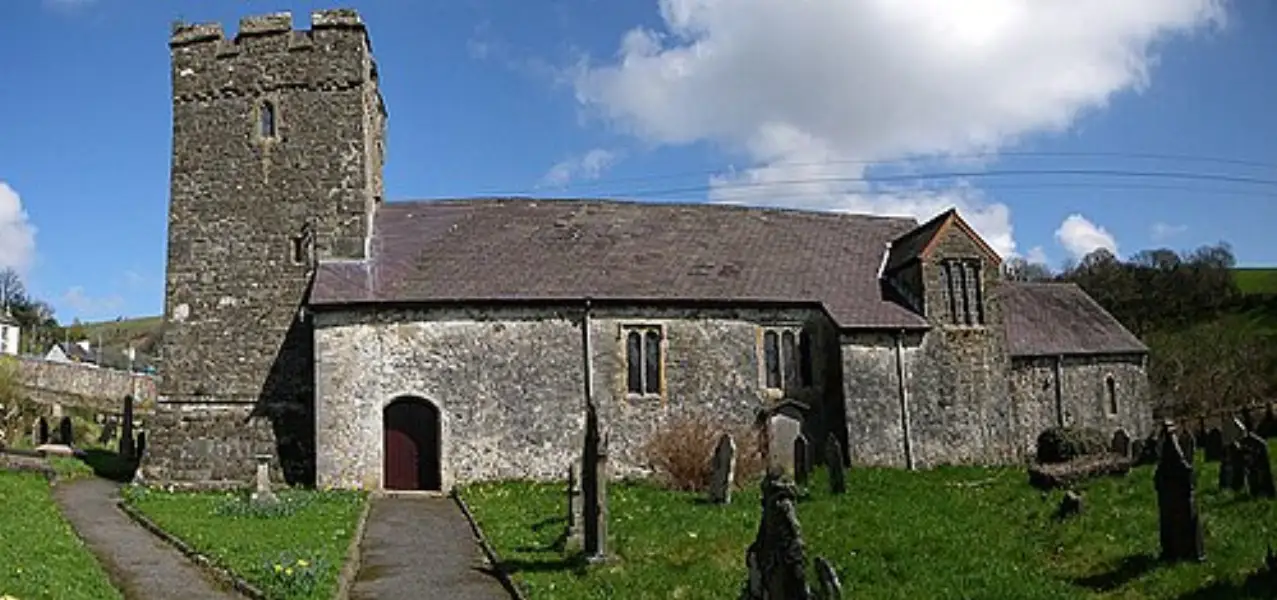
Egwad was a bishop of Wales in the seventh century, one of the many holy churchmen of the age of the Celtic saints whose lives are preserved chiefly in the dedications they left across the land. The medieval Welsh sources, above all the poetry of Lewis Glyn Cothi as cited by the antiquarians, record that he built a church at Ystrad Tywi, the vale of the river Tywi in Carmarthenshire, in an era when the founding of a church was the characteristic act of a Welsh saint's mission. From that foundation his memory spread: the town of Llanegwad, whose very name declares it the church settlement of Egwad, honours him as its patron saint, and in the Middle Ages a festival was kept there each year in his honour. His cult also took root a little distance away at Llanfynydd in Carmarthenshire, where the parish church commemorates him to this day. Like most of the founders of the age of Welsh Christianity, Egwad belongs to a church that transmitted its saints by local memory rather than by written chronicle, and what the records preserve is the imprint of his work: holy places, a name in the landscape, and a people's centuries-long habit of honouring him.
The Complete Life
A Bishop of the Seventh Century
Egwad lived and served as a bishop in Wales during the seventh century, the age in which the Christian communities planted by the first Welsh saints had matured into a network of local churches under their own bishops and abbots. His episcopal rank is affirmed by the early modern students of the Welsh Church, who drew on sources reaching back through Browne Willis's survey of the cathedrals to the medieval materials beneath them. To be a bishop in that century meant presiding over a church that looked to Rome no longer and to no central authority at all, a Christianity sustained by monastic settlements, hereditary families of clergy, and the memory of founders. The most characteristic act of such a churchman was the raising of a church, the llan that gave its name to the settlement around it, and this is precisely the deed recorded of Egwad: he built a church at Ystrad Tywi, in the fertile valley of the river Tywi. The founding of a church fixed the map of Welsh Christianity for a thousand years, and the men who performed it were remembered as saints whether or not any biographer ever wrote their lives. Egwad is one of those founders whose work speaks where documents are silent.
§ Saint Egwad
Patron of Llanegwad
The memory of Egwad has lived longest in the places that carry his name. Llanegwad in Carmarthenshire is his town in the literal sense, its name uniting the Welsh word for a church settlement with that of the saint who founded it, and there he is honoured as patron. The devotion was no abstraction: in the Middle Ages the town kept an annual festival in his honour, a fair of the saint comparable to the patronal feasts by which rural Wales celebrated its founders each year, drawing the countryside together in a mixture of worship and market. His cult crossed the few miles to Llanfynydd as well, where the parish church commemorates him, a second dedication that suggests his influence extended through the district rather than being confined to a single site. The bard Lewis Glyn Cothi, the great fifteenth-century poet whose works the antiquaries cited in recovering Egwad's story, stands among the literary witnesses to the saint's continued place in local memory centuries after his death. Modern students of the Welsh saints, from Rice Rees's essay on the primitive church founders onward, have counted Egwad among that company of seventh-century bishops whose churches still anchor the spiritual geography of west Wales, keepsakes of an age when saints built the parishes of the future.
§ Saint Egwad
The Record
- Major works
- Church at Ystrad Tywi
- Patron of
- Llanegwad, Wales
- Canonization
- Pre-congregation
Prayer
Bibliography
Show 5 sources
- Lewis Glyn Cothi, The Poetical Works of Lewis Glyn Cothi: A Celebrated Bard (Cymmrodorion, 1837), p. 37.
- Browne Willis, A Survey of the Cathedrals of York, Durham, Carlisle, Chester, Manchester (T. Osborne Gray's Inn and T. Bacon in Dublin, 1742), p. 190.
- George William Manby, The History and Antiquities of the Parish of Saint David, South-Wales (Harding, 1801), p. 115.
- Rice Rees, An Essay on the Welsh Saints Or the Primitive Christians, Usually Considered to Have Been the Founders of the Churches in Wales (Longman, Rees, Orme, Brown, Green, and Longman, 1836), p. 298.
- "St Egwad's Church, Llanfynydd, Carmarthenshire".
Profile text adapted from the Wikipedia article, licensed CC BY-SA 4.0.
Pray with this saint every day
Save St. Egwad to your favorites, read the full profile, and get feast-day reminders in the Saints app.
Get the Saints AppFree on the App Store for iPhone and iPad