
died 30 December 717·Feast December 30
St. Egwin of Evesham
Benedictine Bishop of Worcester and founder of Evesham Abbey
Overview
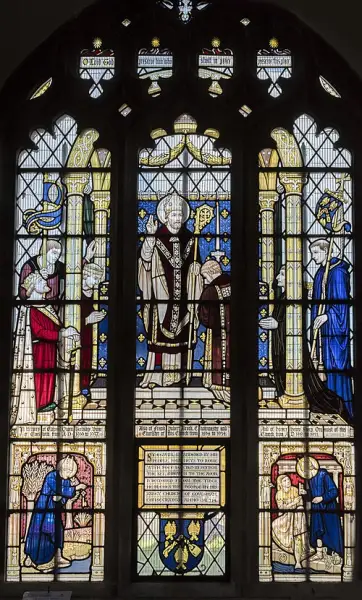
Egwin, also rendered Ecgwin or Ecgwine, was a Benedictine monk who became the third Bishop of Worcester in Anglo-Saxon Mercia. Born in Worcester into a noble family descended from Mercian kings, possibly a nephew of King Æthelred of Mercia, he was consecrated bishop after 693. His biographers report that king, clergy, and commoners alike pressed him into the office, yet the popularity that carried him to the episcopate faded as he governed. He proved a guardian of orphans and widows and an even-handed judge, but his stern enforcement of Christian marriage and clerical celibacy stirred resentment among his flock, and complaints eventually reached his ecclesiastical superiors. He undertook a penitential pilgrimage to Rome, famously locked in shackles whose key he cast into the River Avon and received back, according to legend, from the mouth of a fish caught in the Tiber. Vindicated by the pope, he returned to England and founded Evesham Abbey, dedicated to the Virgin Mary, a house that grew into a principal centre of Benedictine life in the English middle ages. He took part in the Council of Clovesho, died at his abbey on 30 December 717, and was enshrined there.
The Complete Life
Noble Birth in Mercia
Egwin was born in Worcester, the town at the heart of his later diocese, into a noble family that traced its descent from the kings of Mercia. Some traditions suggest he was a nephew of King Æthelred of Mercia, the ruler who would later prove his friend in moments of political danger. Seventh-century Mercia was a kingdom still consolidating its Christian identity, and noble families supplied the church with many of its bishops and abbots. Egwin entered monastic life as a Benedictine monk, a path that within his social class was both a genuine renunciation and a common route to leadership. His biographers describe how, when the episcopal see of Worcester fell vacant, every order of society united to demand his elevation: the king, the clergy, and the common people together pressed the monk into office. The detail is telling, for it shows a man chosen not by faction but by a remarkable consensus, and it makes the difficulties of his episcopate the more instructive, since the same public that acclaimed him would later turn against the discipline he imposed.
§ Life
Bishop of Worcester
Consecrated bishop after the year 693, as the third occupant of the see of Worcester, Egwin governed a large Mercian diocese in the generation after the great conversion work of the previous century. His record, as his early biographers present it, combined pastoral tenderness with unflinching rigor. He earned a reputation as a protector of orphans and widows, the classical tests of a bishop's justice, and was remembered as a fair judge in disputes. Yet he struggled throughout his episcopate to bring the local population to accept Christian morality, above all the church's teaching on marriage and the obligation of clerical celibacy. His severity in these matters, however well founded in doctrine, bred a deep resentment among his people. Complaints found their way to his ecclesiastical superiors, encouraged perhaps by the knowledge that the king himself was his friend. Faced with accusations rather than abandon his principles or rule by force, Egwin chose a third path: he would take his case to the apostolic see itself, in person, and in the garb of a penitent. In a kingdom where the faith was still barely two generations deep, such teaching cut against settled custom, and every ruling he issued gathered fresh opposition around him.
§ Life
Pilgrimage to Rome and the Founding of Evesham
The legend of Egwin's Roman pilgrimage is among the most vivid of Anglo-Saxon hagiography. Preparing for the journey, he locked iron shackles on his own feet and threw the key into the River Avon, placing his cause entirely in God's hands. Crossing the Alps, his party was tormented by thirst; companions who mocked his sanctity dared him to produce water as Moses had done, while the believers among them asked in faith. Egwin prostrated himself in prayer, and on rising they saw a pure stream gush from the rock. In Rome, as he prayed before the tomb of the Apostles, a servant brought him a fish freshly caught from the Tiber, and in its mouth lay the very key from the Avon. Freeing himself from his self-imposed bonds, he straight away won from the pope an authoritative dismissal of the charges his enemies had pressed. Back in England he founded Evesham Abbey, on a spot the Virgin Mary was said to have pointed out to a swineherd named Eof, from whom the town takes its name. The abbey rose among the foremost Benedictine monasteries of the English middle ages, and stands as Egwin's lasting monument.
§ Life
Clovesho and Death at Evesham
The closing years of Egwin's episcopate were marked by participation in the first great Council of Clovesho, one of the significant legislative assemblies of the Anglo-Saxon church, recorded among the last important acts of his office. The council's convening suggests a bishop restored fully to the confidence of his peers after his Roman vindication. According to the Benedictine historian Jean Mabillon, Egwin died on 30 December 720, but most authorities place his death three years earlier, on 30 December 717, after some twenty-four years as bishop. He died where he had chosen to build, at the abbey of Evesham, and his remains were enshrined there, making the abbey his shrine and a center of his cult for the following eight centuries. The medieval church of St Lawrence at Evesham preserves scenes from his life in its decoration, testifying to the endurance of his memory among the townspeople. His tomb, with the abbey church itself, was destroyed at the dissolution of the abbey in 1540 under Henry VIII, though his feast on 30 December has continued unbroken. Pilgrims sought his shrine for centuries afterward, and the painted scenes of his life in the town's churches kept his story alive in Evesham long after the abbey itself had fallen.
§ Life
An Anglo-Saxon Cult
Egwin belongs to the great company of saints canonized by popular acclaim before the formal processes of the modern era existed. Veneration began at his tomb in Evesham Abbey, where his remains were enshrined soon after his death in 717, and spread through Mercia and beyond. He is venerated today in both the Catholic Church and the Eastern Orthodox Church, a rarity among local Anglo-Saxon saints. The survival of his cult depended on the monks who told his story: around 1016 Byrhtferth of Ramsey, one of the most learned English monks of his age, composed a hagiography of the saint, and around 1130 Dominic of Evesham, prior of the abbey itself, wrote another Vita Sancti Egwini. These two lives preserved the pilgrim legends, the miracle of the key and the fish, and the founding vision of Eof the swineherd for later generations. Medieval iconography settled on a distinctive emblem: a bishop holding a fish and a key, a summary in images of his Roman trial and vindication. Though his physical shrine perished at the dissolution in 1540, his feast of 30 December endures in the calendars of both communions.
§ Life
The Abbey That Outlived Him
Egwin's most tangible legacy is Evesham Abbey, which grew from his early-medieval foundation into a leading Benedictine house of the English middle ages, dominating the life of the town that formed around its walls. Its dedication to the Virgin Mary, made at the saint's direction on the strength of a swineherd's vision, tied the house to a story its monks cherished for nine hundred years. The literary legacy has proved equally durable. The lives by Byrhtferth of Ramsey and Dominic of Evesham made Egwin one of the better-documented Mercian saints, and modern scholarship continues to study both texts; Michael Lapidge's Oxford Dictionary of National Biography article on Byrhtferth records the earlier life, and J. C. Jennings examined Dominic's writings in The English Historical Review. Historians of the episcopate, consulting the Handbook of British Chronology, place his consecration after 693 and his death on 30 December 717, securing his place in the line of bishops of Worcester between Oftfor and Wilfrith. In the landscape of Anglo-Saxon sanctity he stands as the type of the reforming bishop: stern, misunderstood, vindicated at Rome, and remembered in stone, story, and feast.
§ Life
Timeline
- 693
Consecrated as the third Bishop of Worcester, taking up an office he held until his death.
§ Life
- 30 Dec 717
Died at Evesham Abbey, the house he had established, and his remains were enshrined at that site.
§ Life
- 1016
Byrhtferth of Ramsey, a monk at Ramsey Abbey, composed a hagiography of the bishop around this time.
§ Life
- 1130
Dominic of Evesham, a medieval prior of Evesham Abbey, wrote another Vita of the saint around this date.
§ Life
- 1540
His tomb, together with the abbey church, was destroyed when the abbey was dissolved by royal authority.
§ Life
The Record
- Major works
- Founder of Evesham Abbey (dedicated to the Virgin Mary)
- Patron of
- protector of orphans and widows·the town and abbey of Evesham
- Symbols
- bishop holding a fish and a key
- Canonization
- Pre-congregation canonization; venerated in the Catholic Church and Eastern Orthodox Church since antiquity
Prayer
Bibliography
Show 6 sources
- Macpherson, Ewan. "St. Egwin." The Catholic Encyclopedia. Vol. 5. New York: Robert Appleton Company, 1909.
- Fryde, E. B.; Greenway, D. E.; Porter, S.; Roy, I. (1996). Handbook of British Chronology (Third revised ed.). Cambridge: Cambridge University Press. ISBN 0-521-56350-X.
- Jennings, J. C. (April 1962). "The Writings of Prior Dominic of Evesham". The English Historical Review. 77 (303): 298–304.
- Lapidge, Michael (2004). "Byrhtferth of Ramsey (fl. c. 986–c. 1016)". Oxford Dictionary of National Biography. Oxford University Press.
- Monks of Ramsgate. "Egwin". Book of Saints, 1921. CatholicSaints.Info. 22 November 2012.
- Herbermann, Charles, ed. (1913). "St. Egwin". Catholic Encyclopedia. New York: Robert Appleton Company.
Profile text adapted from the Wikipedia article, licensed CC BY-SA 4.0.
Pray with this saint every day
Save St. Egwin of Evesham to your favorites, read the full profile, and get feast-day reminders in the Saints app.
Get the Saints AppFree on the App Store for iPhone and iPad