
fl. c. 53·Feast Unknown
St. Eigen
Legendary First Female Saint of the Britons
Overview
Eigen, whose name survives in the variant forms Eurgen, Eurgain and Eurgan, is remembered in Welsh tradition as the first female Christian saint among the Britons, though the historical evidence for her life is slight and disputed. Medieval genealogies describe her as a daughter of Caratacus, the British king who resisted the Roman conquest. The annals of Tacitus record that one of Caratacus' daughters, never named there, appeared before the Roman Senate and the emperor Claudius around the year 53. Later Welsh sources say that she came back from Rome alongside her father and the saints Cyllin and Ilid, and that together they established Cor Eurgain, a college of twelve devoted to Christian teaching, which would place her among the first bringers of the faith to Britain. The family records of Iestyn ab Gwrgant add that she lived at the close of the first century and married Sarllog, a lord associated with Old Sarum. Nearly everything recorded about her derives from manuscripts linked with the collection of Iolo Morganwg, a source modern scholars treat with caution, and her name has been attached only doubtfully to two Welsh churches. Antiquarians from Rice Rees to Sabine Baring-Gould nevertheless discussed her as the first British holy woman, and her story has drawn composers and novelists into modern times.
The Complete Life
A Princess of the Roman Frontier of Memory
Welsh genealogical tradition makes Eigen a daughter of Caratacus, the celebrated king who led British resistance to the Roman invasion before being carried to Italy in chains. The only near-contemporary glimpse of any such daughter comes from the pen of Tacitus, whose annals place a daughter of Caratacus before the Roman Senate and the emperor Claudius in approximately the year 53. Tacitus does not supply her name, and he notably does not list her beside her mother, father and uncles among those the emperor spared from execution, a silence that has given scholars pause. Her recorded names vary widely across the sources: Eurgen, Eurgain and Eurgan all appear, and some writers have suggested she was also called Gladys, on the theory that this was a Welsh word for a princess. A bolder line of speculation has tried to identify her with the Claudia whom Saint Paul greets in the Second Epistle to Timothy, though the evidence for that identification is generally judged to be coincidental. What remains is a portrait sketched almost entirely by later hands, a royal daughter caught between Britain and Rome at the very hinge of the island's history.
§ Saint Eigen
A College of Twelve in the First Springtime
The tradition preserved in the manuscripts of the Morganwg collection gives Eigen a role far beyond that of a captive's daughter. It tells that she returned from Rome in the company of Caratacus, together with Saint Cyllin and Saint Ilid, and that the party formed a religious college of twelve members known as Cor Eurgain, the choir of Eurgain. In this telling, her household became a school of the faith at a date so early that it would mean Christianity took root in Britain within living memory of the apostles. The same sources make the claim explicit: the Welsh people, they say, came to belief in Christ through the instruction given by the saints of Cor Eurgain. Historians treat these stories with reserve, since the manuscripts that carry them are of doubtful antiquity and value. Even so, the picture they preserve is a coherent one, of a noblewoman who turned whatever she had learned abroad into a community of teaching and song, and who was remembered by later generations not as a convert but as a teacher of converts.
§ Saint Eigen
A Saint Remembered in Doubtful Pages
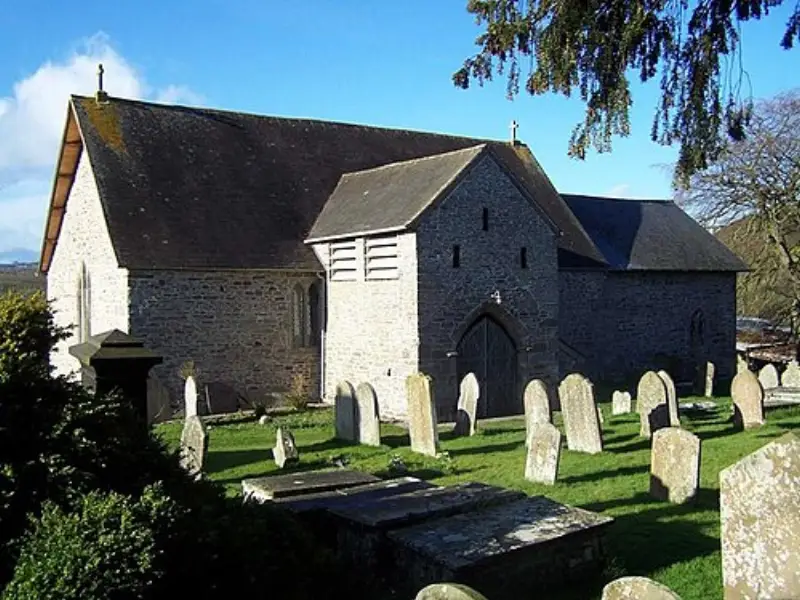
Eigen's afterlife has been largely literary. Antiquarians from Rice Rees through Jane Williams to Sabine Baring-Gould and John Williams each weighed her claim to be the first female saint of the Britons, keeping her name alive even while conceding how thin the record is. Two Welsh churches have been linked with her, though both links are uncertain. The parish church of Llanigon in Wales is dedicated to a Saint Eigon, but this almost certainly points instead to Eigion, brother of Saint Cynidr, whose own church stood at nearby Glasbury. A church at Northop in Flintshire, Llaneurgain in Welsh, honors a Saint Eurgain said to be a daughter of Prince Maelgwn Gwynedd and niece of Saint Asaph, a sixth-century figure with a feast on 30 June, whom most scholars keep distinct from Eigen. Her story also crossed into the arts. Edward Elgar made her a character in a cantata on her father's defeat, first heard at Leeds in 1898, and in 2008 Barbara Erskine placed a modern heroine beside her in the time-slip novel The Warrior's Princess. Whatever the verdict of history, her legend has proven durable.
§ Saint Eigen
Timeline
- 53
According to the annals of Tacitus, an unnamed daughter of Caratacus stood before the Roman Senate and Emperor Claudius.
§ Saint Eigen
- 1848
The Iolo Manuscripts appeared in print, preserving the genealogical material that names Eigen as a daughter of Caratacus.
§ Saint Eigen
- 1897
Edward Elgar began a cantata centered on the defeat and capture of her father by the Romans.
§ Saint Eigen
- 1898
Elgar's cantata received its first performance at the Leeds choral festival.
§ Saint Eigen
- 2008
Barbara Erskine published The Warrior's Princess, a time-slip novel that takes Eigon as its subject.
§ Saint Eigen
In Their Own Words
She lived in the close of the first century, and was married to Sarllog, who was a lord of Caer Sarllog, or the present Old Sarum
The Record
- Major works
- Cor Eurgain, a religious college of twelve, according to Welsh tradition
- Canonization
- Pre-congregation; her cult rests on medieval Welsh genealogical tradition, and modern scholars doubt that she existed.
Prayer
Bibliography
Show 5 sources
- S. Baring-Gould and John Fisher, The Lives of the British Saints: The Saints of Wales, Cornwall and Irish Saints, Kessinger Publishing, 2005
- Rice Rees, An Essay on the Welsh Saints or the Primitive Christians, Usually Considered to Have Been the Founders of the Churches in Wales, Longman, Rees, Orme, Brown, Green, and Longman, 1836
- Iolo Morganwg and Owen Jones, Iolo Manuscripts: A Selection of Ancient Welsh Manuscripts, in Prose and Verse, W. Rees, 1848
- Richard Williams Morgan, St. Paul in Britain; or, The Origin of British as Opposed to Papal Christianity, The Marshall Press, 1861
- Tacitus, Annals 12:33-38 and 13:32
Profile text adapted from the Wikipedia article, licensed CC BY-SA 4.0.
Pray with this saint every day
Save St. Eigen to your favorites, read the full profile, and get feast-day reminders in the Saints app.
Get the Saints AppFree on the App Store for iPhone and iPad