
c. 470 – c. 550·Feast February 9
St. Einion Frenin
King of Llŷn and patron of the saints of Bardsey
Overview
Einion Frenin, whose Welsh name literally means Saint Einion the King, was a Welsh confessor and saint of the Celtic Church who lived in the late fifth and early sixth centuries. A member of Gwynedd's Cuneddan dynasty, he numbered Owain Danwyn, called Owain Whitetooth, among his parents, and counted Cuneglasus, the king of Rhos, and the saints Seiriol and Meirion among his brothers. Einion himself apparently reigned as a local king, a regulus, over the Llŷn Peninsula lying south-west of Anglesey, and perhaps over Anglesey too. What makes him lastingly important is his generosity to the church: he granted his brother Seiriol the land for the monastery at Penmon on Anglesey and later for Seiriol's hermitage on Puffin Island, and he drew the Breton saint Cadfan from Tywyn to found St Mary's Abbey on Bardsey Island, which became one of the great pilgrimage sites of Wales. He is sometimes said to have joined Cadfan's island community, yet Llanengan's church claimed his relics for itself and credits him with founding its original building. His feast was originally 9 February and had shifted to the 10th or 12th by the sixteenth century. Wells, caves, hills, and crosses across north Wales still carry his name.
The Complete Life
A Prince of the Cuneddan Line
Einion Frenin was born into the highest rank of the Brittonic north. He belonged to Gwynedd's Cuneddan dynasty, descended from Cunedda, the northern warlord whose sons carved out the kingdom of Gwynedd in the generations after the Roman withdrawal. His father was Owain Danwyn, Owain Whitetooth, a ruler whose own lineage was debated in the sources — some older accounts made Einion the son instead of Einion Yrth ap Cunedda, king of Gwynedd and Einion's grandfather, before the genealogy settled on Owain. His siblings were as remarkable as his ancestors. His brother Cuneglasus became king of Rhos and is remembered as one of the five kings denounced by the sixth-century writer Gildas for their tyranny — a fate his saintly brother's reputation escaped entirely. Two other brothers, Seiriol and Meirion, were numbered among the saints of Wales, Seiriol becoming one of the great monastic founders of Anglesey. In such a family, where one brother ruled, one was condemned, and two were canonized, Einion took a distinctive path: he exercised royal power himself, yet employed it not for conquest but as patron and protector of the ascetic movement transforming his kingdom.
§ Life
The Regulus of Llŷn
Einion ruled as a local king — the Latin sources call him a regulus, a petty king — over the Llŷn Peninsula and its lands south-west of Anglesey, with Anglesey perhaps under him as well. The title that clung to his memory, Frenin, simply means the King, and the medieval church of Llanengan later inscribed him in Latin as Æniani Rex Wallie, Einion king of Wales, an exaggeration of his true rank but proof of how highly the tradition esteemed him. The period of his rule, the turn of the fifth and sixth centuries, was a formative age for Welsh Christianity, when royal courts and monastic communities were intertwined and a king's chief legacy might be the saints he sheltered. Einion was formally a confessor — a saint honoured for the witness of a holy life rather than a martyr's death — and his particular form of confession was the union of kingship with personal sanctity. Rather than retire from the world into a monastery, he governed his peninsula while placing its resources at the disposal of the church, a model of Christian rulership that made him the natural partner for the founding saints who came seeking land and protection in his realm.
§ Life
Patron of Penmon, Puffin Island, and Bardsey
Einion's mission unfolded through three great acts of patronage that shaped the sacred geography of north Wales. First, he gave his brother Seiriol the ground for the monastery, the clas, at Penmon in Anglesey, a house that grew into one of the island's principal religious centres. Second, he gave Seiriol the site of a hermitage on Puffin Island, the rocky islet off Anglesey's eastern point that came to be called Ynys Seiriol, Seiriol's Island, in memory of the anchorage. Third, and most consequential, he lured the Breton saint Cadfan away from Tywyn to found St Mary's Abbey on Bardsey Island, the first religious establishment on that remote isle off the tip of Llŷn. Bardsey, lying at the edge of the known world across a perilous strait, grew into one of Wales's great pilgrimage shrines, so esteemed that tradition spoke of it as a burying place for thousands of saints. Though the island never formed part of the Cistercian Way, its abbey owed its existence to Einion's persuasion of the Breton. In all three foundations the king gave what only a king could give — land, security, and invitation — and thereby inscribed his own name on holiness he did not personally perform.
§ Life
Confessor and Perhaps Monk
The sources honour Einion as a confessor of the Celtic Church, and his sanctity expressed itself in a distinctive spirituality of gift. Where his brother Seiriol sought God in the ascetic isolation of Penmon and Puffin Island, Einion sought him through renunciation of another kind: the surrender of dynastic land to the kingdom of heaven. Each grant — Penmon, the hermitage isle, Bardsey — was a piece of his inheritance transferred to prayer, and the cumulative effect was to make the periphery of his realm a chain of holy places. The tradition goes further and suggests that Einion himself eventually joined Cadfan's community on Bardsey, exchanging the regulus's authority for the monk's obedience, though the claim cannot be verified. His devotion left physical traces that his people read as sacramentals: Ffynnon Engan, Einion's Well, whose gathered rainwater was credited with curative powers, and the hoofprint of his horse near Castell Cinan, a petrosomatoglyph that made his very journeys part of the landscape's holiness. For the Welsh church he became the exemplar of the royal confessor, a saint whose crown and cross were worn together.
§ Legacy
Death and the Relics at Llanengan
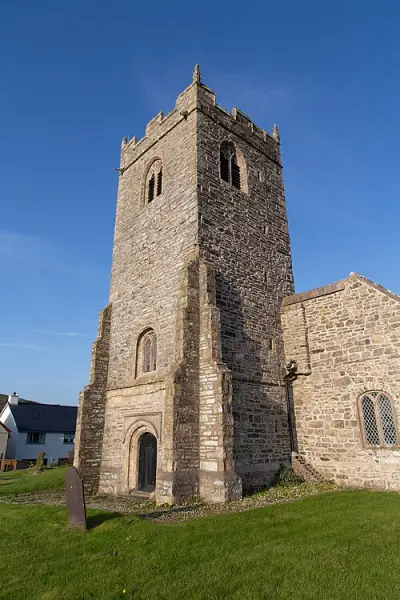
Einion died in the course of the sixth century, the sources giving no precise year, and his remains became the object of rivalry between the places his life had sanctified. Bardsey, where he was said to have ended his days in Cadfan's community, might naturally have claimed him, but it was the church at Llanengan on the Llŷn mainland — the church whose original foundation was credited to Einion himself — that possessed his relics. There, in the age before the Reformation, the faithful venerated a gilt and crowned statue of the royal saint, an image that caught in gold the paradox of his life: a king enthroned among the saints. The present St Engan's Church at Llanengan, erected in the late fifteenth or early sixteenth century, still stands as his shrine and still holds the memory of his remains. His feast, originally kept on 9 February, had migrated to the 10th or 12th of the month by the sixteenth century, a small sign of the drift that befell many Welsh cults; in time the observance lapsed altogether and is no longer kept by either the Anglican or the Catholic church in Wales, though the saint's presence in the landscape of Llŷn has never wholly faded.
§ Life
Pre-Congregation Honour and Lost Feast
Einion's canonization belongs wholly to the pre-congregation era, resting on the veneration of his relics at Llanengan and the dedication of churches in his name rather than on any papal act. The chief evidence of his ancient cult is liturgical: his feast day, originally given as 9 February in the sources collected by the Baring-Gould circle, appears to have been transferred to the 10th or 12th of the month by the sixteenth century, perhaps through the reform of local calendars. The honour survived the Reformation imperfectly — the gilt statue of the crowned saint disappeared with the old religion, and today the feast is no longer observed by either the Anglican Church in Wales or the Catholic church — yet the title of saint has never been withdrawn from him. The Latin inscriptions in his church, hailing him as Rex Wallie, show how his cult elevated the local regulus into a king of all Wales, a measure of the affection in which he was held. In the Orthodox churches of the West his memory has been partially revived, with 9 February kept as his feast — a modern restoration of the oldest attested date, returning the royal confessor to the calendar he once adorned.
§ Legacy
A Saint Written into the Landscape
Einion Frenin's most enduring monument is not a book or a basilica but a landscape saturated with his name. Around Llanengan the pilgrim still encounters Ffynnon Engan, Einion's Well, whose rainwater was claimed to cure; Ogo' Engan, Einion's Cave; Bryn Engan, Einion's Hill; Caer Engan, Engan's Camp; and even Croes Engan, Einion's Cross, a farm in Denbighshire far from his peninsula. Near Castell Cinan lies Ol Troed March Engan — the Hoofprint of Einion's Horse — a petrosomatoglyph that tied the royal saint's riding to the rock itself. His cult travelled east as well: Llandogo in Monmouthshire was sometimes known of old as Lann Enniaun, and toward the close of the fifteenth century the poet Hywel Rheinallt addressed a cywydd to Saint Einion of the golden hands, a poem whose very epithet keeps an iconographic detail now lost, and which attests another church in Gwynedd, its dedication now unknown, that honoured him. Institutions remember him too, from the fifteenth-century church that guards his relics to the pilgrimage routes of Bardsey, the island abbey his invitation created. Few Welsh saints have left so dense a toponymic footprint, and fewer still a foundation, Bardsey, whose spiritual fame so far outgrew the king who made it possible.
§ Legacy
Timeline
- 550
Died at some point during the sixth century, the sources preserving no more exact date.
§ Life
- 1500
The present St Engan's Church, which keeps his remains, went up in the late fifteenth or early sixteenth century.
§ Legacy
- 1500
By the sixteenth century his observance had shifted from 9 February to the 10th or 12th of the month.
§ Introduction
The Record
- Major works
- Grant of land for the monastery (clas) at Penmon, Anglesey·Grant of the hermitage site on Puffin Island (Ynys Seiriol)·Foundation of St Mary's Abbey on Bardsey Island, established through his invitation of Cadfan·Original church at Llanengan, St Einion's
- Patron of
- Llanengan·kings who serve the church·pilgrimage to Bardsey Island
- Symbols
- gilt and crowned statue (pre-Reformation Llanengan)·golden hands (from Hywel Rheinallt's cywydd)·Ffynnon Engan, his healing well
- Canonization
- Pre-congregation canonization; feast formerly observed on 9 February, moved to the 10th or 12th by the 16th century
Prayer
Bibliography
Show 7 sources
- Baring-Gould, Sabine & al. The Lives of the British Saints: The Saints of Wales and Cornwall and Such Irish Saints as Have Dedications in Britain, Vol. II, p. 422ff. Chas. Clark (London), 1908.
- Baring-Gould, Sabine & al. The Lives of the British Saints, Vol. III, p. 460. Chas. Clark (London), 1908.
- Carlisle, Nicholas; A Topographical Dictionary of the Dominion of Wales, p. 305, W. Bulmer & Co., (London), 1811.
- Thomas, John; The Myvyrian Archaiology of Wales, Part 1, p. 424. T. Gee, 1870.
- Peter, David; Hanes Crefydd yn Nghymru [The Ecclesiastical History of Wales], p. 152, J. Evans (Heol-y-Farchnad), 1816.
- Pennick, Nigel (1996); Celtic Sacred Landscapes, Thames & Hudson. ISBN 0-500-01666-6.
- Jones, T. Thornley; "The 'Llannau' of Cwmdauddwr Parish" in The Transactions of the Radnorshire Society, Vol. XXXVI, pp. 18–19, Radnorshire Society, 1966.
Profile text adapted from the Wikipedia article, licensed CC BY-SA 4.0.
Pray with this saint every day
Save St. Einion Frenin to your favorites, read the full profile, and get feast-day reminders in the Saints app.
Get the Saints AppFree on the App Store for iPhone and iPad