
1863 – 1953·Feast January 3
St. Ekvtime Takaishvili
Scholar who guarded Georgia's scattered treasury
Overview
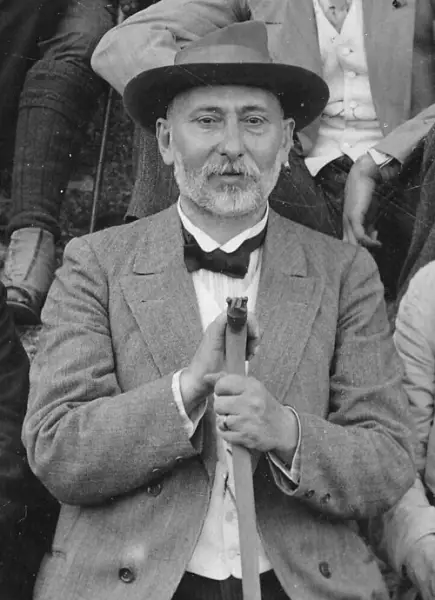
Ekvtime Takaishvili was a Georgian historian, archaeologist, and public benefactor who became one of the most honored Orthodox saints of modern Georgia. Born to a nobleman in the village of Likhauri in Guria, he graduated from St. Petersburg University in 1887 and spent three decades teaching the history of Georgia in the schools of Tbilisi. He chaired the Society of History and Ethnography of Georgia, led archaeological expeditions to the historic region of Tao-Klarjeti, and helped found Tbilisi State University. When the Red Army ended Georgia's independence in 1921, he followed the exiled government to France, carrying with him the Georgian national treasury: thirty-nine crates of priceless manuscripts, treasures, and works of art. Through decades of poverty and persuasion he refused to sell a single piece, guarding the collection in Paris until it could be returned to Tbilisi after the Second World War. He died in 1953 after years of house arrest. Canonized in 2002 as a 'Man of God', he was named a National Hero of Georgia in 2013.
The Complete Life
From Guria to the Capital's Schools
The future saint first saw light on 3 January 1863 at Likhauri, a village of the Guriantskiy prefecture in the Ozurgeti uezd, within the Tiflis Governorate of the Russian Empire. His father, Svimon Takaishvili, was a local nobleman. The boy's abilities carried him along the path of Russian imperial education to its summit: he studied at St. Petersburg University and graduated in 1887. The Caucasus drew him home, and Tbilisi became his arena: from 1887 until 1917 he taught Georgian history in its most prestigious schools, among them the Gymnasium for Nobility. These were the years in which he built his scholarly standing. He pursued extensive research into the Georgian past, and from 1907 to 1921 he chaired the Society of History and Ethnography of Georgia, the leading learned body of its kind in the country. His expeditions of 1907–1910 explored Tao-Klarjeti, a historic Georgian region lying today within Turkey, and brought back evidence of a medieval Christian heritage far from the Russian frontiers.
§ Biography
Scholar, Professor, Legislator
Takaishvili's vocation joined scholarship with public service. When Tbilisi State University was created in 1917, he stood among its founding professors; the institution grew into the center of modern Georgian learning, and his name stands among the great founders beside Ivane Javakhishvili and Petre Melikishvili. The February Revolution of that year drew him openly into politics: he took part in establishing the National Democratic Party of Georgia, and from 1919 to 1921 he served as Deputy Chairman of the Constituent Assembly of the short-lived Democratic Republic of Georgia. He thus stood at both desks of national life, the lecture hall and the legislative chamber, at the moment when Georgia asserted its independence amid the collapse of empires. The pairing was characteristic. For Takaishvili, the study of Georgian history was never an antiquarian pastime; it was the ground on which a nation claims its right to exist, and the assembly in which he sat was the political expression of the same conviction that sent him digging among the ruined churches of Tao-Klarjeti.
§ Biography
Exile and the National Treasury
In 1921 Bolshevik Russia's Eleventh Red Army put an end to Georgia's independence, and Takaishvili lost his posts both in the parliament and at the university. He chose to share his government's French exile, and he carried with him the Georgian national treasury: thirty-nine immense boxes of precious material culture, shipped to Marseille and lodged in a bank depository, then moved to a Paris bank. Though the collection belonged officially to the government-in-exile, its actual supervisor was Takaishvili himself. In the early 1930s the courts upheld him against Salome Obolenskaya — the last Mingrelian prince Niko Dadiani's daughter — who claimed a portion of the treasure removed from the Dadiani Palace at Zugdidi. European museums repeatedly sought to buy portions of the collection, and Takaishvili lived in real hardship, yet he never sold a single piece. When the League of Nations recognized the Soviet Union in 1933 and the Georgian embassy in Paris became a mere 'Georgian Office', the treasury passed to the French state. In 1935 he urged France to return it to Georgia, and in November 1944 he finally drew the Soviet ambassador Aleksandr Bogomolov to its cause.
§ Georgian national treasury
Return, Silence, and Death
The good relations between Stalin and General de Gaulle opened the way for the treasury's homecoming, and Takaishvili brought the collection back to Georgia, the life's work of a scholar and the patrimony of a nation delivered intact after more than two decades abroad. His own reward was guarded: he passed his long final years in Tbilisi under house arrest — deemed, it seems, too old to jail. A heart attack took him on 21 February 1953, in his ninety-first year. The Didube Pantheon received his body first; in 2002 it was moved up to the Mtatsminda Pantheon, where Georgia's most honored figures lie, above the capital he had served. The old scholar had outlived his exile, his party, his republic, and most of those who had shared them, keeping faith with all of them to the end.
§ Georgian national treasury
A Man of God
On 17 October 2002 the Holy Synod of the Georgian Orthodox Church canonized Ekvtime Takaishvili, giving him the title 'Man of God' and the name Euthymius after his baptismal form. It was an unusual canonization, for the church raised to the altars not a martyr of the sword or a desert ascetic but a lay scholar, honoring a sanctity of fidelity: the man who had kept his nation's treasures whole through poverty, exile, and indifference, asking nothing for himself. His feast is kept on 3 January, the day of his birth in 1863. He is honored in the Eastern Orthodox Church, and his cult is anchored in the Georgian church he served, with his tomb among the pantheon of national worthies on Mtatsminda. In this the Georgian church recognized that guarding the memory and the inheritance of a persecuted people can be a path to holiness as real as any written in the older lives of the saints.
§ Veneration
Memory in Georgia
Takaishvili's many studies of Georgian and Caucasus history and archaeology are prized by researchers still today. His institutional legacy is equally durable: Tbilisi State University counts him among its thirteen founders, and the Tbilisi Second Gymnasium, one of the schools where he once taught, bears his name. The state he served in its first independence honored him in its second: Georgia conferred its highest decoration on him posthumously in 2013, naming him a National Hero. A museum of Georgian parliamentarism associated with his name keeps his public memory in the civic sphere, while his canonization keeps it in the church's calendar. Few figures of modern Georgia stand in both registers, the academic and the hagiographic, and fewer still earned the place by the simple, stubborn virtue on which his biographers agree: he had charge of a treasure, everyone wanted a piece of it, and he refused to let one piece go.
§ Legacy
Timeline
- 3 Jan 1863
Born in the village of Likhauri, in Guria of the Russian Empire, to the local nobleman Svimon Takaishvili.
§ Introduction
- 1887
Graduated from St. Petersburg University and began lecturing on the history of Georgia in Tbilisi schools.
§ Biography
- 1907
Assumed the chairmanship of the Society of History and Ethnography of Georgia, holding it until 1921.
§ Biography
- 1907
Began leading scholarly expeditions to Tao-Klarjeti, a medieval Georgian land lying within modern Turkey, through 1910.
§ Biography
- 1917
Took part in founding the National Democratic Party of Georgia after the February Revolution.
§ Biography
- 1917
Stood among the founders and professors of Tbilisi State University.
§ Georgian national treasury
- 1919
Elected Deputy Chairman of the Constituent Assembly of the Democratic Republic of Georgia, serving until 1921.
§ Biography
- 1921
Followed the exiled Georgian government to France, taking the national treasury of thirty-nine boxes with him.
§ Georgian national treasury
- 1930
Won a lawsuit against Salome Obolenskaya, who also claimed part of the treasury taken from the Dadiani Palace.
§ Georgian national treasury
- 1933
Saw the treasury pass to the French state after the League of Nations recognized the Soviet Union.
§ Georgian national treasury
- 1935
Urged the French government to hand the collections back to Georgia.
§ Georgian national treasury
- Nov 1944
Attracted Soviet ambassador Aleksandr Bogomolov's attention to the fate of the treasury, opening the way home.
§ Georgian national treasury
- 21 Feb 1953
Died of a heart attack in Tbilisi and was buried in the Didube Pantheon.
§ Georgian national treasury
- 2002
His remains were transferred from the Didube Pantheon to the Mtatsminda Pantheon.
§ Legacy
- 17 Oct 2002
Canonized with the title 'Man of God' by the Holy Synod of the Georgian Orthodox Church.
§ Veneration
- 2013
Posthumously awarded the title and Order of National Hero of Georgia.
§ Legacy
The Record
- Major works
- Numerous scholarly works on the history and archaeology of Georgia and the Caucasus·Archaeological expeditions to Tao-Klarjeti (1907–1910)·The safeguarding and return of the Georgian national treasury
- Canonization
- Canonized 17 October 2002 by the Holy Synod of the Georgian Orthodox Church, with the title 'Man of God'
Prayer
Bibliography
Show 4 sources
- "Saint Euthymius (Takaishvili)". www.oca.org. Retrieved 2024-09-21.
- "EKVTIME TAKAISHVILI MUSEUM OF GEORGIAN PARLIAMENTARISM - Parliament of Georgia". parliament.ge. Retrieved 2026-08-22.
- Kekelia, Elene (2014). "The Formation and the Legacy of the Mtatsminda Pantheon as a Site of Memory". Identity Studies in the Caucasus and the Black Sea Region.
- Такаишвили, Эквтиме. Люди и судьбы. Биобиблиографический словарь востоковедов - жертв политического террора в советский период (1917-1991). СПб.: Петербургское Востоковедение, 2003.
Profile text adapted from the Wikipedia article, licensed CC BY-SA 4.0.
Pray with this saint every day
Save St. Ekvtime Takaishvili to your favorites, read the full profile, and get feast-day reminders in the Saints app.
Get the Saints AppFree on the App Store for iPhone and iPad