
c. 451/481 – c. 532·Feast February 20
St. Eleutherius of Tournai
First bishop of Tournai of the Merovingian dawn
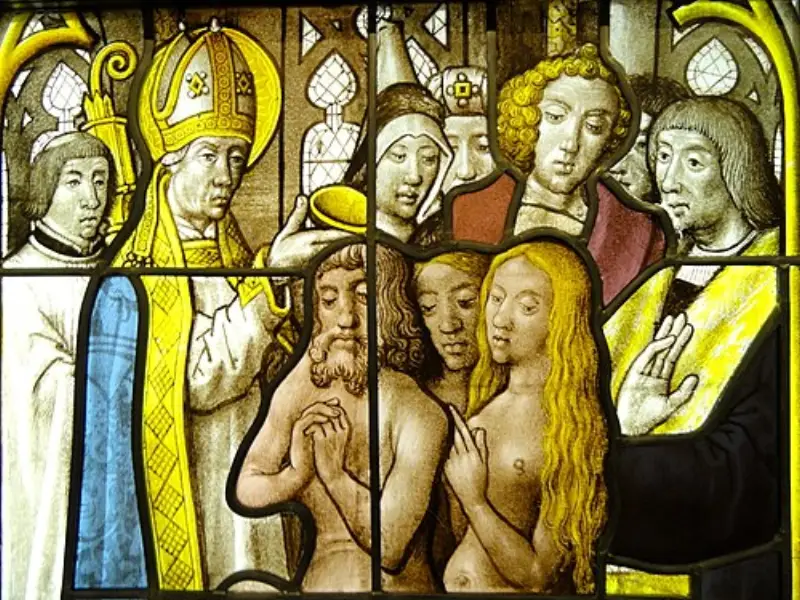
Overview
Eleutherius of Tournai, who died around 532, is venerated as the first bishop of Tournai, though the Catholic Encyclopedia concedes that very little is historically known of him. Tournai claims him as a native son of the later fifth century, the age of Childeric I; tradition pairs him in lifelong friendship with St. Medardus, both future bishops having worn courtiers' dress before bishops' vestments. When St. Remigius set the church order of northern Gaul in order at the fifth century's close, Eleutherius probably received the newly founded see. The martyrdom for which he is honored is a later construction: the story of a fatal beating by Arians angered at his preaching derives from the vita that Henri, canon of Tournai, penned in 1141, anxious to establish his church's age amid its fight to throw off Noyon. His relics, attested from the ninth century, rest in the great reliquary shrine of 1247 in Tournai Cathedral.
The Complete Life
Born in the Reign of Childeric
Nearly everything told of Eleutherius's origins comes from the vita written in 1141, and it must be read with the caution that document deserves. According to Henri's account, Eleutherius was a native of Tournai, born there during the reign of Childeric I, the Frankish king whose grave the city made famous; his birth is accordingly placed between 451 and 481. His parents, Terenus and Blanda, were Christians, and Terenus was counted a descendant in the family of Irenaeus of Lyons, a pedigree that gave the Frankish bishop an apostolic lineage in the telling. The age was not safe for Christians, and persecutions forced the family to flee Tournai for a village named Blandinium, today's Blandain. There the family remained until the conversion of Clovis changed the fortunes of the Frankish church, and the Christians of Blandinium, freed from fear, built a church in their village. A boy of Christian parents, of an illustrious claimed descent, exiled by persecution and restored by the conversion of a king: such is the childhood the medieval vita paints for the first bishop of Tournai.
§ Martyrdom
Courtier, Friend, and Bishop
Tradition gives Eleutherius a friendship for life with the great bishop of Noyon, St. Medardus; both men, the story goes, served the Frankish court before either was set over its churches. As the fifth century ended, St. Remigius — so it is thought — put the church of northern Gaul in order, and in that reorganization Eleutherius was made bishop of Tournai, its first holder. He governed the see at its very foundation, in the decades when the faith of Clovis was being spread through the old Gallo-Roman cities of the Scheldt. To his name the Middle Ages added a literary monument: sermons on the Trinity, on the Nativity, and on the feast of the Annunciation printed among the works of the fathers in the Bibliotheca Patrum. Scholarship has judged these falsely attributed, another layer of the legend that gathered around a bishop about whom, as the Catholic Encyclopedia admits, very little is historically known.
§ Eleutherius of Tournai
A Bishop Against the Arians
In Henri's vita the episcopate of Eleutherius becomes a contest with Arianism. The story relates that Pope Hormisdas consulted him on the matter of eradicating the Arian error, a mark of the esteem in which the legendary bishop was held at Rome. Eleutherius convened a church council and argued so effectively against the Arians that they were angered by their defeat, and their resentment sought another field. One day, as the bishop was going to church, a group of Arians attacked him, beat him severely, and left him for dead. Catholic Online retells the legend much as the vita has it: Arians, furious at his preaching, beat him badly, and death came weeks afterward. On his death-bed, the vita relates, Eleutherius confided his flock to his old friend Medardus, closing the circle of the two courtiers' friendship with a bishop's last act of pastoral care. That a first bishop of a Frankish see should die at the hands of heretics rather than of pagans suited the concerns of the twelfth-century church that told the story.
§ Martyrdom
Death and the Legend Examined
Eleutherius died around the year 532, and the church of Tournai has honored him ever since as a martyr. Modern scholarship, however, is clear about where the martyrdom comes from: modern scholars judge the martyr tale to be Henri of Tournai's own invention, devised for the vita he composed in 1141. Henri had a purpose beyond piety. Through the later eleventh century Tournai's church had been fighting to free itself of the diocese of Noyon, and Henri wrote to establish how ancient Tournai's episcopate truly was — reaching back, he wished to show, to the Franks' conversion, with a founder who had died a confessor's death. A murdered first bishop was the strongest possible deed of title. The historical residue beneath the legend is slight but solid: a man named Eleutherius who was without doubt the first Bishop of Tournai, who died about 532, and whose memory the city never let go, whatever the hagiographers added to it.
§ Martyrdom
A Saint of the Undivided Memory
Eleutherius was never formally canonized; he belongs to the vast company of pre-congregation saints whose cults were established by local devotion and later ratified by inclusion in the calendars. He is venerated in both the Roman Catholic Church and the Eastern Orthodox Church. His feast is kept on 20 February, though the Catholic Encyclopedia notes that 21 July is also given and that the July date is usually the one celebrated; a second observance falls on 25 August, commemorating the translation of his relics. The absence of a papal canonization has never mattered to Tournai, which counted him among its bishops-saints from the early middle ages onward. In his case the process ran the other way from the modern one: first the tomb, then the calendar, then the vita, and only in the hands of modern historians the sifting of what was certain from what was devised. What remains after the sifting is enough for a cult: the first bishop, the friend of Medardus, the man of Tournai.
§ Veneration
The Relics and the Shrine
The cult of Eleutherius left its most beautiful trace in metal and stone. A surviving testimony tells of the relics' recovery while Hedilo governed Tournai as its bishop, around 897/898; Bishop Baudoin translated them again in 1064 or 1065; and in 1247 — the year Bishop Walter de Marvis ordered the great reliquary shrine — they were moved yet again. On the gable of that shrine stands St Eleutherius, crozier gripped in one hand and, in its fellow, a miniature of the five-spired cathedral — the bishop presenting his church, as his legend had presented his death, as Tournai's deed of standing. Claims on the treasure came from other houses too: the abbey of St Martin in Tournai and Bruges's cathedral each held some of the saint's relics. Meanwhile the church of Saint-Eleuthère at Blandain kept the memory of the village where his family had fled and built their first church, so that the saint's legend and his cult together marked the landscape of his life from beginning to end.
§ Veneration
Timeline
- 451
Tradition holds he was born at Tournai between 451 and 481, during the reign of Childeric I.
§ Martyrdom
- 500
Probably became bishop of Tournai once Remigius had arranged northern Gaul's church order at the century's close.
§ Introduction
- 532
Beaten by Arians enraged at his preaching against them, he died of his wounds around this year.
§ Martyrdom
- 897
A recorded testimony tells of his relics being recovered under Bishop Hedilo, in 897 or 898.
§ Veneration
- 1064
Bishop Baudoin had the relics moved to a new resting place, in 1064 or 1065.
§ Veneration
- 1141
The canon priest Henri of Tournai wrote a vita inventing the martyrdom legend, to prove his church's antiquity against Noyon.
§ Martyrdom
- 1247
Bishop Walter de Marvis commissioned the great reliquary shrine, and the relics were translated once more.
§ Veneration
In Their Own Words
historically there is very little known about St. Eleutherius, but he was without doubt the first Bishop of Tournai
The Record
- Major works
- Sermons on the Trinity, the Nativity, and the feast of the Annunciation, falsely attributed to him (Bibliotheca Patrum, vol. XV)
- Patron of
- Tournai
- Symbols
- bishop's crozier·a model of Tournai Cathedral with its five spires, as he appears on the 1247 reliquary
- Canonization
- Pre-congregation saint; his martyrdom rests on a medieval legend
Prayer
Bibliography
Show 2 sources
Profile text adapted from the Wikipedia article, licensed CC BY-SA 4.0.
Pray with this saint every day
Save St. Eleutherius of Tournai to your favorites, read the full profile, and get feast-day reminders in the Saints app.
Get the Saints AppFree on the App Store for iPhone and iPad