
c. 822/823 – 903·Feast August 17
St. Elias of Enna
Monk and Wanderer of Three Continents
Overview
Elias of Enna, born John Rachites in Enna, Sicily, between 822 and 823, is also called Elias the Younger to distinguish him from the prophet Elijah. His life was transformed by the Muslim conquest of Sicily: Enna fell to the Saracens in 859, and John was seized and transported to Ifriqiya for the slave market. Once he had recovered his freedom, he resolved to preach the Gospel at the risk of his life, and reached Palestine, where the Patriarch of Jerusalem clothed him with the monastic habit. Three years in a Sinai monastery followed; then he travelled through Alexandria, Persia, Antioch, and Africa, and after the fall of Syracuse in 878 he returned to Sicily, where he found his aged mother in Palermo and gained his disciple Daniel at Taormina. In 884 he founded, in Calabria's Valley of Salt on Mount Aulinas near Palmi, a monastery that later bore his name. When further Arab invasions drove him to Patras in Greece and then to Santa Caterina in Aspromonte, and he made a pilgrimage to Rome. Invited to Constantinople by the emperor Leo VI the Wise, the seventy-year-old monk fell ill on the journey and died at Thessalonica on 17 August 903. Daniel buried him in his own monastery of Monte Aulinas.
The Complete Life
A Sicilian Stronghold and Its Fall
John Rachites was born at Enna in the heart of Sicily in 822 or 823, in the generation when the Muslim conquest of the island was remaking every Christian life there. Enna was no ordinary town: set on its high plateau, it was recognised as a military stronghold, one of the last centres of Byzantine resistance in Sicily. That strength could not hold forever. In 859 the Saracens finally took the city, and for its inhabitants the fall meant captivity and dispersion. John himself fell into Arab hands and was carried across the sea to Ifriqiya, the North African land of his captors, to be sold as a slave. Nothing in the record suggests that the young Sicilian's faith failed in bondage; instead, the catastrophe that stripped him of home, freedom, and family became the door to an entirely different destiny. The conquest that destroyed the Christian towns of Sicily scattered its Christians across the Mediterranean, and in Elias's case the scattering became a pilgrimage that would touch Palestine, Egypt, Persia, Greece, and Italy before it ended. Before that road was walked, however, it began with the boy of Enna and the fall of the city that could not hold.
§ Biography
From Slavery to the Monastic Habit
Elias managed to regain his freedom, and the manumitted slave made a decision that defined the rest of his life: he would preach the Gospel, several times at the risk of his own life. The road of his preaching led him to the Holy Land, and at Jerusalem the summit of his early vocation was reached when the Patriarch of Jerusalem himself received him and clothed him with the monastic habit, the moment in which John Rachites became Brother Elias. From Palestine he withdrew to Sinai, spending three years in one of its monasteries, the classic school of desert asceticism between Egypt and the Holy Land. But Elias was not formed for a settled cell. After those years of preparation he undertook a venturesome chain of journeys, first to Alexandria in Egypt and onward to Persia, and afterwards to Antioch and back again to Africa. In an age when Mediterranean travel meant danger from sea and raiders alike, a monk who moved between the great Christian centres of three continents was a rarity; in Elias's case it made him known wherever Christians still gathered under the pressure of the Islamic conquests.
§ Biography
Return to a Conquered Island
The news that drew Elias back toward the west was grim. In 878 Syracuse, the chief city of Byzantine Sicily, fell into Arab hands after a long siege, and with that blow the conquest of the island was all but complete. Elias returned to Sicily, and there the wandering monk experienced the tenderest meeting of his life: in Palermo he found his elderly mother, still living after the decades of separation since Enna's fall. At Taormina, one of the last Christian strongholds, he met Daniel, who became his disciple and his most faithful companion for the rest of the story. Going north, Elias crossed into Calabria, the Italian province that had become a refuge for Greeks and Sicilians fleeing the conquest. There in 884 he founded a monastery on Mount Aulinas, known today as Mount Saint Elias near Palmi, within the Valley of Salt, a house that would later take his own name. The foundation gave his restless life an anchor: a house of prayer on a Calabrian mountain, built by a former slave of Ifriqiya and a monk of Sinai, for a church under constant threat from the sea.
§ Biography
The Ascetic on the Move
Elias's spirituality was formed at the fountainheads of Eastern monasticism: the patriarchate of Jerusalem, which gave him the habit, and the monasteries of Sinai, where he spent his three years of formation. Yet his sanctity unfolded not in enclosure but in movement, and this is what makes him distinctive among ninth-century monks. He prayed and preached his way across Alexandria, Persia, Antioch, and Africa, returned to a Sicily under the Crescent, planted a monastery on a mountain in Calabria, and then, when Arab invasions reached even there, took refuge in Patras in Greece and at Santa Caterina in Aspromonte, before walking as a pilgrim to Rome. Each displacement was borne as part of his obedience rather than an accident. The virtues the sources reveal through these events are endurance, courage in preaching at the risk of his life, fidelity to family in his care to find his mother, and the gift of spiritual fatherhood, shown in his bond with Daniel, who followed him from Taormina to Thessalonica and buried him at Monte Aulinas. His was an asceticism of the road: stability of heart amid perpetual exile.
§ Biography
An Emperor's Invitation and Death at Thessalonica
The adventures, wonders, and evangelisation Elias had undertaken across three continents carried his fame as far as Constantinople, and the Byzantine emperor Leo VI the Wise sent him an invitation to visit the imperial city. Elias was now seventy years old, but he set out on the long journey northward through Greece. He never completed it: on the way he fell ill and died at Thessalonica on 17 August 903, far from his Calabrian monastery but within the Byzantine world that had first driven him from his Sicilian home. His faithful disciple Daniel, who had stayed with him through the final years, took charge of the body and carried it back for burial in the monastery of Monte Aulinas at Palmi, the foundation Elias had made in 884 in the Valley of Salt. Thus the man who had been carried as a slave from Enna to Africa returned in death, by the care of his friend, to the mountain monastery that bore his name. His tomb in his own foundation made Palmi the centre of his memory, as the Greek life of the saint, preserved and published in modern times, made his story part of Italo-Greek hagiography.
§ Biography
Veneration East and West
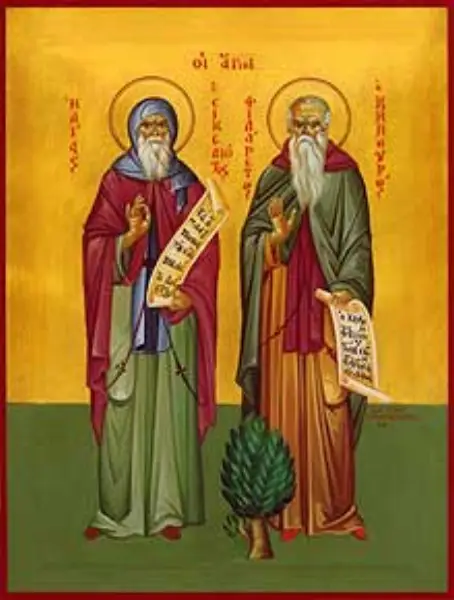
Elias of Enna was never the subject of a formal canonization; his cult arose among the Greek Christians of southern Italy and spread from there. He is honoured as a saint both by the Catholic Church and by the Eastern Orthodox Church, and revered also in the Oriental Orthodox tradition, a breadth of recognition appropriate to a life spent across the whole Mediterranean. His feast is kept on 17 August, the day of his death at Thessalonica in 903. To distinguish him from the prophet Elijah, whose name he bears, the tradition knows him as Elias the Younger or Elias Junior, and his Greek vita circulated under that title. The memory of the saint is anchored in dedicated places of worship: the Church of Saint Elias at Palmi, standing in the shadow of the mountain monastery he founded; the Orthodox Monastery of Saints Elias and Filaret at Seminara, which keeps his name together with that of the Calabrian saint Filarete; and the Church of Saint Elias in Reggio Calabria. In Malta, a statue of the saint erected in 1818 at Cospicua testifies to his cult beyond the Calabrian coast.
§ Places of worship dedicated to the saint
The Life That Survived in Greek
Elias's afterlife in memory depends above all on the Greek text of his life, a hagiographic narrative of a kind unusually adventurous for its genre, which survived to be edited and translated in the modern era. Giuseppe Rossi Taibbi published an edition of the Greek text together with an Italian translation as Vita di Sant'Elia il Giovane, issued in Palermo by the Istituto siciliano di studi bizantini e neoellenici, making the saint's story accessible to scholarship and devotion alike. A further modern Greek edition and Italian rendering of the Life and Works of Our Holy Father Elijah Young appeared in Rome through the Editorial and Translation work of Cosma the Hagiorite Monk and Stefano the Islander, published by Joseph Pontari. Scholars of the Byzantine south have kept his monastery in view: A. Basile wrote on the new monastery of Saints Elias and Philaret at Seminara, and N. Ferrante studied the monastery of Saint Elianovo and Philaretos there. The physical legacy endures as well, in the monastery on Mount Saint Elias near Palmi, the churches of Palmi, Seminara, and Reggio Calabria dedicated to him, and the 1818 statue at Cospicua in Malta.
§ Bibliography
Timeline
- 822
Born John Rachites at Enna, a Byzantine stronghold in the interior of Sicily
§ Introduction
- 859
Enna falls to the Saracens despite its strength; he is seized and carried to Ifriqiya for the slave market
§ Biography
- 878
After Syracuse too succumbs to the Arabs, he sails back to Sicily and finds his aged mother in Palermo
§ Biography
- 884
Founds a monastery in the Valley of Salt on Mount Aulinas near Palmi, in Calabria, later named for him
§ Biography
- 17 Aug 903
Now seventy, he sets out for Constantinople at Leo VI's invitation but dies en route at Thessalonica
§ Biography
- 903
His faithful companion, the monk Daniel, lays him to rest in the monastery of Monte Aulinas at Palmi
§ Biography
The Record
- Major works
- Monastery of Mount Aulinas, founded 884 in the Valley of Salt near Palmi, Calabria
- Symbols
- Monastic habit
- Canonization
- Pre-congregation; venerated by the Catholic, Eastern Orthodox, and Oriental Orthodox Churches
Prayer
Bibliography
Show 4 sources
- Rossi Taibbi, Giuseppe (1982). Vita di Sant'Elia il Giovane. Palermo: Istituto siciliano di studi bizantini e neoellenici.
- Basile, A. "The New Monastery of St. Elias and St. Philaret at Seminara". ASCL XIV, 1945, n. 2.
- Ferrante, N. "The Monastery of St. Elianovo and Philaretos Seminara". Historica XXXII (1979).
- Anonymous (Monaco). Life and Works of Our Holy Father Elijah Young (Siculus). Edited and translated into modern Greek by Cosma Hagiorite, Italian translation by Stefano the Islander. Joseph Pontari Editore, Rome.
Profile text adapted from the Wikipedia article, licensed CC BY-SA 4.0.
Pray with this saint every day
Save St. Elias of Enna to your favorites, read the full profile, and get feast-day reminders in the Saints app.
Get the Saints AppFree on the App Store for iPhone and iPad