
759 – 779·Feast February 1 (Syriac tradition); February 4 (Georgian tradition)
St. Elias of Heliopolis
Carpenter and New Martyr of Damascus
Overview
Elias of Heliopolis, also called Elias of Damascus, was a Syrian carpenter martyred under the Abbasid Caliphate and revered in the Eastern Orthodox and Syriac Orthodox Churches. Born at Baalbek around 759, he moved as a boy of about ten to Damascus with his mother and two brothers to escape poverty, and was employed by a Syrian Christian who served an Arab Muslim master. At a wedding feast he was pressed to accept Islam; after eating and dancing with the guests, whose loosening of his belt was read as apostasy, he was accused the next morning of having renounced his faith. His family returned to Baalbek, but eight years later Elias came back to Damascus and opened a camel-saddle shop. His apostatised former employer denounced him, and he was hauled before the judge al-Layth, who offered to spare him if he would return to Islam. His refusal earned torture and chains, eased by visions in prison, and finally a hearing before the governor Muhammad, nephew of the caliph al-Mahdi. Beheaded on 1 February 779 at about twenty years of age, his corpse was hung outside the city gates for two weeks and cast into the river Barada, though Christians of Baalbek recovered relics.
The Complete Life
A Poor Boy from Baalbek
Elias was born into a Syrian Christian family at Baalbek, the old Heliopolis of the ecclesiastical province of Second Phoenicia, then part of the Abbasid Caliphate. His dates are fixed by his Greek hagiography, which fixes his death at the age of twenty in the year 6287 of the world; reckoned by the Byzantine era, as Robert Hoyland argues from the reference to the reign of al-Mahdi, this yields the familiar dates of 759 to 779, though the Prosopographie der mittelbyzantinischen Zeit would place his birth in 758 or earlier, and some authorities give 775 to 795 instead. Baalbek gave him both his name and his trade: there he was trained as a carpenter. But the family was poor, and around 769, when Elias was about ten years old, he left his native town with his mother and two brothers for Damascus, hoping to escape hardship. In that great city he found work with a Syrian Christian craftsman, who in turn worked for an Arab Muslim employer. The arrangement placed the boy at the crossing point of two communities, one Christian by inheritance and one Muslim by law and power, and it was there that his fate would be decided.
§ Life
The Feast, the Belt, and the Accusation
Elias's Damascus employer, the Syrian Christian, was persuaded by his Arab master to convert to Islam. When the Arab died shortly after arranging his son's marriage, the son threw a celebration at which Elias waited on table, and the guests pressed the young carpenter to convert and so become their social equal. Elias put them off, pleading that a feast was not the occasion for such talk; in the end, though, he was induced to share their meal and join the dancing. Guests loosened, then removed, his belt, ostensibly so that he could move more freely, a gesture heavy with meaning: the belt belonged to the standard dress of a dhimmi, a protected Christian, and to strip it off in public was to proclaim the abandonment of one's faith. The next morning Elias rose while the household slept, fastened his belt, and went out to pray. A guest who caught sight of him charged him with apostasy from the night before, and Elias denied it. His employer intervened to prevent some of the guests from harming him, then refused to pay him. Warned by his brother, Elias left Damascus until rumours died down, and the whole family returned to Baalbek.
§ Life
Return to Damascus and Refusal
Eight years after the disastrous feast, with his brothers' consent, Elias went back to Damascus at the age of twenty and opened his own shop making camel saddles. His former employer, now an apostate and a competitor, invited him to return to the old workshop; Elias refused. Spurned, the Syrian apostate urged his Arab master to report that Elias had converted and apostatised on the night of the party. The accusation put Elias's life in the hands of Islamic law, under which the conversion and later abandonment of Islam was capital. Brought before the judge al-Layth, Elias was given the straightforward opportunity to return to Islam and live. He refused. For that refusal he was tortured and put in chains, yet the hagiography records that in prison he was comforted by visions, the first sign that his suffering was read by his community as martyrdom rather than mere judicial killing. His case was then escalated to the very summit of provincial power: the governor Muhammad, nephew of the reigning caliph al-Mahdi himself, summoned him and tried to win him back to Islam, alternating punishments with promises of material gain.
§ Life
Visions in Prison and the Confession of a Craftsman
The spirituality that emerges from Elias's passio is that of an ordinary Christian artisan whose faith proved stronger than every instrument brought against it. He was no ascetic recluse but a tradesman, a carpenter turned saddle-maker, whose religion showed itself in the habits of a dhimmi: the belt worn as the badge of his protected status, the morning prayer to which he rose while others slept. It was precisely these quiet marks of identity that made the accusation of apostasy intelligible and his denial of it credible. When the machinery of the state fell upon him, first the judge al-Layth's court, then torture, chains, and the governor's alternating punishments and rewards, the sources record not eloquence but steadfastness: he would not return to Islam. What sustained him was visionary consolation. In prison, awaiting the governor Muhammad's judgment, Elias was comforted by visions, the classic mark of the confessor preparing for death in early Christian and Byzantine martyr-acts. After his execution the pattern continued, for Christians reported receiving visions of him, and the recovery of his relics, including limbs rescued by the faithful of Baalbek, showed that his city regarded him as its own saint.
§ Life
Before the Governor and the Sword
The end of Elias's life was compressed into the judicial process of 779. Denounced at his saddle-shop by the apostate who had once been his employer, he passed from the court of the judge al-Layth, where he was tortured and chained for refusing Islam, into prison, and finally into the presence of the governor Muhammad, the caliph al-Mahdi's own nephew. The governor tried persuasion by both extremes, continued punishments on one side and the offer of material rewards on the other, and met the same refusal. Elias was beheaded on 1 February. The authorities intended his death to be a public lesson: his corpse was hung outside the city gates of Damascus for fourteen days, exposed to the passers-by, before being thrown into the river Barada. The gesture failed in its purpose. Christians of Baalbek, his birthplace, recovered some of his relics, including limbs, and visions of the young martyr were reported after his death. The hagiography composed soon afterwards preserved the details of the whole affair, from the wedding feast to the river, and fixed the memory of a twenty-year-old craftsman among the martyrs of early Islamic Syria.
§ Life
Feast Days in Two Calendars
Elias's recognition as a saint rests on the liturgical calendars of the ancient churches rather than on any formal decree. Besides his Greek biography, he is known from the Palestinian Georgian Calendar and the Martyrology of Rabban Sliba, two witnesses to the way his cult spread through the Christian East. According to the Palestinian Georgian Calendar, his feast day was kept on 4 February. The Syriac Martyrology of Rabban Sliba records his feast on 1 February, the day of his beheading, celebrated at Ba Qisyan (Beth Qusyana) near Hah in the region of Tur Abdin, far to the east of his Phoenician homeland, evidence of how widely the story of the Damascene carpenter travelled. Modern scholars note a caution here: Christian Sahner questions whether the martyr commemorated by Rabban Sliba is identical with Elias of Heliopolis, since the martyrology does not associate him with Damascus or Baalbek. Whatever the resolution of that question, both traditions honoured him under the same name in the same week of February, and the Eastern Orthodox Church and Syriac Orthodox Church continue to revere him as a saint today.
§ Hagiography
A Single Manuscript and a Modern Afterlife
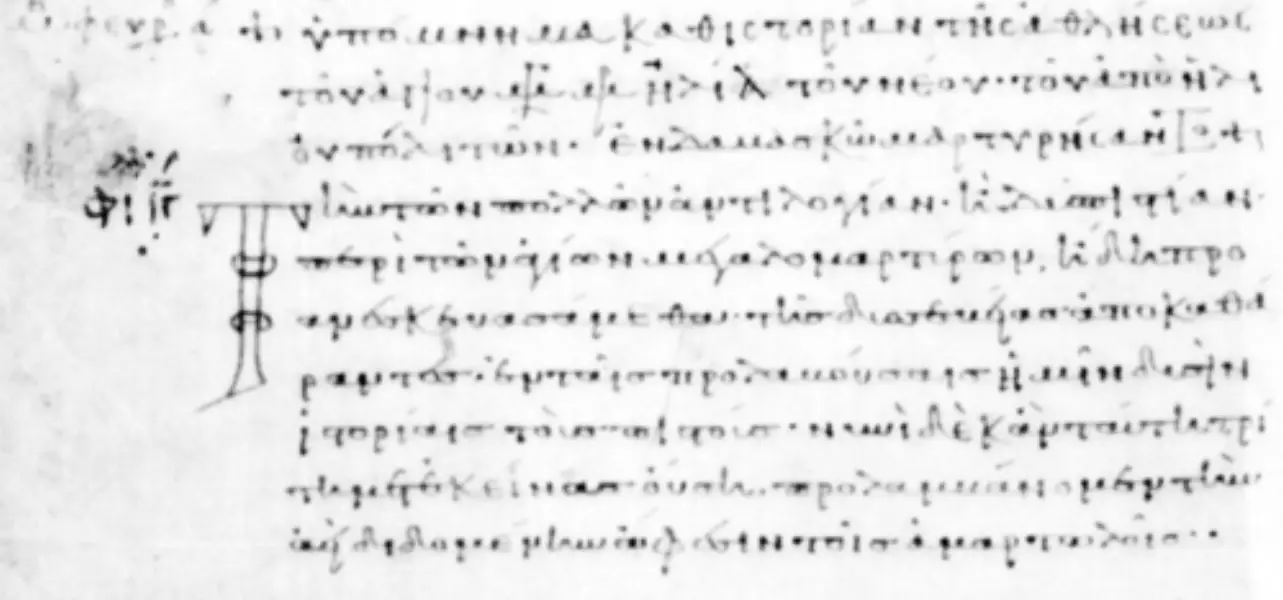
Elias's memory depends on a remarkably slender textual thread: a single manuscript copy of his hagiography, catalogued as BHG 578–579, preserved in the Bibliothèque nationale de France in the Coislin 303 collection at folios 236v to 249v. The codex was copied in the tenth or eleventh century, probably in a Palestinian monastery, yet the anonymous text itself seems, to judge from its precision, to have been composed soon after Elias's death. Its writer says he penned two other lives of martyrs to Islam, though he never knew Elias personally. This Vita became the foundation for all later knowledge of the saint, and modern scholarship has recovered it for the history of Christian–Muslim relations: Stamatina McGrath studied the life of the eighth-century Syrian saint, Stephanos Efthymiadis assessed the Martyrdom for the bibliography of Christian–Muslim relations, Clive Foss placed Elias among the Byzantine saints of early Islamic Syria, and Thomas Sizgorich read his story, with its fatal dance, as a study of violence and identity in the Abbasid world. The Palestinian Georgian Calendar and Rabban Sliba's martyrology complete the picture of a cult that crossed languages.
§ Hagiography
Timeline
- 759
Born into a Christian family at Baalbek, though the Prosopographie der mittelbyzantinischen Zeit would place his birth earlier
§ Dating
- 769
Aged about ten, he left Baalbek with his mother and two brothers for Damascus to escape poverty and trained as a carpenter
§ Life
- 779
Eight years after returning to Baalbek, he came back to Damascus aged twenty and opened a shop making camel saddles
§ Life
- 779
Denounced by his apostate former employer, he was brought before the judge al-Layth and refused the chance to return to Islam
§ Life
- 779
Tortured and put in chains, he was comforted in prison by visions while his case awaited the governor
§ Life
- 779
Brought before the governor Muhammad, nephew of Caliph al-Mahdi, whose punishments and promised rewards failed to shake him
§ Life
- 1 Feb 779
Beheaded on 1 February; after fourteen days of exposure outside the walls, his corpse was cast into the river Barada
§ Life
- 779
Christians of Baalbek recovered relics of the martyr, including limbs, and others reported receiving visions of him
§ Life
The Record
- Symbols
- Carpenter's tools·Palm of martyrdom
- Canonization
- Pre-congregation; feast recorded in the Palestinian Georgian Calendar and the Martyrology of Rabban Ṣalība
Prayer
Bibliography
Show 9 sources
- Binggeli, André (2018). "La réception de l'hagiographie palestinienne à Byzance après les conquêtes arabes". In Byzantine Hagiography: Texts, Themes and Projects. Brepols. pp. 265–284.
- Efthymiadis, Stephanos (2008). "The Martyrdom of Elias of Helioupolis (Elias of Damascus)". In Christian–Muslim Relations: A Bibliographical History. Vol. 1 (600–900). Brill. pp. 916–918.
- Foss, Clive (2007). "Byzantine Saints in Early Islamic Syria". Analecta Bollandiana. 125 (1): 93–119. doi:10.1484/J.ABOL.5.102076.
- Hoyland, Robert G. (1997). Seeing Islam As Others Saw It: A Survey and Evaluation of Christian, Jewish and Zoroastrian Writings on Early Islam. Darwin Press.
- Lilie, Ralph-Johannes; Ludwig, Claudia; Pratsch, Thomas; Zielke, Beate (1998–2013). "Elias (no. 1485)". Prosopographie der mittelbyzantinischen Zeit. Berlin and Boston: De Gruyter.
- McGrath, Stamatina (2003). "Elias of Heliopolis: The Life of an Eighth-Century Syrian Saint". In Byzantine Authors: Literary Activities and Preoccupations. Brill. pp. 85–107.
- Peeters, Paul (1908). "Le martyrologe de Rabban Sliba". Analecta Bollandiana. 27: 129–200. doi:10.1484/J.ABOL.4.01857.
- Sahner, Christian (2002). "Old Martyrs, New Martyrs and the Coming of Islam: Writing Hagiography after the Conquests". Bulletin of the School of Oriental and African Studies. 65: 89–112.
- Sizgorich, Thomas (2017). "The Dancing Martyr: Violence, Identity, and the Abbasid Postcolonial". History of Religions. 57 (1): 2–27. doi:10.1086/692315.
Profile text adapted from the Wikipedia article, licensed CC BY-SA 4.0.
Pray with this saint every day
Save St. Elias of Heliopolis to your favorites, read the full profile, and get feast-day reminders in the Saints app.
Get the Saints AppFree on the App Store for iPhone and iPad