
588 – 660·Feast 1 December
St. Eligius
Goldsmith of Kings and Bishop of Noyon
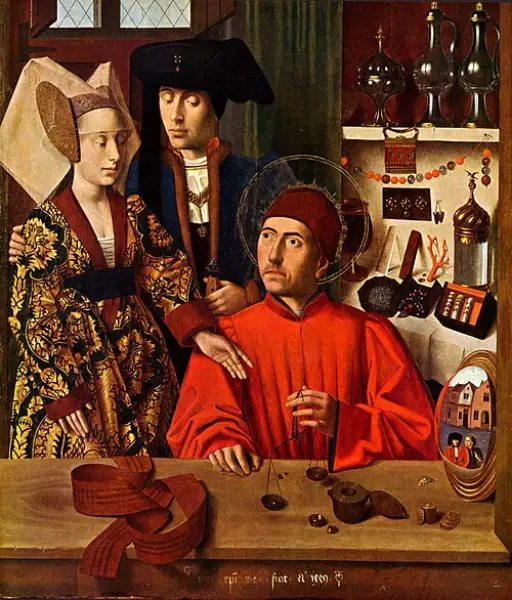
Overview
Eligius, in French Eloi, was a Frankish goldsmith, courtier and bishop whose life spans the transition from the craftsman's bench to the episcopal throne. Born on 11 June 588 into a Gallo-Roman family at Chaptelat near Limoges, he showed such gift for metalwork that his father placed him in the workshop of Abbo, the goldsmith who directed the mint at Limoges. His talent carried him to the royal court, where King Clotaire II commissioned him to make a throne of gold and precious stones; Eligius produced from the allotted material not one throne but two, without fraud or short weight, and the king took him into his household as master of the mint at Marseille. Under Dagobert I he rose to chief counsellor, using his influence to ransom slaves, endow monasteries and give decent burial to the executed. Ordained a priest in 640 under the regency of Queen Nanthild, he led a campaign against simony, and in 642 he became Bishop of Noyon-Tournai, laboring for two decades to convert the pagan peoples of the North Sea coast. He died at Noyon on 1 December 660, leaving monasteries, churches, a written sermon and homily, and a reputation so durable that he remains the patron of goldsmiths, farriers, veterinarians and countless trades.
The Complete Life
The Apprentice of Chaptelat
Eligius was born on 11 June 588 into a Gallo-Roman family settled at the villa of Chaptelat in Aquitaine, six miles north of Limoges, in a region where the old Roman skills of minting and metalwork had survived the collapse of the empire. His father, recognizing unusual ability in the boy, gave him to Abbo, the goldsmith who directed the Limoges mint, and there Eligius learned the exacting trade that would first make him famous. As his skill matured he moved north to Neustria, the palace country of the Frankish kings, where he served beneath Babo, treasurer of the royal household. It was on that official's recommendation that Clotaire II, king of the Franks, entrusted him with the commission that decided his career: a golden throne studded with precious gems. The biographer Audoin relates with delight that from the material supplied for a single piece Eligius made two thrones, drawing on no fraudulent additions, no clipped fragments, no excuse of the furnace's appetite, but filling every setting faithfully with gems. The story became the emblem of his whole life, integrity in the handling of what belongs to another. Among the works soon entrusted to him was the relief carving for Bishop Germain's tomb at Paris, and on that account Clotaire received the goldsmith into his own household, appointing him master of the mint at Marseille.
§ Early life
Counselor at the Court of Dagobert
When Clotaire died in 629, his son Dagobert I named Eligius chief counsellor, and the craftsman became one of the most powerful men in the Frankish kingdoms. His reputation spread so quickly that foreign ambassadors sought him out for his counsel and paid their respects to him before approaching the king; Audoin records that Dagobert loved him so much that he would slip away from the crowds of princes, dukes and bishops to take Eligius' private advice. The favor was real and so were its enemies, but Eligius used it for ends that astonished the court. He gathered alms for the poor and ransomed captives arriving daily at the Marseille slave market, Romans, Gauls, Bretons, Moors and above all Saxons. With the king's consent he sent his servants through the towns to take down the bodies of executed criminals and bury them decently, a work of reverence no one else dared. He persuaded the Breton ruler Judicael to make peace with Dagobert at a meeting at Creil in 636 or 637, a diplomatic success that widened his influence further. At court he lived by the strict Irish monastic rule introduced into Gaul by Columbanus, sharing its discipline with his friend Audoin of Rouen, and founding in 632 the monastery of Solignac near Limoges and a Paris convent of three hundred virgins under the Abbess Aurea.
§ Chief counsellor to Dagobert I: 629–639
Bishop Among the Pagans of the North
The turning to full apostolic office came under Dagobert's successor's regency. Ordained a priest in 640, Eligius at once attacked the simony that disfigured the Frankish church, and his campaign bore fruit in a royal edict forbidding the sale of church offices and demanding instead sound character and upright conduct. When Acarius, Bishop of Noyon-Tournai, died on 14 March 642, Eligius was chosen to succeed him by the common consent of clergy and laity; Audoin remarks that the unwilling goldsmith was tonsured and made guardian of Vermandois, Tournai, Noyon, Ghent and Kortrijk of Flanders. The diocese was largely pagan, and Eligius threw himself into its conversion, making repeated missionary journeys among the Flemings, Frisians, Suevi and the remaining Germanic peoples dwelling by the North Sea. Across the region he planted monasteries and churches across the whole region, built and endowed a nunnery for virgins in his own city of Noyon, and honored the saints whose bones he found: after the discovery of the body of Quentin of Amiens he raised a church with an attached monastery under Irish rule, and he uncovered the remains of Piatus of Tournai and his martyred companions. In 654 he translated the body of Fursey, the celebrated Irish missionary, whose relics he had located.
§ Bishop of Noyon–Tournai: 642–660
The Goldsmith Under the Hairshirt
Audoin of Rouen, who shared Eligius' quarters at court and knew him more intimately than any other witness, has left a portrait of the man's inner life that is among the most vivid in Merovingian hagiography. He was tall, with a rosy face, curly hair and long, honest fingers, and in his early years at court he wore the magnificence his office expected: belts of gold and gems, jeweled purses, silks of the most precious fabrics. Beneath the display, however, he wore a hairshirt against his flesh, and as he advanced in perfection he gave the ornaments away for the needs of the poor, until the man once seen gleaming with gold went about in the meanest garments, girded with a cord. Audoin recalls too his tears, for, as he writes, Eligius had the great grace of tears, a habitual weeping that Frankish monks regarded as a gift of the Spirit. The Irish rule he followed demanded severe fasting, common prayer and the renunciation of property, and he kept it amid the temptations of a royal palace. A legend of later growth, that he once cut off a demon-possessed horse's foreleg, shod it and reattached the limb, belongs to this world of wonder that gathered around his holiness, and it fixed his patronage of horses and their workers forever.
§ Death and legacy
Two Decades on the See of Noyon
Eligius governed the double see of Noyon and Tournai for eighteen years, until his death on 1 December 660 at Noyon, where he was buried. These final years were spent much as the preceding ones had been, in journeys, foundations and the unglamorous pastoral work of a missionary diocese. He continued to found monasteries and churches throughout Flanders and along the coast, and to preach among peoples whose fathers had worshiped Woden and the older gods within living memory. He also wrote: a sermon combatting the pagan practices still current among his people and a homily on the Last Judgment have survived under his name, along with the letter of 645 in which he begged the prayers of Bishop Desiderius of Cahors. Fourteen other homilies long attributed to him are now recognized as pseudepigraphical. His friend Audoin, who would become Bishop of Rouen and a saint in his own right, composed the Vita Sancti Eligii, the biography that preserved for every later age the words and deeds of the goldsmith bishop. The work is among the principal sources for Merovingian court life as well as for the saint, and its affectionate detail shows how deeply Eligius was mourned by the men who had known him.
§ Death and legacy
A Saint of the Undivided Early Church
Eligius belongs to the great company of saints canonized not by process but by acclamation. He died in 660, before the formal machinery of canonization existed, and his sanctity was recognized by the church of his own region in the years immediately following his burial at Noyon. His cult spread first through the lands he had evangelized, and he is cherished above all across Flanders — the Antwerp province especially — and in the towns of Tournai, Kortrijk, Ghent, Bruges and Douai. Through the Middle Ages his relics were the object of special devotion and were repeatedly shared among and moved between shrines, with 881, 1066, 1137, 1255 and 1306 marking the occasions, each translation a public testimony to the veneration of the churches that received them. He is venerated today in the Catholic Church, the Eastern Orthodox Church and the Anglican Communion, one of those early bishops whose holiness was never in dispute across the later divisions of Christendom. In Paris the goldsmiths kept his memory with particular splendor: between 1630 and 1707 they presented the cathedral of Notre Dame with a great religious painting each May, and in 1953 they revived the Guild Chapel, providing the altar, the crucifix above it and a statue of the saint. A mass is still celebrated there around 9 December for the Confraternity of Saint Eloi.
§ Veneration
Patron of Every Trade That Rings and Strikes
Few saints have accumulated so wide a patronage as Eligius, and it began with his first trade. As the most famous goldsmith of the Frankish age he is the patron of goldsmiths and jewelers, and with them of blacksmiths and metalworkers of every kind, cutlers, locksmiths, minters and coin collectors, toolmakers and gilders, harness makers and saddlers and cartwrights. The legend of the shod horse brought him the horses themselves, and with them jockeys, exercise riders, grooms, farriers and veterinarians; farmers and servants, miners and laborers joined the roster in country and town. The industrial and electronic ages added their own petitions: electricians, railway and domestic electricians, mechanics, taxi and gas station workers, watchmakers and clockmakers, and even computer scientists and engineers claim him, and the British Army's corps of Royal Electrical and Mechanical Engineers, together with its Australian counterpart, keeps him as patron. His emblem in art is the goldsmith's hammer, and he is invariably shown in bishop's garb, usually with a crosier in his right hand and a tiny gold-wrought church held open on his left palm. The shoeing legend appears in carvings, tapestries and frescoes from Somerset to Denmark. Even the American medical drama St. Elsewhere, set in the fictional St. Eligius Hospital, carried his name into popular culture.
§ Patronage
Timeline
- 11 Jun 588
Was born at the villa of Chaptelat in Aquitaine, six miles north of Limoges.
§ Early life
- 629
On the death of Clotaire II, was appointed chief counsellor to the new king, Dagobert I.
§ Chief counsellor to Dagobert I: 629–639
- 632
Founded the monastery of Solignac near Limoges on a villa he had purchased, introducing the Irish monastic rule.
§ Chief counsellor to Dagobert I: 629–639
- 636
Brought the Breton prince Judicael to terms with Dagobert, meeting him at the king's residence of Creil.
§ Chief counsellor to Dagobert I: 629–639
- 640
Was ordained to the priesthood during the regency of Queen Nanthild.
§ Service under Nanthild: 639–642
- 14 Mar 642
On the death of Bishop Acarius, was chosen with unanimous approval as Bishop of Noyon-Tournai.
§ Bishop of Noyon–Tournai: 642–660
- 645
Wrote a letter begging the prayers of Bishop Desiderius of Cahors, one of his surviving works.
§ Death and legacy
- 654
Removed the remains of the Irish missionary Fursey, who had died in 650.
§ Bishop of Noyon–Tournai: 642–660
- 1 Dec 660
Died at Noyon and was buried there.
§ Death and legacy
- 881
His relics were divided and transferred to a new resting place, the first of several translations.
§ Veneration
- 1066
His relics were again divided and moved to another shrine.
§ Veneration
- 1137
A further translation of his relics took place.
§ Veneration
- 1255
His relics were divided and transferred once more.
§ Veneration
- 1306
The last recorded medieval translation of his relics took place.
§ Veneration
In Their Own Words
Indeed King Dagobert, swift, handsome and famous with no rival among any of the earlier kings of the Franks, loved him so much that he would often take himself out of the crowds of princes, optimates, dukes or bishops around him and seek private counsel from Eligius.
For he had the great grace of tears.
The Record
- Major works
- Abbey of Solignac·Convent in Paris under the Abbess Aurea·Basilica of St Paul, Paris·Restoration of the basilica of Martial at Paris·Nunnery for virgins at Noyon·Sermon against pagan practices·Homily on the Last Judgment·Letter to Desiderius of Cahors (645)
- Patron of
- goldsmiths·blacksmiths and metalworkers·farriers and horses·coin collectors and numismatists·veterinarians·miners·jockeys and grooms·clockmakers and watchmakers·locksmiths·cutlers·the Royal Electrical and Mechanical Engineers (REME)·electricians and mechanics·computer scientists and engineers
- Symbols
- anvil·goldsmith's hammer·horseshoe·crosier·miniature church of chased gold in his palm·pincers·a horse's foreleg·giving a ring to Godeberta
- Canonization
- Pre-congregation; venerated from shortly after his death in 660.
Prayer
Bibliography
Show 5 sources
- Léon Van der Essen, "St. Eligius", The Catholic Encyclopedia, Vol. 5, New York: Robert Appleton Company, 1909
- Audoin of Rouen, The Life of Saint Eligius (Vita Sancti Eligii), translated by Jo Ann McNamara
- Hugo van der Velden, "Defrocking St Eloi: Petrus Christus' vocational portrait of a goldsmith", Simiolus: Netherlands Quarterly for the History of Art 26, no. 4 (1998): 243-276
- Hugh Chisholm, ed., "Eloi, Saint", Encyclopædia Britannica, Vol. 09, 11th ed., Cambridge University Press, 1911, p. 298
- Hayo Vierck, "Werke des Eligius", in Studien zur vor- und frühgeschichtlichen Archäologie: Festschrift für Joachim Werner, Münchener Beiträge zur Vor- und Frühgeschichte, 1974, pp. 309-381
Profile text adapted from the Wikipedia article, licensed CC BY-SA 4.0.
Pray with this saint every day
Save St. Eligius to your favorites, read the full profile, and get feast-day reminders in the Saints app.
Get the Saints AppFree on the App Store for iPhone and iPad