
1774 – 1821·Feast January 4
St. Elizabeth Ann Seton
First native-born American saint and foundress of Catholic education
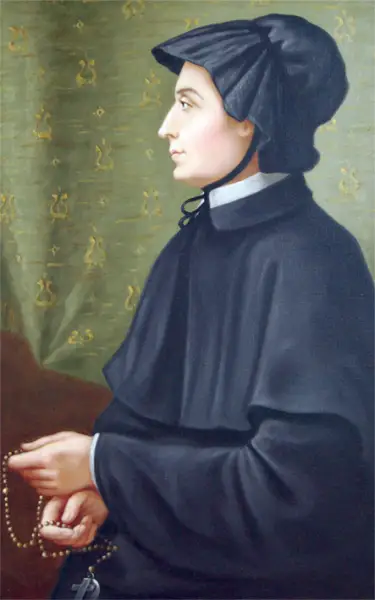
Overview
Elizabeth Ann Seton was the first person born in what became the United States to be raised to the altars of the Catholic Church. Born into a prosperous Episcopal family of New York in 1774, she lost her mother as a small child, suffered a painful estrangement from her stepmother and seasons of depression, and at nineteen married William Magee Seton, a wealthy merchant of the import trade. Five children followed, along with organized charity among the city's widows and the sick. Commercial ruin and William's tuberculosis carried the couple to Italy, where he died in 1803; the kindness of his Catholic partners, the Filicchi brothers, opened the widow's path toward Rome. Received into the Catholic Church in New York in 1805, she lost her pupils and endured family ostracism, yet turned to teaching for her living. Invited by the Sulpician Louis Dubourg, she moved to Emmitsburg, Maryland, in 1809, founded the Sisters of Charity of St. Joseph's — the first congregation of women religious established on American soil — and opened Saint Joseph's Academy and Free School, the country's first free Catholic school, open to every girl regardless of means. Tuberculosis carried her off at Emmitsburg on January 4, 1821, aged forty-six. Beatified in 1963 and canonized by Paul VI in 1975, she is honored as the founder of the nation's parochial school system.
The Complete Life
A Daughter of Old New York
Elizabeth Ann Bayley was born on August 28, 1774, into the mercantile elite of New York, the second child of Richard Bayley and Catherine Charlton, both families numbered among the region's earliest European settlers. Her father, a surgeon of French Huguenot and English stock from New Rochelle, became the Port of New York's chief health officer, examining immigrants landing at Staten Island and tending victims of the city's yellow fever outbreaks; he later held Columbia College's first chair of anatomy. Her mother was the daughter of an Anglican priest who served at St. Andrew's on Staten Island, and Elizabeth was reared an Episcopalian. Grief came early: Catherine died in 1777, when the child was three, perhaps after complications from the birth of a sister who also died in infancy. Richard remarried Charlotte Amelia Barclay, who drew young Elizabeth into church charity, carrying food to the poor in their own homes; after the marriage dissolved, Charlotte declined to take the two older girls, who moved in with their uncle William Bayley and his wife Sarah. In her journals Elizabeth later recorded the sting of that rejection, and a depression dark enough that she contemplated ending her life with laudanum — thoughts she came to credit God with ending. The same journals show a girl of unusual gifts: fluent in French and English, a pianist, a fine rider, a devoted reader of the Bible, poetry and music, already contemplative by temperament.
§ Early life
Marriage, Ruin, and a Widowed Faith
On January 25, 1794, at nineteen, she married William Magee Seton, a twenty-five-year-old merchant of the import trade, in a ceremony led by Samuel Provoost, first Episcopal bishop of New York. The couple took an upscale residence on Wall Street and worshiped at Trinity Church, where pastor John Henry Hobart became Elizabeth's spiritual director. With her sister-in-law Rebecca Mary Seton she continued the charitable rounds of her father's household, nursing the sick and dying among relatives, friends and needy neighbors, and in 1797 she helped charter a society for the relief of poor widows with small children, serving as its treasurer. Prosperity then collapsed. The elder William Seton died in 1798, leaving six younger siblings — aged seventeen down to seven — to be absorbed into the household; the Embargo Act of 1807 strangled American commerce; ships were lost to seizure by Britain and France; and William was forced into bankruptcy, the family retreating to her father's house on Staten Island. Under that pressure her faith deepened. William's tuberculosis worsened, and in late 1803 he sailed for Tuscany with Elizabeth and their eldest daughter, seeking a milder climate. Held a month in quarantine at Livorno, he died there on December 27. The hospitality of his Italian partners, Filippo and Antonio Filicchi, then gave the grieving widow her first sustained acquaintance with the Catholic faith.
§ Marriage and motherhood
Mother Seton of Emmitsburg
The founding years at Emmitsburg turned a bereaved parent into the mother of a new kind of family. In 1809, accepting the invitation of the Sulpician Louis William Valentine Dubourg — whose order, exiled from revolutionary France, was planting the nation's first Catholic seminary there — Seton relocated with her children and a band of companions to the Maryland village, the venture sustained by Samuel Sutherland Cooper, a wealthy seminarian of the new Mount Saint Mary's. On July 31, 1809 she established the Sisters of Charity of St. Joseph's, a community devoted to the care of poor children — the first congregation of women religious ever founded on American soil — and the sisters came to call her Mother Seton. That same year she opened Saint Joseph's Academy and Free School, dedicated to girls' education and remembered as the country's first free Catholic school; she accepted every student whatever her family could pay, wrote the classroom textbooks herself, and trained her sisters as teachers. In 1811 the community took up the rules of the Daughters of Charity, and in 1813 Seton and several companions professed the vows of poverty, chastity and obedience together with a pledge of service to the poor. The work spread quickly: by 1815 sisters were dispatched to Philadelphia to administer an orphan asylum, and in 1817 she planted a mission in New York City.
§ Founder
A Converted Conscience
Seton's spirituality joined a contemplative temperament to decisions of unusual cost, and her journals trace both. Formed in the Episcopal Church and directed first by John Henry Hobart at Trinity, she tested her growing attraction to Catholicism through roughly eight months of reflection and correspondence with Jean-Louis Lefebvre de Cheverus, the priest in Boston, before asking to be received. On March 14, 1805, Matthew O'Brien, pastor of St. Peter's — then the city's only Catholic church — brought her into communion with Rome; Bishop John Carroll of Baltimore confirmed her the next year. The price was immediate: Protestant parents withdrew their daughters from her academy, and her own family ostracized her. New York's Catholics were few and mistrusted, and she weighed emigration to Catholic Lower Canada before Dubourg's invitation changed her course. Her conversion carried the marks that would define her holiness: obedience prayed through rather than merely felt, charity organized into lasting institutions, and an acceptance of loss — mother, stepmother, husband, daughters, reputation — as the raw material of sanctity. Even her literary legacy bore this stamp: the hymn "Jerusalem," written as her seventeen-year-old daughter Anna Maria lay dying in 1815, made her likely the first American-born woman to publish both an original hymn tune and a widely sung hymn text.
§ Conversion to Catholicism
Sending Sisters, Bearing Sorrow
The last years of Seton's life were years of sending and of suffering. From Emmitsburg she directed a congregation in expansion: sisters to Philadelphia in 1815 for the St. John's Orphan Asylum, a mission to New York in 1817, and within a decade of her death, houses running orphanages and schools reaching as far west as Cincinnati and New Orleans, together with the first hospital of the Mississippi's western lands at St. Louis. Her personal losses mounted all the while. Anna Maria, the daughter who had sailed with her to Italy, died in 1812; Rebecca followed in 1816. Her own tuberculosis — the disease that had killed William — advanced through her active years, yet she kept the supervision of Saint Joseph's Academy to the end. She died at Emmitsburg on January 4, 1821, forty-six years old, and her remains rest today at the National Shrine of Saint Elizabeth Ann Seton there. In 1850 the community she founded merged with the Daughters of Charity of St. Vincent de Paul, becoming that congregation's first American branch, while six further independent congregations tracing their origin to her sisters were still operating as of 2026 — from New York and Halifax to Cincinnati, Greensburg and Convent Station — the grown branches of the tree John XXIII would say had sprouted from her small house of charity.
§ Later life and death
Two Miracles and an American Saint
The road to the altars opened in 1882, when Cardinal James Gibbons of Baltimore told the Emmitsburg sisters he was beginning Seton's cause; the Archdiocese studied her writings and questioned witnesses, Vatican theologians approved her spiritual writings in 1936, and Pius XII's Decree of Introduction of 1940 gave her the title Servant of God. Two cures carried the cause forward. In 1951 four-year-old Ann Teresa O'Neill of Baltimore, given up with acute leukemia, was carried to Emmitsburg by her parents, laid upon Seton's tomb, and prayed over; within days she began to improve, and bone marrow tests across several years showed a remission medicine could not account for. The Vatican certified the healing, and John XXIII beatified her on March 17, 1963, remarking that in a very small house with ample room for charity she had sown a seed in America that grew into a great tree. In October 1963 Carl Kalin, sixty-one and comatose five days with an untreatable brain disease, recovered within a day of receiving a sliver of Seton's bone at his bedside in Yonkers. That verified miracle brought Paul VI to St. Peter's Square on September 14, 1975, where he proclaimed her a saint — the first born in the United States — hailing her as the calendar of saints' first American blossom; President Ford afterward proclaimed the date National Saint Elizabeth Seton Day.
§ Canonization
Schools, Shrines, and a Shared Memory
Seton's afterlife in American culture has been strikingly broad. The Sister and Daughter of Charity networks she seeded staffed schools, orphanages and hospitals across a growing continent, and her name attached itself to hundreds of institutions: Seton Hall University in New Jersey, established in 1856; Saint Elizabeth University; Elizabeth Seton High School in Bladensburg; Mother Seton School in Emmitsburg; schools and parishes from Ohio to the Philippines, Ireland and Western Australia. Medical institutions bear her name as well, from Bayley Seton Hospital on Staten Island to the Elizabeth Seton Pediatric Center in New York and the Elizabeth Ann Seton Hospital in Maine. Civic honors followed the ecclesial ones: in 1979 she entered the National Women's Hall of Fame at Seneca Falls, and the Maryland Women's Hall of Fame counts her in its 1986 class. Her story has reached mass audiences through the 1980 television film A Time for Miracles and a 2025 mini-documentary produced at Seton Hall. The Episcopal Church that reared her keeps her on its calendar on January 4, the day of her death — the same date the Catholic Church observes — so that the communion she joined in 1805 and the church of her childhood now remember her on the same day, an ecumenical footnote as quietly fitting as her life.
§ Legacy
Timeline
- 28 Aug 1774
Born in New York City, second child of Richard Bayley and Catherine Charlton, and raised as an Episcopalian.
§ Early life
- 1777
Her mother Catherine died, perhaps from complications after the birth of Elizabeth's sister, who died in infancy the next year.
§ Early life
- 25 Jan 1794
Married the wealthy import merchant William Magee Seton at St. Paul's Chapel in a wedding presided over by Bishop Samuel Provoost.
§ Marriage and motherhood
- 1797
Became a charter member and treasurer of a New York society that aided poor widows with small children.
§ Marriage and motherhood
- 1798
On her father-in-law's death her husband took over the family firm, and the couple absorbed his six younger siblings into their household.
§ Financial setbacks
- 27 Dec 1803
After sailing with her tubercular husband to Tuscany and a month's quarantine at Livorno, she was widowed there; the Filicchi family then introduced her to Catholicism.
§ Death of William Seton
- Jun 1804
Returned to New York with her eldest daughter and opened an academy for girls to support her family.
§ Conversion to Catholicism
- 14 Mar 1805
Was received into the Catholic Church at St. Peter's Church in Manhattan by pastor Matthew O'Brien, losing many pupils and facing family ostracism.
§ Conversion to Catholicism
- 1806
Received confirmation from Bishop John Carroll of Baltimore, whose archdiocese was then the only one in the United States.
§ Conversion to Catholicism
- 1807
Opened a boarding house in the Bowery for students of a local Protestant academy.
§ Conversion to Catholicism
- 1809
Accepted the Sulpician invitation and moved with her children and followers to Emmitsburg, Maryland, at the new Mount Saint Mary's.
§ Founder
- 31 Jul 1809
Established at Emmitsburg the Sisters of Charity of St. Joseph's, the earliest community of religious sisters founded within the United States.
§ Founder
- 1809
Opened Saint Joseph's Academy and Free School, the country's first free Catholic school, accepting pupils regardless of ability to pay.
§ Founder
- 1811
Her sisters adopted the rules of the Daughters of Charity for the young community.
§ Founder
- 1813
She and several sisters of the young community bound themselves by vows — poverty, chastity, obedience — and by dedication to serving the poor.
§ Founder
- 1815
Sent three sisters to manage St. John's Orphan Asylum in Philadelphia and composed the hymn "Jerusalem" while her daughter Anna Maria was dying.
§ Later life and death
- 1817
Established a mission of the community in New York City.
§ Later life and death
- 4 Jan 1821
Died of tuberculosis at Emmitsburg aged forty-six; her remains are interred at the National Shrine of Saint Elizabeth Ann Seton there.
§ Later life and death
- 1882
Cardinal James Gibbons of Baltimore celebrated a mass at Emmitsburg and announced he was opening her cause for canonization.
§ Beatification
- 1936
A panel of Vatican theologians approved her spiritual writings as part of the canonization process.
§ Beatification
- 1940
Pope Pius XII issued the Decree of Introduction, granting her the title of Servant of God.
§ Beatification
- 17 Mar 1963
Was beatified by Pope John XXIII after the Vatican certified the cure of Ann Teresa O'Neill as a miracle.
§ Beatification
- 14 Sep 1975
Was canonized by Pope Paul VI in St. Peter's Square, becoming the first native-born United States citizen declared a saint.
§ Canonization
In Their Own Words
In a house that was very small, but with ample space for charity, she sowed a seed in America which by Divine Grace grew into a large tree.
Elizabeth Ann Seton is a saint. St. Elizabeth Ann Seton is an American. All of us say this with special joy and with the intention of honoring the land and the nation from which she sprang forth as the first flower in the calendar of the saints.
The Record
- Major works
- Sisters of Charity of St. Joseph's (1809)·Saint Joseph's Academy and Free School, Emmitsburg (1809)·The hymn "Jerusalem"·Classroom textbooks and teacher training for her sisters·St. John's Orphan Asylum administration, Philadelphia (1815)·Mission of the Sisters of Charity in New York City (1817)
- Patron of
- Catholic schools·widows·Shreveport, Louisiana·the State of Maryland·Catholic converts
- Canonization
- Beatified March 17, 1963, by Pope John XXIII; canonized September 14, 1975, by Pope Paul VI in St. Peter's Square
Prayer
Bibliography
Show 8 sources
- "The Life of Saint Elizabeth Ann Seton". National Shrine of Saint Elizabeth Ann Seton. January 20, 2016. Retrieved January 5, 2020.
- Rothman, Lily (July 6, 2016). "How Mother Cabrini Became the First American Saint". Time. Retrieved March 4, 2020.
- Barkley, Elizabeth Bookser. "Elizabeth Ann Seton: A Profoundly Human Saint". St. Anthony Messenger. Franciscan Media, July 2009.
- "Catholic Encyclopedia: St. Elizabeth Ann Seton". newadvent.org. Retrieved August 17, 2017.
- McNeil, Betty Ann (September 27, 2009). "St. Elizabeth Ann Seton". Archdiocese of Baltimore. Retrieved January 5, 2020.
- "A Short History of the Sisters of Charity". Emmitsburg Area Historical Society. Retrieved March 3, 2014.
- Kimberling, Clark; "Two Early American Women and their Hymns: Elizabeth Ann Seton and Matilda Durham Hoy", The Hymn 67, no. 3 (Summer 2016): pp. 19–22.
- O'Donnell, Catherine. Elizabeth Seton: American Saint. Cornell University Press, 2018.
Profile text adapted from the Wikipedia article, licensed CC BY-SA 4.0.
Pray with this saint every day
Save St. Elizabeth Ann Seton to your favorites, read the full profile, and get feast-day reminders in the Saints app.
Get the Saints AppFree on the App Store for iPhone and iPad