
1st century BC – early 1st century AD·Feast September 23
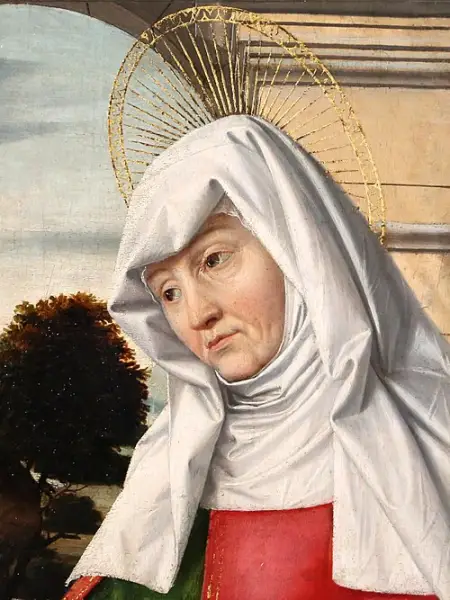
St. Elizabeth
Mother of John the Baptist and kinswoman of Mary
Overview
Elizabeth appears in the opening chapter of the Gospel of Luke as the wife of the priest Zechariah, a descendant of Aaron, and a relative of the Virgin Mary. Though the Gospel describes both spouses as upright and observant, Elizabeth remained childless into old age, a condition she lamented as a disgrace. While Zechariah served incense in the Temple, the angel Gabriel announced that she would bear a son, John, who would be great before the Lord. Zechariah doubted the message and was struck mute until the prophecy was fulfilled. Elizabeth conceived and withdrew in privacy for five months. During her sixth month the angel Gabriel sent Mary of Nazareth to visit her, and at Mary's greeting the infant leaped in Elizabeth's womb. Filled with the Holy Spirit, Elizabeth blessed Mary and her unborn child, and Mary responded with the Magnificat. At the child's birth Elizabeth insisted that he be named John, against family custom. Luke records nothing further of her life. Christians of East and West have honored her since apostolic times; Islam also reveres her as the devout wife of Zechariah, and Mandaeism remembers her under the name Enišbai.
The Complete Life
A Righteous House of Aaron
The Gospel of Luke introduces Elizabeth as one of the daughters of Aaron, a priestly line of Israel, and as the wife of Zechariah, who served as a priest in the Temple of the Lord. Luke sums up their household in words that have echoed through centuries of commentary: the two walked blamelessly in all the commandments and ordinances of God. Yet their righteousness had not shielded them from sorrow. Elizabeth was barren, and the couple grew old without children, a condition that ancient Israel regarded not merely as misfortune but as public shame. Her own words after conceiving betray how heavily that reproach had pressed upon her: she credited God with taking away her disgrace among the people. Commentators such as Matthew Henry observed that the couple lived near Jerusalem in order to fulfill their Temple duties, and tradition places their home at Ein Kerem in the Judean hills, where pilgrims still visit a house and tomb shown in her memory. Islamic tradition knows her by other genealogies: some reports make her a daughter of Imran and sister of Mary, others a daughter of Fakudh and sister of Hannah, while Shia tradition names her Hananah.
§ Biblical narrative
The Promise in the Sanctuary
Elizabeth's calling unfolded in her old age through an angelic announcement made not to her but to her husband. While Zechariah was chosen by lot to offer incense in the sanctuary, Gabriel appeared beside the altar and declared that Elizabeth would bear him a son destined to be called John and to stand great before the Lord, possessed by the Holy Spirit even before his birth. The theologian Adam C. English reckons the encounter to September 24, calculating from the Jewish calendar and the Day of Atonement prescribed in Leviticus. Zechariah doubted the promise because both he and his wife were elderly, and for his disbelief he was rendered unable to speak until the words came true. When his Temple service ended he returned home, and Elizabeth conceived. For five months she lived in seclusion, keeping the wonder to herself while her body proclaimed the mercy of God. Luke presents her pregnancy as the opening movement of the drama of salvation: before the Messiah is announced to Nazareth, his forerunner is already growing within an aging mother in the Judean hill country.
§ Biblical narrative
The Visitation and the Blessing
In the sixth month of her pregnancy, Elizabeth became the setting for one of the most tender encounters in the Gospel. Gabriel was sent to her relative Mary in Nazareth, and as a sign he revealed that the aging Elizabeth was already with child. Mary traveled quickly into the hill country of Judah, and when her voice reached Elizabeth the infant in Elizabeth's womb leaped for joy. Elizabeth herself was filled with the Holy Spirit and cried out aloud, blessing Mary among all women and blessing the fruit of her womb, and wondering aloud that the mother of her Lord should come to her. Matthew Henry reasoned that such knowledge of Mary's destiny could only have come by revelation, since no one had yet told her, and that it must have been a great encouragement to the young Virgin. Elizabeth's praise drew from Mary the canticle the Church now calls the Magnificat. Mary remained about three months before returning home. When Elizabeth's son was born, the neighbors rejoiced with her, and on the eighth day she stood firm against the whole family circle, declaring that the child must be called John, as the angel had commanded.
§ Biblical narrative
Veneration of the Righteous Mother
Elizabeth's sanctity was recognized not by any formal process but by the uninterrupted devotion of the Churches, for she belongs to the company of pre-congregation saints. The Roman Catholic Church keeps her feast on 5 November in the older calendar and on 23 September in the current arrangement, while the Orthodox, Lutheran, and Anglican traditions commemorate her on 5 September, together with her husband Zechariah, whom the Lutheran Church–Missouri Synod honors as a prophet. She is also remembered on the Feast of the Visitation, observed on 2 July in the West and on 30 March in the East, recalling Mary's journey to her side while both women were pregnant. Islam likewise holds her in honor: the Quran describes how God answered Zechariah's prayer, made his wife fruitful, and set the couple and their son among those who race in doing good, calling on God in hope and fear. In Mandaeism she is known as Enišbai and is named in the eighteenth, twenty-first, and thirty-second chapters of the Mandaean Book of John. A traditional tomb is shown at the Franciscan Monastery of Saint John in the Wilderness near Jerusalem.
§ Sainthood
A Voice in the Church's Prayer
Few figures of the New Testament have entered so deeply into the daily speech of believers. From the medieval era onward, Elizabeth's Spirit-filled greeting to Mary has formed the second half of the Hail Mary, so that millions of Christians repeat her words every day in the Church's most beloved prayer. The apocryphal Gospel of James enlarged her story, recounting the birth of her son, the murder of her husband, and the miraculous escape of Elizabeth and the child John during the Massacre of the Innocents. Artists returned to her again and again: Master Heinrich of Constance carved the Visitation in the early fourteenth century, Domenico Ghirlandaio painted it in 1491, Jacopo da Ponte rendered it in the late 1520s, Bronzino set her beside the Virgin and Child, and Elisabetta Sirani portrayed the Holy Family with Elizabeth and the boy Baptist in the seventeenth century. In the Quranic tradition she stands among the honored women of God, wise and steadfast, exalted to a high station alongside her relative Mary. For Mandaeans, Enišbai remains a named presence in their Book of John. A mother's faithfulness, brief as her biblical appearance is, has thus resounded across every branch of the Abrahamic family.
§ Apocrypha
Timeline
- -2
Elizabeth conceives after long barrenness and remains in seclusion for five months, thanking God for taking away her disgrace.
§ Biblical narrative
- 24 Sep -2
The angel Gabriel appears to Zechariah in the Temple, announcing that Elizabeth will bear a son to be named John; the encounter is reckoned to September 24.
§ Biblical narrative
- -1
Elizabeth bears a son; on the eighth day she insists he be called John, and Zechariah's speech is restored when he writes the same name.
§ Biblical narrative
- 25 Mar -1
In Elizabeth's sixth month, Gabriel announces the conception of Jesus to her relative Mary, who travels to the Judean hill country; there Elizabeth blesses her.
§ Biblical narrative
- 1
Elizabeth dies in the first century BC or early in the Christian era; a traditional tomb is shown at the Monastery of Saint John in the Wilderness near Jerusalem.
§ Biblical narrative
In Their Own Words
Blessed are you among women, and blessed is the fruit of thy womb. But why am I so favored, that the mother of my Lord should come to me?
The Lord has done this for me … In these days he has shown his favor and taken away my disgrace among the people.
No! He is to be called John.
The Record
- Major works
- Her canticle-like blessing of Mary, preserved in Luke 1:42–45, which helped provoke the Magnificat
- Patron of
- Pregnant women
- Symbols
- Visitation scene with Mary·Infant John the Baptist at her side·Elderly woman at the Temple doorway
- Canonization
- Pre-congregation; venerated as a saint from the earliest centuries of Christianity
Prayer
Bibliography
Show 7 sources
- English, Adam C. (October 14, 2016). Christmas: Theological Anticipations. Wipf and Stock Publishers. pp. 70–71. ISBN 978-1-4982-3933-2.
- Thurston, Herbert. "Hail Mary", The Catholic Encyclopedia. Vol. 7. New York: Robert Appleton Company, 1910.
- Lutheran Church–Missouri Synod (2006). Lutheran Service Book. St. Louis, MO: Concordia Publishing House. pp. x–xiii. ISBN 978-0-7586-1217-5.
- Stowasser, Barbara Freyer (1994). Women in the Qur'an, Traditions, and Interpretation. New York: Oxford University Press. pp. 68–69. doi:10.1093/acprof:oso/9780195111484.001.0001. ISBN 9780199879694.
- Vicchio, Stephen J. (2008-07-01). Biblical Figures in the Islamic Faith. Wipf and Stock Publishers. ISBN 978-1-55635-304-8.
- Muntazir Qa'im, Mahdi (2007). Jesus Through the Qur'an and Shi'ite Narrations (Bilingual ed.). Queens, New York: Tahrike Tarsile Qur'an. pp. 14–15. ISBN 9781879402140.
- Häberl, Charles G.; McGrath, James F. (2019). The Mandaean Book of John: Text and Translation. Berlin/Boston: De Gruyter.
Profile text adapted from the Wikipedia article, licensed CC BY-SA 4.0.
Pray with this saint every day
Save St. Elizabeth to your favorites, read the full profile, and get feast-day reminders in the Saints app.
Get the Saints AppFree on the App Store for iPhone and iPad