
1207 – 1231·Feast November 17
St. Elizabeth of Hungary
Landgravine of Thuringia and servant of the sick
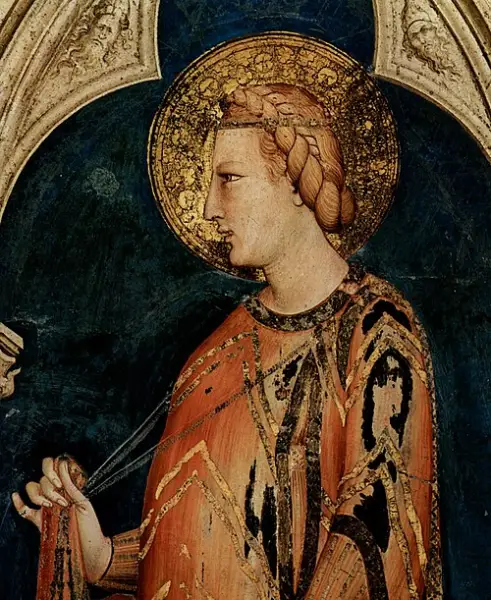
Overview
Elizabeth of Hungary, also called Elizabeth of Thuringia, was a princess of the Árpád dynasty who became one of the most beloved saints of the Middle Ages. Born on July 7, 1207, daughter of King Andrew II of Hungary and Gertrude of Merania, she was raised from childhood at the Thuringian court as the betrothed of Louis IV, Landgrave of Thuringia, whom she married at fourteen in 1221. When Franciscan friars reached Thuringia in 1223, the young landgravine embraced the ideals of Francis of Assisi and began to live them, to the support of her husband. During the famine, flood, and plague of 1226, while Louis represented the Emperor at Cremona, she governed the estate and distributed alms throughout the land, even surrendering state robes to clothe the poor. Louis died of fever at Otranto on September 11, 1227, en route to the Sixth Crusade, leaving her a widow at twenty. After bitter dispute over her dowry she left the Wartburg for Marburg, where, with her dowry money she built a hospital for the poor and sick and served them with her own hands. Subjected to a severe spiritual regimen by her confessor Konrad von Marburg, she held fast to her vows even under threat of forced remarriage. She died at Marburg on November 17, 1231, aged twenty-four, was canonized by Gregory IX in 1235, and is honored today as patroness of the Third Order of St. Francis.
The Complete Life
A Hungarian Princess in Thuringia
Elizabeth was the daughter of King Andrew II of Hungary and Gertrude of Merania, born on July 7, 1207. Where she was born the sources disagree: one tradition points to the castle of Sárospatak in Hungary, first named as her birthplace by the Franciscan Osvaldus de Lasco in a sermon of 1497, which also relocated the miracle of the roses to her Hungarian childhood; another holds that she was born at Pozsony — modern Bratislava — where she lived in the castle until the age of four. What is certain is her early removal from Hungary: the Thuringian court in central Germany received her as a small girl, promised as bride to its future ruler, Louis IV — a union meant to cement the alliance of the two houses. Raised by the Thuringian court, she grew up fluent in its language and culture, a Hungarian princess who became a German in all but blood. Her mother's family wove her into a network of sanctity — her aunt was Saint Hedwig of Andechs, duchess of Silesia and Poland. In 1221, at fourteen, she married Louis, who was enthroned as landgrave that same year, and the union, the sources agree, was a happy one — the foundation on which the extraordinary public charity of her brief life would be built.
§ Early life and marriage
The Franciscan Landgravine
In 1223 Franciscan friars arrived in Thuringia, and the teenage landgravine did not merely learn the ideals of Francis of Assisi — she began to live them. The movement was barely two years old as an organized order, and Elizabeth's embrace of it made her one of its earliest and most illustrious adherents among the laity. Remarkably, her husband raised no obstacle: Louis believed that distributing his wealth to the poor would win eternal reward, and the Thuringians venerate him as a saint for it, though the Church never canonized him. Alongside the friars came a darker influence: the priest Konrad von Marburg, later an inquisitor, gained considerable sway over Elizabeth when appointed her confessor. The crisis of 1226 revealed the depth of her charity and her competence. That spring floods, famine and plague devastated Thuringia while Louis, a staunch supporter of Emperor Frederick II, represented him at the Imperial Diet in Cremona. Elizabeth took charge of the estate and sent alms into every corner of the land — surrendering even state robes and ornaments, the accounts relate, for the relief of the poor. The landgravine in her palace had become, in all but formal profession, a Franciscan: a woman whose husband's treasury existed, as far as she could make it so, for the relief of the least of his subjects.
§ Religious inclinations, influences
Widowhood and the Hospital of Marburg
Elizabeth's life changed irrevocably on September 11, 1227, when Louis, traveling to join the Sixth Crusade, died of fever at Otranto in Italy, only weeks before the birth of their third child. Her words on receiving the news were recorded: it was to her, she said, as if the whole world had died that day. She was twenty. What followed was dispossession and struggle. Louis's brother Henry Raspe assumed the regency for her young son Hermann, and after bitter arguments over her dowry — a conflict in which Pope Gregory IX appointed Konrad von Marburg official defender of her case — Elizabeth departed the Wartburg and settled at Marburg in Hesse. Out of the funds she had recovered from her dowry she raised a hospital for the poor and the sick, and there she and her companions served them with their own hands — the princess become nurse. Her widowhood brought further trials: she made solemn vows to Konrad resembling a nun's, including celibacy and complete obedience to him, and his treatment of her grew so harsh that he allegedly ordered beatings and commanded her to send away her three children. Held more or less hostage at her uncle's castle of Pottenstein to force her into remarriage, she refused, reportedly threatening to cut off her own nose to end any suitor's hopes. Her children remember her otherwise: Sophie became ancestress of the Landgraves of Hesse; Gertrude, born after her father's death, abbess of Altenberg.
§ Widowhood
Roses, a Leper, and the Poverty of Francis
Two famous stories sum up Elizabeth's spirituality, though both come filtered through later hagiography. The miracle of the roses — bread carried in secret to the poor, transformed into white and red roses when her husband demanded what she hid beneath her cloak — was originally attached to other saints, including her namesake Elizabeth of Portugal, and is absent from Elizabeth of Thuringia's earliest life; the version told of her also contradicts the vitae, which insist Louis always supported her charity. The second story, told in Dietrich of Apolda's Vita, is stranger: Elizabeth took the leper Helias of Eisenach into her own marital bed; Louis's mother, scandalized by the discovery, told him at once, and he tore back the bedclothes in indignation — and beheld, in place of the leper, the figure of Christ crucified. However embroidered, the stories encode a real theology: Elizabeth found Christ in the hungry and the diseased, and treated the service of the poorest as service of the crucified Lord. Her formal bond with the Franciscans is likewise layered — whether she formally joined the young Third Order is not proven to everyone's satisfaction, though she clearly received a ceremony of consecration and adopted a Franciscan religious habit. The friars laboring in Thuringia owed much to her patronage, and through them Francis came to know of her, sending her a blessing in his own words not long before he died in 1226 — a seal, as it were, upon her way of life.
§ The Miracles
Death at Twenty-Four
Elizabeth died at Marburg on November 17, 1231, twenty-four years old — an age at which most lives are only beginning. She had packed into them a princess's childhood in two kingdoms, a happy marriage, the governance of a ravaged territory, the loss of her husband to a crusade she never saw him leave for, the fight for her dowry, the founding of a hospital, and a spiritual life of relentless severity under Konrad von Marburg, whose demands — strict dietary commands among them — could scarcely be met even at the Wartburg and helped push her final move to Hesse. The brevity of her life is inseparable from its force: everything she had, she gave quickly. Her death opened a new chapter rather than closing one. Miracles were reported at her grave in the church of her hospital almost immediately, especially healings, and on Konrad's suggestion and by papal command, formal examinations of those healed were conducted between August 1232 and January 1235. The findings, together with a brief vita and the testimony of Elizabeth's handmaidens and companions — preserved in the Libellus de dictis quatuor ancillarum, the book of the four ancillas' words — supplied grounds for one of the swiftest canonizations of the age: Pope Gregory IX declared her a saint at Perugia on 27 May 1235, less than four years after her death.
§ Miracles after death and canonization
A Swift and Duly Proved Sainthood
Canonization in the thirteenth century required process, and Elizabeth's is among the best documented of the era. Very soon after her death, wonders were reported at her tomb in the hospital church, healings above all. On Konrad's suggestion and by papal command, investigations of the healed were held from August 1232 to January 1235; the results were supplemented by a short vita and, decisively, by the sworn testimony of Elizabeth's own handmaidens and companions, bound into the little volume whose Latin name — Libellus de dictis quatuor ancillarum — preserves the sayings of the four handmaidens of St. Elizabeth. This combination of tested miracles and eyewitness testimony proved sufficient for a remarkably rapid elevation: Pope Gregory IX canonized her at Perugia, and the infobox sources date the act to 27 May 1235. The papal bull of canonization survives and is displayed in the Schatzkammer of the Deutschordenskirche in Vienna. Upon her canonization she was named patron saint of the Third Order of St. Francis, sharing the honor with St. Louis IX of France. Her feast is kept on November 17 in the modern Roman calendar, on November 19 in the 1960 calendar; the Church of England remembers her with a Lesser Festival on November 18, and the Episcopal Church on November 19 — a saint shared across confessions.
§ Miracles after death and canonization
Shrines, Relics, and a Cult That Endures
Elizabeth's body was laid in a golden shrine that can still be seen in the Elisabethkirche at Marburg, and Marburg, made a center of the Teutonic Order, became one of the great pilgrimage destinations of fourteenth- and early fifteenth-century Germany, the Order honoring her as its secondary patroness until Napoleon dissolved it there in 1803. The cult's fortunes were turbulent: as the fifteenth century waned, devotion faded, though aristocratic families — descended from her through her daughter Sophia — kept it alive. In the Reformation era her descendant Philip I of Hesse raided the Marburg church, demanding the dispersal of her bones to end the dwindling pilgrimages; he carried off the crowned agate chalice holding her head but returned it after Charles V imprisoned him. Swedish troops plundered the reliquary chalice during the Thirty Years' War; it now stands in the Swedish History Museum in Stockholm. Her skull and bones rest at her convent in Vienna, with further relics in Brussels, at La Roche-Guyon, in the electoral treasury of Hanover — and in Bogotá, where friar Luis Zapata de Cárdenas carried a portion, now enshrined in the cathedral chapel dedicated to her. Art has never tired of her: from Lorenzetti and Riemenschneider to Moreau's Miracle of the Roses and Liezen-Mayer's canonization scene; Franz Liszt set her to music, a 1984 musical play and a 2007 Eisenach musical followed, and in 2007 Marburg kept the Elizabeth Year for her 800th birthday. In 2019 she was declared patroness of Košice, where the St Elisabeth Cathedral bears her name.
§ Death and legacy
Timeline
- 7 Jul 1207
Born, daughter of King Andrew II of Hungary and Gertrude of Merania; traditions place her birth at Pozsony or Sárospatak.
§ Early life and marriage
- 1221
Married Louis IV of Thuringia in her fourteenth year; Louis took up the landgrave's throne that same year.
§ Early life and marriage
- 1223
Franciscan friars arrived in Thuringia, and the teenage Elizabeth began living the ideals of Francis of Assisi.
§ Religious inclinations, influences
- 1226
During floods, famine and plague, she administered the estate while Louis attended the Imperial Diet at Cremona, giving alms even from state robes.
§ Religious inclinations, influences
- 11 Sep 1227
Louis died of fever at Otranto while journeying to the Sixth Crusade, weeks before their daughter Gertrude's birth.
§ Widowhood
- 1228
Louis's remains were returned and entombed at Reinhardsbrunn; after disputes over her dowry, Elizabeth left the Wartburg for Marburg.
§ Widowhood
- 17 Nov 1231
Died at Marburg at the age of twenty-four.
§ Death and legacy
- Aug 1232
Papal-commanded examinations of reported healings at her grave began, running until January 1235.
§ Miracles after death and canonization
- 27 May 1235
Canonized by Pope Gregory IX at Perugia, on the strength of the examinations and the testimony of her handmaidens.
§ Miracles after death and canonization
- 1235
Declared patron saint of the Third Order of St. Francis upon her canonization, an honor shared with St. Louis IX of France.
§ Association with the Franciscans
- 1803
The Teutonic Order, which had made Marburg a center and Elizabeth its secondary patroness, was dissolved there by Napoleon.
§ Death and legacy
- 7 Jul 2007
Marburg's Elizabeth Year culminated in a town-wide festival for the 800th anniversary of her birth, with pilgrims from around the world.
§ 2007 octocentennial celebrations
In Their Own Words
He is dead. He is dead. It is to me as if the whole world died today.
Almighty God opened the eyes of his soul, and instead of a leper he saw the figure of Christ crucified stretched upon the bed.
Here before my eyes is our sweet Saviour crowned with thorns. My crown would mock Him if I dared kneel at His feet bedecked with gold and jewels.
The Lord came all the way from heaven to earth for us, so we can surely go the short distance from the castle to Eisenach for Him! ... We must not sadden God with sullen looks. Whatever we do, we must do gladly.
The last request of Christ was that we should love one another as He loved us. But are we obeying Him, dear Brother? The moment we own anything we want to increase our possessions by depriving some one else. And if we are asked to share what we own, we are unwilling to part with it. We are made loveless by our possessions.
We women were allowed to stand at the Cross. We saw His wounds bleed and His eyes grow dim. As He was dying Jesus put His faith in us, we were to carry His love through the whole world and here we sit and have forgotten Him.
The Record
- Major works
- Hospital at Marburg for the poor and the sick
- Patron of
- hospitals·nurses·falsely accused people·bakers·brides·countesses·dying children·exiles·homeless people·lace-makers·widows·the Third Order of Saint Francis·the Teutonic Order·Budapest and Košice·Bogotá
- Symbols
- roses·crown·basket of bread or food
- Canonization
- Canonized 27 May 1235 at Perugia by Pope Gregory IX, scarcely four years after her death
Prayer
Bibliography
Show 9 sources
- Wolf, Kenneth Baxter, ed. (24 November 2010). The Life and Afterlife of St. Elizabeth of Hungary: Testimony from her Canonization Hearings. Oxford University Press. ISBN 9780199732586.
- Hackett, Mary, ed. (1848). The life of Saint Elizabeth of Hungary, Dutchess of Thuringia. p. 244. Retrieved 22 December 2013.
- Bihl, Michael (1909). "St. Elizabeth of Hungary". In Herbermann, Charles (ed.). Catholic Encyclopedia. Vol. 5. New York: Robert Appleton Company.
- Chisholm, Hugh, ed. (1911). "Elizabeth, Saint". Encyclopædia Britannica. Vol. 9 (11th ed.). Cambridge University Press. p. 287.
- Reber, Ortrud (2006). Elisabeth von Thüringen, Landgräfin und Heilige. Regensburg: Pustet. ISBN 9783791720142.
- Albrecht, Thorsten; Atzbach, Rainer (2007). Elisabeth von Thüringen: Leben und Wirkung in Kunst und Kulturgeschichte. Petersberg: Michael Imhof Verlag. p. 7.
- Butler, Alban. "Saint Elizabeth of Hungary, Widow". Lives of the Fathers, Martyrs, and Principal Saints, 1866. CatholicSaints.Info. 7 May 2016.
- Foley, OFM, Leonard. "St Elizabeth of Hungary". Saint of the Day, Lives, Lessons, and Feast (revised by Pat McCloskey OFM). Franciscan Media. ISBN 978-0-86716-887-7.
- McNichols, William (November 1985). "Elizabeth of Hungary: For Everything There is a Season". The Cord. 35 (10): 297–302.
Profile text adapted from the Wikipedia article, licensed CC BY-SA 4.0.
Pray with this saint every day
Save St. Elizabeth of Hungary to your favorites, read the full profile, and get feast-day reminders in the Saints app.
Get the Saints AppFree on the App Store for iPhone and iPad