
1271 – 1336·Feast July 4
St. Elizabeth of Portugal
Queen and peacemaker of Portugal, the Holy Queen
Overview
Elizabeth of Portugal, born a princess of Aragon on January 4, 1271, became one of the most beloved royal saints of the Middle Ages. Daughter of the future Peter III of Aragon and Constance II of Sicily, she was married at eleven by arrangement to King Denis of Portugal, with the wedding celebrated in 1288. As queen she kept the strict religious disciplines of her girlhood — the full Divine Office daily, fasting, and penance — while devoting herself to the poor and the sick, eventually winning the conversion of her adulterous husband through patience and prayer. She took a decisive hand in Iberian politics, helping negotiate the Treaty of Alcañices in 1297 and arbitrating between Castile and Aragon in 1304. Twice she rode between armies to stop civil bloodshed: in 1323, mounted on a mule, she placed herself between Denis and their rebellious son Afonso on the field of Alvalade, and in 1336, old and ailing, she interposed herself between her son and the King of Castile at Estremoz. After Denis died in 1325 she retired to the Poor Clare monastery she had founded at Coimbra, joined the Third Order of St. Francis, and lived for the poor in obscurity. Her final peacemaking cost her life; she died of fever at Estremoz castle on July 4, 1336, having earned the title of Peacemaker.
The Complete Life
A Princess of Aragon
Elizabeth was born on January 4, 1271, into the royal house of Aragon, at the Aljafería Palace in Zaragoza. Her father was the Infante Peter, soon to reign as Peter III of Aragon, and her mother Constance of Sicily; through them she was sister to three kings — Alfonso III and James II of Aragon and Frederick III of Sicily. Her name and her destiny alike were inherited from her great-aunt, Elizabeth of Hungary, the thirteenth-century royal saint whose miracle of the roses would pass into art and legend, and who like her great-niece became a member of the Third Order of Saint Francis. The child was raised with an unusual severity of piety for a palace: from her earliest years she led a life of strict regularity, reciting the full Divine Office each day, keeping fasts, and practicing other penances. Such formation in a ruling family was no accident of temperament but a deliberate education in holiness, and it bore fruit that would astonish two kingdoms. When marriage negotiations began before she was twelve, the little princess of Aragon carried into Portugal a spirituality already mature beyond her years — a discipline of prayer that would steady her through a difficult marriage, civil strife, and the burdens of queenship.
§ Family and early life
Queen of Portugal
In 1282, an eleven-year-old, Elizabeth was promised as bride to King Denis of Portugal, with the towns of Óbidos, Abrantes and Porto de Mós granted her as dowry; the wedding itself was celebrated only in 1288, when she was seventeen and Denis twenty-six. The king was a remarkable man — a poet and statesman remembered as the Farmer King for the great pine forest he planted near Leiria against the degradation of the soil — but he was also unfaithful, living for years in open adultery. Against this the young queen waged no war of words. She quietly continued the religious practices of her youth, served the poor and the sick, and let her life become a silent reproach that stirred ill will in many quarters of the court. Her weapons were prayer and patience, and they prevailed: in time Denis was converted from his sinful life. The marriage produced two children, Constance, who married Ferdinand IV of Castile, and Afonso, the future Afonso IV of Portugal. Elizabeth's vocation as queen thus took the form of a long, hidden conquest — the conversion of a household — while her public energies went into the great work that would define her memory: reconciling kings, fathers, and sons who had taken up arms against one another.
§ Marriage
The Peacemaker
Elizabeth's public mission was conciliation in an age of armed quarrels. Politics engaged her interest, and within them she was a consummate peacemaker: a decisive conciliator in the bargaining that produced the Treaty of Alcañices, signed in 1297 by Denis and Fernando IV of Castile and fixing the border between the two kingdoms. In 1304 the royal couple crossed once more into Spain to mediate between Fernando IV and Elizabeth's brother James II of Aragon. Her hardest mediation lay within her own family. Their son Afonso, resenting the king's favor toward his illegitimate son Afonso Sanches, took up arms; during the civil war of 1322 to 1324 Elizabeth served as intermediary between husband and son, and in 1323, mounted on a mule, she rode out onto the field of Alvalade and positioned herself between the two armies to prevent the combat — by her intervention stopping the king from killing his own son. Peace returned in 1324 when the illegitimate son was exiled and the Infante swore loyalty. Her charities flowed alongside her diplomacy: flour from her cellars for Coimbra's starving in the famine of 1293, lodging for pilgrims, dowries for poor girls, schooling for the children of impoverished nobles, and support for hospitals and religious houses across the kingdom.
§ Marriage
A Franciscan Queen
Beneath the crowns and negotiations, Elizabeth lived as a penitent in the Franciscan mode. Like her great-aunt Elizabeth of Hungary she belonged to the Third Order of Saint Francis, the way of life that allowed men and women of the world — and above all of the court — to follow the Gospel under a rule while remaining in their stations. From childhood she had recited the full Divine Office daily and practiced fasting and penance, and as queen she never abandoned these observances, though her courtiers might take them as a rebuke. Her piety was strikingly concrete: modesty in dress, humility in conversation, bread for the hungry, shelter for pilgrims, dowries so that poor girls might marry, education for the children of impoverished nobles, and steady benefaction to hospitals at Coimbra, Santarém and Leiria and to religious projects from the Trinity Convent in Lisbon to the cloister of Alcobaça. In 1314 she founded the Poor Clare monastery at Coimbra that would become her final home. The widow's life she embraced after 1325 — devoted, as the chroniclers say, to the poor and sick in obscurity — was thus not a new invention but the continuation, freed of ceremony, of a spirituality she had practiced through thirty-five years of queenship: the Franciscan love of the humiliated Christ, served in the poorest of His members.
§ Dowager Queen
The Last Reconciliation
After Denis died in 1325, Elizabeth withdrew to the monastery of Poor Clare nuns at Coimbra that she had founded in 1314, enrolled among Francis's tertiaries, and passed her remaining years in obscurity, serving the poor and the sick. She was buried near Denis's memory in a Gothic sarcophagus at the Convent of Santa Clara, and when floods from the Mondego River drove the Poor Clares out in the seventeenth century, her remains were moved to the Monastery of Santa Clara-a-Nova, where they rest in the main chapel beneath a sarcophagus of silver and crystal. Her last journey, however, was made not to a tomb but to one more battlefield. In 1336 her son Afonso IV marched against Alfonso XI of Castile, his nephew, who had neglected and mistreated the Portuguese princess Maria he had married. Though old and weak, the dowager queen insisted on hurrying to Estremoz, where the armies stood drawn up, and once again stopped the fighting and brought terms of peace to be arranged. The exertion proved fatal. As soon as her mission was accomplished she took to her bed with fever, and on July 4, 1336, she died in the castle of Estremoz — a queen who had spent her final breath purchasing concord for her family and her kingdoms.
§ Dowager Queen
The Holy Queen Honored
Veneration of the Peacemaker Queen followed quickly upon her death. She was beatified in 1516 in the Papal States by Pope Leo X, and canonized on June 24, 1626, by Pope Urban VIII, under the name by which Portugal has always loved her — Saint Elizabeth of Portugal, the Rainha Santa Isabel, the Queen Saint. Her feast was inserted into the General Roman Calendar for July 4, the day of her death. In 1694 Pope Innocent XII transferred the observance to July 8 so that it would not clash with the Octave of Saints Peter and Paul; when Pius XII abolished that octave in 1955 and the 1962 Roman Missal lowered the feast's rank, the 1969 calendar revision made it an optional memorial and restored it to its original date of July 4. In the United States the memorial is kept on July 5, since July 4 is the national holiday of independence. She is honored too on the Franciscan Calendar of Saints, fittingly for a tertiary, and since 1819 she has been co-patron of the Diocese of San Cristóbal de La Laguna in the Canary Islands and of its cathedral, by a papal bull of Pius VII. Her major shrine is the Monastery of Santa Clara-a-Nova at Coimbra, where her silver-and-crystal sarcophagus draws pilgrims to this day.
§ Sainthood
Roses in the Memory of Portugal
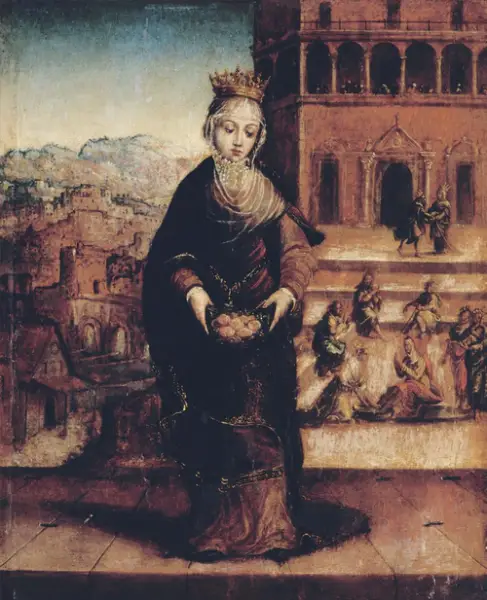
The Queen Saint endures in Portugal's religious imagination above all through the miracle of the roses, a legend she shares with her great-aunt Elizabeth of Hungary and one that Portuguese popular culture attaches to her still: bread carried to the hidden poor, transformed into roses when challenged. In art she appears crowned and robed as a queen, carrying a dove, an olive branch, or roses gathered into the folds of her gown or her scapular — emblems of the peace she made and the charity that made her. Her influence reached far beyond Iberia: she was the original namesake of Santa Isabela Island in the Galápagos, though the island was later renamed Isabela for Isabella I of Castile on the quadricentennial of Columbus's first voyage. Her story has passed into modern culture as well, from the 1947 Portuguese-Spanish film The Holy Queen, in which Maruchi Fresno played her, to Diana Pinguicha's young adult fantasy novel A Curse of Roses, which reimagines her as a princess able to turn food into flowers. In England, the church of St. Elizabeth in Richmond, Greater London — its present building dating from 1824 — was named in her honor, and her statue stands in the colonnade of St Peter's Square in Rome, numbered among the company of saints who overlook the pilgrims of the universal church.
§ Legacy
Timeline
- 4 Jan 1271
Born at the Aljafería Palace in Zaragoza, daughter of Infante Peter and Constance of Sicily.
§ Family and early life
- 26 Jun 1282
Her marriage to King Denis of Portugal was arranged when she was eleven, and her tenure as queen consort began, with Óbidos, Abrantes and Porto de Mós as dowry.
§ Marriage
- 1288
The wedding with Denis was celebrated, she being seventeen and the king twenty-six.
§ Marriage
- 1293
During a great famine, donated flour from her cellars to feed the starving of Coimbra.
§ Dowager Queen
- 1297
Acted as a decisive conciliator in negotiations for the Treaty of Alcañices between Denis and Fernando IV of Castile.
§ Marriage
- 1304
Traveled with Denis to Spain to arbitrate between Fernando IV of Castile and her brother James II of Aragon.
§ Marriage
- 1314
Founded the Poor Clare monastery in Coimbra later known as the Monastery of Santa Clara-a-Velha.
§ Dowager Queen
- 1323
Rode on a mule between the opposing armies on the field of Alvalade, preventing her husband from killing their son Afonso.
§ Marriage
- 1325
After Denis's death, retired to the Coimbra monastery and joined the Third Order of St. Francis, serving the poor and sick.
§ Dowager Queen
- 4 Jul 1336
Hastened to Estremoz to halt the war between Afonso IV and Alfonso XI of Castile, then died of fever in the castle there, aged sixty-five.
§ Dowager Queen
- 1516
Was beatified by Pope Leo X in the Papal States.
§ Sainthood
- 24 Jun 1626
Was canonized by Pope Urban VIII, and her feast inserted into the General Roman Calendar for July 4.
§ Sainthood
- Jul 1694
Pope Innocent XII moved her feast to July 8 so it would not clash with the Octave of Saints Peter and Paul.
§ Sainthood
The Record
- Major works
- Monastery of Santa Clara, Coimbra·Benefactions to hospitals at Coimbra, Santarém and Leiria·Trinity Convent in Lisbon, chapels at Leiria and Óbidos, cloister of Alcobaça
- Patron of
- peacemakers·women disrespected by their husbands·Diocese of San Cristóbal de La Laguna·against jealousy
- Symbols
- olive branch·dove·a bunch of roses in her skirt or scapular·royal garb
- Canonization
- Beatified 1516 by Pope Leo X; canonized 24 June 1626 by Pope Urban VIII
Prayer
Bibliography
Show 8 sources
- Foley, Leonard. "St. Elizabeth of Portugal". Saint of the Day. Franciscan Media.
- Capes, Florence (1909). "St. Elizabeth of Portugal". In Herbermann, Charles (ed.). Catholic Encyclopedia. Vol. 5. New York: Robert Appleton Company.
- Baquero Moreno, Humberto (1997). "Relações entre os Reinos Peninsulares (1290-1330)". p. 30. Retrieved 18 April 2024.
- Livermore, H. V. (2004). Portugal: A Traveller's History. Boydell Press. p. 15. ISBN 978-1-84383-063-4.
- Pirlo, Paolo O., SHMI (1997). "St. Elizabeth of Portugal". My First Book of Saints. Sons of Holy Mary Immaculate - Quality Catholic Publications. pp. 142–143. ISBN 971-91595-4-5.
- Farmer, David Hugh (14 April 2011). The Oxford Dictionary of Saints, Fifth Edition Revised. OUP Oxford. p. 143. ISBN 978-0-19-959660-7.
- Ferreira, João (2010). Histórias Rocambolescas da História de Portugal (in Portuguese) (6 ed.). Lisbon: A Esfera dos Livros. ISBN 978-989-626-216-7.
- Previte-Orton, C.W. (1960). The Shorter Cambridge Medieval History. Vol. II. Cambridge at the University Press. p. 825.
Profile text adapted from the Wikipedia article, licensed CC BY-SA 4.0.
Pray with this saint every day
Save St. Elizabeth of Portugal to your favorites, read the full profile, and get feast-day reminders in the Saints app.
Get the Saints AppFree on the App Store for iPhone and iPad