
6th century·Feast Unknown
St. Elli
Saint of Two Traditions, Founder of Llanelli
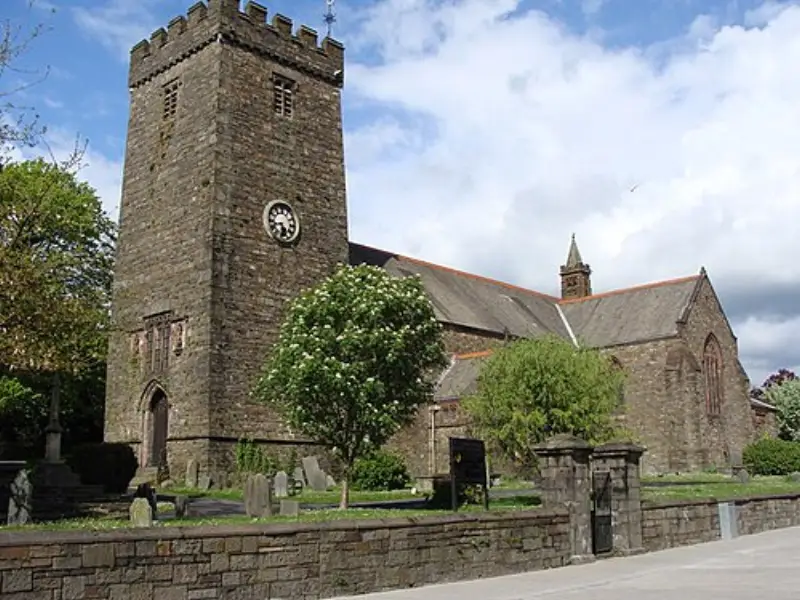
Overview
Elli was a sixth-century Welsh saint, or perhaps two saints, for the records preserve a male Elli and a female Elli and ancient depictions show both a man and a woman under the name. The female tradition, related in the accounts of the Llanelli district, makes Elli or Ellyw a daughter or granddaughter of King Brychan, the prolific holy patriarch of Brycheiniog. This Elli established a church beside the waters of the River Lliedi, drawing country folk who settled around her foundation and became, in time, the town of Llanelli in Carmarthenshire. The male tradition comes from the eleventh-century Vita Cadoci, the life of Saint Cadoc, which tells how Cadoc landed on the islands of Grimbul and interceded for their barren queen, who then bore a son, Elli, and entrusted the boy to the saint. Cadoc raised and educated him at the clas of Llancarfan, and the Vita says that Elli took Cadoc's place as abbot there as the old saint made ready to depart for Benevento. The hagiographer Sabine Baring-Gould argued that the church of Llanelieu in Powys belongs to the female Ellyw, though he doubted her kinship with Brychan, and he connected Llanelli and Llanelly with Cadoc's male disciple instead.
The Complete Life
One Name and Two Saints
Few Welsh saints present so puzzling a face as Elli. The dedications are ancient and undisputed: Llanelli in Carmarthenshire and Llanelly in Monmouthshire both take their names from the saint, and churches of the Church in Wales in both towns still stand under the dedication. Yet when the old sources are opened, they do not describe one life but two. The sources speak of a man called Elli and of a woman called Elli, and the old images include both a male and a female figure under the name, so that even the iconography refuses to settle the question. The female Elli, called Ellyw in Welsh, appears in legend as a daughter or perhaps granddaughter of King Brychan, whose enormous family supplied saints to half the churches of Wales and the west. The male Elli belongs instead to the circle of Saint Cadoc, the great abbot of Llancarfan. Sabine Baring-Gould, the Victorian hagiographer who sorted patiently through these tangles, thought that the church of Llanelieu in Powys honored the female Ellyw, though he doubted the claimed descent from Brychan, while he assigned the Carmarthenshire and Monmouthshire dedications to the male disciple.
§ Saint Elli
The Gift of a Barren Queen
The male Elli's story is told in the Vita Cadoci, the eleventh-century life of Saint Cadoc, and it has the shape of a miracle tale with a monastic ending. Cadoc, voyaging in foreign lands, put in at the islands of Grimbul, where their queen received him. She was childless, and the saint prayed for her; in due course she bore a son, whom she named Elli. Out of gratitude and trust she handed the boy over to the intercessor himself, and Cadoc carried him back to Wales to be raised within the clas, the ecclesiastical settlement, of Llancarfan. There Elli grew up among the monks, receiving the education of psalm, scripture and rule that the community provided, and becoming in every sense Cadoc's foster son as well as his spiritual child. The story blends the legendary and the institutional: whatever the truth of the islands of Grimbul, the tradition reflects Llancarfan's pride in a abbot who came to the community as a gift from across the sea and repaid the gift with his whole life of service.
§ Saint Elli
A Church on the Lliedi, an Abbot's Chair
Each of the two Ells left a distinct work. The woman of the Brychan legend established her church along the River Lliedi, and the settlement of country people that gathered around her foundation grew, over the centuries, into the town of Llanelli, one of the principal towns of Carmarthenshire; the place-name itself, the enclosure of Elli, keeps her at the head of the town's history. The male Elli, according to the Vita Cadoci, rose to govern the community that had raised him: when Cadoc was preparing to depart for Benevento, the life records that Elli succeeded him as Abbot of Llancarfan, taking charge of one of the most influential monastic schools of southern Wales. If the two traditions describe one saint rather than two, then Elli's career would join foundation and governance in a single life; if they describe two, then the name Elli was borne, by a rare providence, by both the mother of a town and the father of a monastery. Either way the vocation was the same, to plant and to keep the church in Welsh soil.
§ Saint Elli
A Name Kept by Three Communions
The memory of Elli has outlasted every uncertainty about the person who bore it. Two churches of the Church in Wales are dedicated to the saint, St Elli Church in Llanelli, Carmarthenshire, and St Elli's Church in Llanelly, Monmouthshire, and the Anglican dedications are only part of the story: the Roman and Orthodox churches likewise number Elli among their own saints, so that three communions keep the name in honor. The town of Llanelli has grown from the peasant settlement beside the saint's riverside church into a place of national renown, carrying the dedication into everyday speech whenever its name is spoken. Baring-Gould's careful disentangling of the two traditions, published in his Lives of the British Saints, remains the standard treatment, and the Dictionary of Welsh Biography preserves the male Elli's place in the succession of Llancarfan. Ambiguity, which would have erased a lesser figure, has here preserved two: the doubling of the name has doubled the devotion, and the saint or saints of the Lliedi are remembered the more for the mystery.
§ Saint Elli
The Record
- Major works
- Church on the banks of the River Lliedi, the origin of Llanelli (female tradition)·Abbot of Llancarfan (male tradition)
- Patron of
- Llanelli in Carmarthenshire·Llanelly in Monmouthshire
- Canonization
- Pre-congregation; venerated in the Roman Catholic, Eastern Orthodox and Anglican traditions.
Prayer
Bibliography
Show 3 sources
- Sabine Baring-Gould and John Fisher, Lives of the British Saints, Vol. 2, Honourable Society of Cymmrodorion, 1908, pp. 447-449
- Hywel David Emanuel, "Elli, saint (fl. 6th cent.)", Dictionary of Welsh Biography, National Library of Wales, 1959
- Jeffrey L. Thomas, History & Description of Llanelly Parish Church, Breconshire, Wales, 2004
Profile text adapted from the Wikipedia article, licensed CC BY-SA 4.0.
Pray with this saint every day
Save St. Elli to your favorites, read the full profile, and get feast-day reminders in the Saints app.
Get the Saints AppFree on the App Store for iPhone and iPad