
388 – 452·Feast May 24
St. Elpidius of Atella
Bishop of Atella and confessor of the Vandal persecution
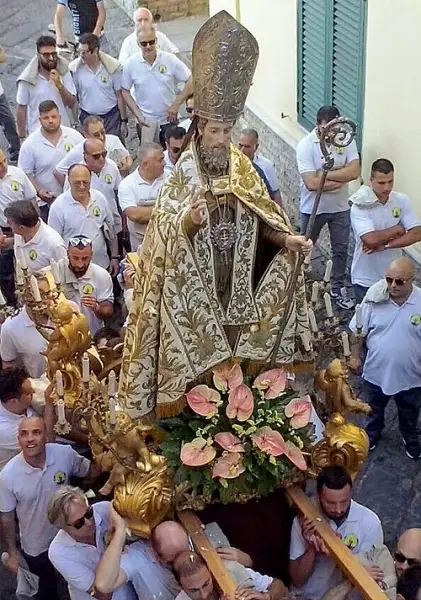
Overview
Elpidius of Atella, remembered in Italian as Sant'Elpidio, was born at Carthage in 388 to a noble family and gave the Church two priestly relatives, a brother named Canius and a nephew also called Elpidius. Around the year 420, at the age of thirty, he was consecrated a bishop. The Vandal conquest of Roman Africa under Gaiseric brought persecution upon the African episcopate, and Elpidius stood among twelve bishops condemned to death. Instead of execution, the condemned men were set adrift in a ship deprived of oars and sails, a sentence meant to end in drowning; the vessel was instead wrecked near the coast of Castel Volturno in Campania, and the bishop reached the Italian shore. In 432 he became bishop of Atella, the ancient town whose memory survives in Sant'Arpino and Casapulla near Naples. Learning of the death of Bishop Canius, he raised a small shrine over the venerated remains and set before it a Latin couplet recording his affection. He governed the see for roughly twenty years and died on May 24, 452. His relics passed from the Cathedral of Atella to Salerno in 787 during the Lombard incursions, and they rest today in the crypt of the Cathedral of St. Matthew.
The Complete Life
A Noble Family of Carthage
Elpidius entered the world in 388 at Carthage, the great metropolis of Roman Africa, within a family of noble rank. The Christianity of his household was not a private inheritance but a shared vocation: his brother Canius became a priest, and a nephew who bore the same name as himself followed the same path. Nothing further survives of his education or upbringing, but the course of his later life suggests a formation of substance, for he was judged fit for the episcopate while still comparatively young. His consecration came around the year 420, when he was about thirty years old, an age at which most candidates for the episcopate in late antiquity had already spent decades in clerical service. Whatever the offices he held before then, his African years ended abruptly with the Vandal invasion. The kingdom founded by Gaiseric after 429 subjected the Catholic hierarchy of Africa to one of the harshest persecutions of the age, and bishops who refused conformity found themselves exiled, enslaved, or condemned. Elpidius's noble birth and priestly family made him exactly the kind of churchman the new regime sought to break, and his own kinship bonds, which he later honored in stone, would outlast the empire that had formed him.
§ Life
Adrift for the Faith
The Vandal persecution gave Elpidius's vocation its sharpest test. Along with twelve other bishops, he was sentenced to death for his fidelity to the Catholic faith. Rather than face the sword, the condemned prelates were loaded onto a ship that had been stripped of oars and sails and pushed out to sea, a form of execution calculated to seem like chance while guaranteeing death by thirst, storm, or drowning. Providence, in the account the Church has preserved, intervened through the elements themselves: the vessel broke apart off the Campanian shore at Castel Volturno, and the bishops reached land alive. Whether all twelve survived the tradition does not say, but Elpidius did, and the shipwreck that his enemies intended as a quiet disposal became the means by which the faith of African Catholics was planted anew in southern Italy. In 432, he took up the bishopric of Atella, a Campanian see whose territory is now divided between Sant'Arpino, which claims him as founder and patron, and Casapulla. The exile from Carthage thus became a shepherd in Campania, carrying the memory of the persecuted African Church into his new ministry.
§ Life
Shepherd of Atella
As bishop of Atella from 432 onward, Elpidius governed for approximately twenty years, dying on May 24, 452. The brevity of the surviving record conceals what must have been the ordinary substance of his episcopate: the celebration of the sacraments, the care of a flock living under the shadow of the barbarian kingdoms that were remaking Italy, and the maintenance of Christian order in a small Campanian city while the western empire collapsed around it. One act of his, however, the tradition has preserved in detail. Word reached him that Bishop Canius had died, and Elpidius responded by erecting a small temple, a modest basilica, on the site to guard the venerated remains. Before it he set a couplet of Latin verse, "Elpidius praesul hoc templum condidit almum," in which he declared that he, the bishop, had raised this nourishing temple for Canius the martyr out of love for him. The inscription is a rare personal document from the fifth century, showing an exile honoring a brother bishop with affection in stone. That his own brother and nephew were priests suggests a household in which the bonds of blood and of ministry had become one and the same.
§ Life
Death and the Road to Salerno
Elpidius died at Atella on the twenty-fourth of May, 452, the date his Church still keeps as his feast. Eight years later, on January 11, 460, his body was laid to rest in the Cathedral of Atella, where it remained for more than three centuries. The security of that tomb ended in 787, when the incursions of the Lombards into Campania forced the translation of the relics; they were carried to Salerno, and there they have stayed. In the crypt of the Cathedral of St. Matthew the remains of the African bishop were placed by Archbishop Alfano I in March 1081 beneath the Altar of the Holy Confessors, together with the relics of Cionius a presbyter, Elpicius a deacon, and Austerius, an arrangement recorded in a marble inscription that still could be read a millennium later. In 1958, Archbishop Demetrio Moscato ordered a canonical exhumation and reconnaissance of the saints buried in that crypt, and among the relics recovered were those of Elpidius, Cionius, and Elpicius, confirming the inscription's testimony after nearly nine hundred years. The exile from Carthage thus rests today in the heart of Salerno's cathedral, a witness whose body has crossed sea and mountain and yet never left the company of the faithful.
§ Veneration
Patron of Two Towns
The cult of Elpidius has endured at the places that claim him. Sant'Arpino, the modern heir of ancient Atella, venerates him as its founder and patron, and neighboring Casapulla honors him as its own patron as well, keeping his feast of May 24 in each. The continuity of that devotion rests on a remarkable chain of documented care: burial at Atella in 460, translation to Salerno in 787 for fear of the Lombards, enshrinement by Alfano I in 1081 with an inscribed marble record, and finally the canonical recognition of 1958 under Archbishop Moscato, which gathered up the bones of the confessor with those of his companion Cionius and the deacon Elpicius. Scholars have kept pace with the piety. The Bollandists printed his acts in the Acta Sanctorum for May; Francesco Lanzoni treated his see in his great study of the Italian dioceses; the Bibliotheca Sanctorum gave him an entry in 1964; and modern studies by Felice Provvisto and Franco Pezzella have collected the historical, artistic, and devotional testimony to his cult. A bishop exiled by force and saved by shipwreck has thus become a permanent fixture of the Campanian landscape, remembered wherever his name is spoken in the towns he once shepherded.
§ Veneration
Timeline
- 388
Born at Carthage into a noble family; his brother Canius and a nephew named Elpidius would both become priests.
§ Life
- 420
Consecrated a bishop at about the age of thirty.
§ Life
- 432
Became bishop of Atella; on learning of Bishop Canius's death, he erected a small temple over the martyr's venerated remains.
§ Life
- 24 May 452
Died at Atella after about twenty years of episcopal service.
§ Life
- 11 Jan 460
His body was buried in the Cathedral of Atella.
§ Veneration
- 787
Following Lombard incursions, his relics were moved to Salerno, where they rest in the crypt of the Cathedral of St. Matthew.
§ Veneration
- Mar 1081
Archbishop Alfano I placed his relics in the Salerno crypt with those of Cionius and Elpicius, as a marble inscription records.
§ Veneration
- 1958
Archbishop Demetrio Moscato carried out a canonical exhumation of the saints' remains under the Altar of the Holy Confessors in Salerno cathedral.
§ Veneration
The Record
- Major works
- The shrine and Latin couplet he raised in honor of Bishop Canius: "Elpidius praesul hoc templum condidit almum, o Canio martyr, ductus amore tuo"
- Patron of
- Patron of Sant'Arpino·Patron of Casapulla
- Symbols
- Bishop's mitre and crozier·A ship without oars or sails·A small basilica
- Canonization
- Pre-congregation; venerated since antiquity in Campania, with relics recognized at Salerno in 1958
Prayer
Bibliography
Show 8 sources
- A. Balducci e G. Lucchesi, Sant'Elpidio, in «Bibliotheca Sanctorum», Roma, 1964 (Vol. IV, Coll. 1146-1148).
- Francesco Lanzoni, Le diocesi d'Italia dalle origini al principio del secolo VII (an.604), Biblioteca Apostolica Vaticana, 1927.
- Socii Bollandiani, Biblioteca Hagiographica Latina Antiquae et Mediae Aetatis, Bruxelles, 1898-1901 (pp. 231-249).
- Acta Sanctorum, m. maii - V. Palmé - Parisii et Romae, 1866 (Tom. V, pp. 285-286).
- Lettera Giovanni Andrea, Compendio storico della vita di S. Elpidio vescovo di Atella, fondatore e patrono del comune di Sant'Arpino, Aversa, Fabozzi, 1904.
- P. Maisto, Memorie storico-critiche sulla Vita di S. Elpidio, Napoli, 1884.
- Felice Provvisto, Sant'Elpidio: vescovo di Atella confessore della fede, Patrono di Casapulla, 1998.
- Franco Pezzella, Testimonianze storiche, artistiche e devozionali sul culto di Sant'Elpidio, vescovo di Atella, 2019.
Profile text adapted from the Wikipedia article, licensed CC BY-SA 4.0.
Pray with this saint every day
Save St. Elpidius of Atella to your favorites, read the full profile, and get feast-day reminders in the Saints app.
Get the Saints AppFree on the App Store for iPhone and iPad